Biocracked
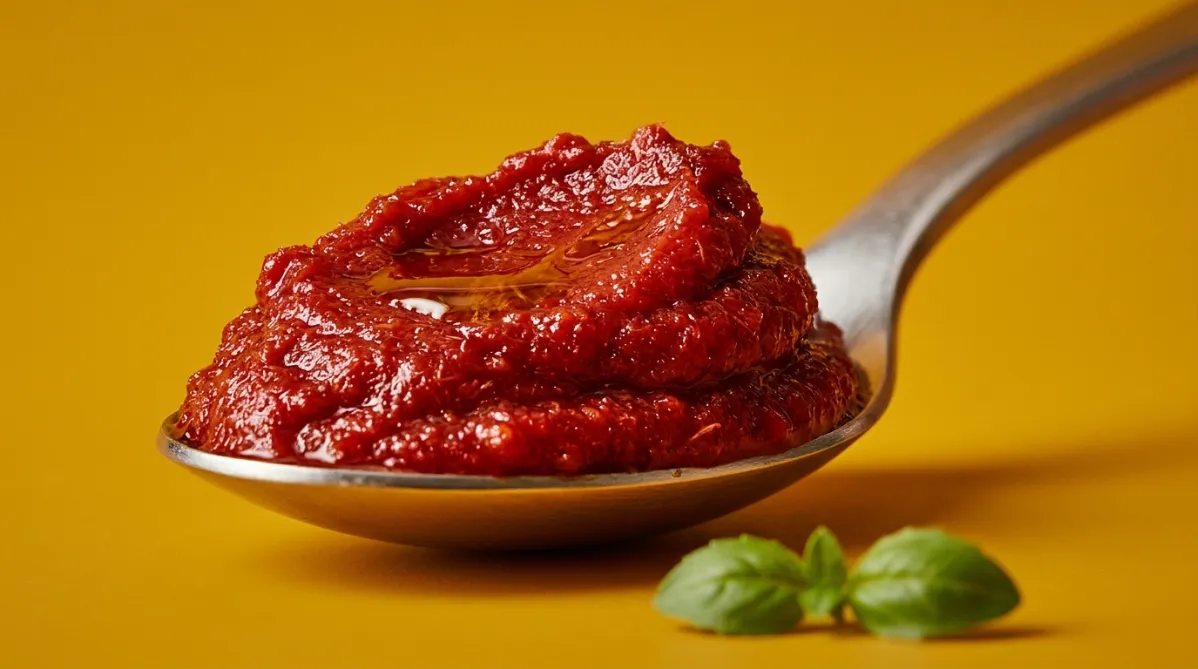
Approach 1, macro science, with Palette D, bold color field. An extreme close-up, shot from a low three-quarter angle with a macro lens, of a single heaped tablespoon of concentrated tomato paste. The paste has a glossy, grainy texture with fine fibrous flecks and a small glistening swirl of olive oil on its surface. The spoon is brushed steel and sits against a saturated mustard-yellow backdrop. The tomato red against the yellow gives strong contrast. Hard but soft-edged studio light comes from the upper left, with crisp specular highlights on the paste and warm, slightly orange shadows, with no blue cast. The depth of field is shallow, so the background melts into smooth yellow. A tiny sprig of fresh basil in the blurred foreground adds a small green accent. The mood is vivid, energetic and curious, and it makes a humble ingredient look like a scientific specimen.
Longevity

The Pantry Staple That Sharpened Middle-Aged Brains in 3 Months

Nova Chen · · 4 min read

It costs about a dollar, it's probably in your cupboard right now, and in a new Barcelona trial, people who ate a measured daily dose of it scored higher on tests of focus and mental speed. It isn't a nootropic stack, a peptide, or an exotic extract. It's tomato paste.

Before you start eating it by the jar, here is what the study found, what it didn't, and how to turn it into a practical routine.

What the researchers actually did

A team led by the Polyphenol Research Group at the University of Barcelona, with Rosa Lamuela-Raventós as senior author, ran a randomized crossover trial published in Antioxidants in 2026 (ClinicalTrials.gov NCT05891977). They enrolled 47 healthy adults aged 40 to 55. Forty-two finished.

Each participant went through two 3-month phases separated by a 1-month washout:

  • Tomato phase: daily concentrated tomato paste at 0.5 g per kilogram of body weight.
  • Control phase: a lycopene-restricted diet.

Because it was a crossover, every person served as their own comparison, which cuts down the noise from differences between individuals. That is a real strength in a small trial.

The results: focus and speed moved most

Cognition was assessed with validated neuropsychological tests, including the d2-R attention test, the Face-Name Associative Memory Exam, and a Modified Wisconsin Card Sorting Test. The tomato phase was associated with:

  • Selective attention: concentration performance up 7.2 points.
  • Processing speed: up 8.3 points.
  • Associative memory: face-name matching up 0.8 points.

The attention and speed gains are the headline. The memory gain is small, and a 0.8-point shift on a face-name task is something to note, not celebrate. The abstract reports no improvement in the card-sorting measure of cognitive flexibility, so this isn't a whole-brain upgrade.

The biology: BDNF and brain networks

The researchers also looked for mechanisms. Tomatoes are the main dietary source of lycopene, a carotenoid that crosses the blood-brain barrier and has antioxidant and anti-inflammatory properties.

BDNF. Brain-derived neurotrophic factor, a protein tied to neuronal health and plasticity, showed a borderline increase with tomato intake, a mean difference of 15.2 ng/mL. "Borderline" is the operative word. This is a hint, not a confirmed mechanism.

Brain connectivity. Resting-state fMRI showed shifts in functional networks. Tomato intake was linked to reduced connectivity in the frontoparietal and auditory networks. During the control period, by contrast, the dorsal attention network showed reductions. One reading is that the tomato phase helped preserve attention-network function while other networks reorganized. That is interpretation, and the abstract doesn't settle what these patterns mean functionally. Less connectivity is not automatically worse, and more is not automatically better.

What 0.5 g/kg looks like in your kitchen

The dose is easy to calculate: body weight in kilograms times 0.5 gives grams per day.

  • 70 kg (154 lb): about 35 g
  • 75 kg (165 lb): about 37.5 g
  • 80 kg (176 lb): about 40 g

A level tablespoon of tomato paste weighs roughly 15 to 17 g, so that works out to about 2 to 2.5 tablespoons a day for most people in that weight range. Brands differ in how concentrated they are, so check the label, and weigh it on a kitchen scale for a week or two until you can eyeball it.

The abstract specifies "concentrated tomato paste" but not exactly how participants ate it. Cooking it is a sensible way to take it.

Why olive oil belongs in the plan

Lycopene is fat-soluble, and cooked, processed tomato products are generally a better lycopene source than raw tomatoes. Pairing paste with olive oil is standard nutrition advice for improving absorption, and it fits the Mediterranean cooking tradition this research group works within. This was not tested as a variable in the trial, so treat it as sound culinary logic rather than a study finding.

Practical ways to get there:

  • Fry the paste in olive oil for a minute at the start of soups, stews, and sauces.
  • Stir it into lentils, beans, or braised vegetables.
  • Build a quick sofrito-style base for eggs, fish, or rice.

What this study can't tell you

Supplements are untested. The trial used food, not capsules. Nothing here shows a lycopene pill would reproduce the effects, and tomato paste also delivers other compounds, so you can't assume lycopene alone is responsible.

The comparison isn't a placebo. A lycopene-restricted diet is a reasonable control, but it is hard to blind. Expectation effects can't be fully ruled out.

It's small and short. Forty-two people over three months, all healthy and middle-aged. The study says nothing about dementia prevention or lifelong outcomes. Its authors say the findings suggest tomato consumption "may support" cognitive function.

Industry context. Several authors disclosed personal fees or grants from wine, beer, and food-related organizations, all described as outside the submitted work. The funders had no role in the study's design, analysis, or publication decision.

Who this suits

This is a low-risk, low-cost experiment for healthy adults in midlife who already eat a varied diet. Anyone on a restricted diet, with a tomato sensitivity, or with reflux triggered by acidic foods should be cautious. Canned pastes can also carry added salt, so read labels. As always, check with a clinician if you have a medical condition or take medications.

The bottom line

The finding is modest but interesting: about two tablespoons of tomato paste a day, eaten for three months, was linked to better attention and processing speed in healthy 40- to 55-year-olds, with early hints of brain-network and BDNF changes. It won't replace sleep, exercise, or a good diet. But as a cheap addition to a Mediterranean-style pattern, it's one of the easier longevity experiments to try, and larger, longer trials will show whether it holds up.

Original study

Read the original research on pubmed.ncbi.nlm.nih.gov →

This article summarizes published research for general information. It is not medical advice.

NC

Written by

Nova Chen

Nova Chen writes for Biocracked: biohacking science, longevity & human performance.

Related Articles

**Approach 1: Macro science. Palette C: Natural.**

Extreme close-up of a fresh lion's mane mushroom (Hericium erinaceus), shot at a slight low three-quarter angle with a macro lens and shallow depth of field. Its cascading white-cream spines hang in dense, delicate strands, and the nearest tips are sharp and slightly translucent, with tiny beads of moisture. Behind it, soft out-of-focus oak bark and moss glow in green and brown. Diffuse overcast daylight from the upper left gives gentle shadows and a faint warm rim light on the spines. A few strands of bright electric green moss in the blurred background pick up the brand accent. The mood is quiet, curious and measured, the look of careful observation rather than hype. Photorealistic, with no text or labels.
supplements

2 g of Lion's Mane for 4 Weeks: What Happened to BDNF and Focus?

BY NOVA CHEN ·

Lion's mane is marketed as a brain-boosting mushroom, but what happens when 10 healthy adults take 2 g a day for 28 days? A new pilot study in Nutrients measured executive function and plasma BDNF, and nothing reached statistical significance. Effect sizes were small to moderate (flanker d=0.48, DCCS d=0.25, BDNF d=0.31), and the supplement was well tolerated. With no placebo group, a tiny sample, and industry ties disclosed, this is a hint rather than proof. Here's what the data can and can't tell you, and how to approach lion's mane if you're curious.

Conceptual metaphor: a sheet of thick, clear laboratory glass standing upright, with a single hairline fracture running diagonally across it. A thin ribbon of vivid electric-green liquid seeps through the crack and drips onto a glossy white surface below. The glass is photographed straight on, at a slight low angle, in crisp macro focus along the fracture edges, where tiny chips catch the light. The backdrop is a seamless, saturated tomato-red field that fills the frame. Soft, directional studio light from the left creates bright refraction lines along the glass edge and a clean, warm-red tinted shadow on the right. The mood is tense but revealing, a long-held assumption starting to give way. Empty space on the right balances the composition. No text, no people, and no blue cast.
longevity

Rapamycin 'Can't Reach the Brain'? Why That Myth Is Falling Apart

BY DR. SYNAPSE ·

"Rapamycin can't reach the brain" is one of the most repeated claims in longevity circles, and a new review says it rests on the wrong measurement. The drug is rarely detectable in cerebrospinal fluid, but the authors explain why that doesn't mean it stays out of brain tissue. Human glioblastoma samples, seizure control in tuberous sclerosis, PET scans in Alzheimer's, and blood flow in APOE4 carriers all point to real activity in the brain. The big catch is that nobody has directly measured the drug in healthy human brain tissue at therapeutic doses. Here's what the evidence supports, what it doesn't, and who should think twice.

Macro science approach: an extreme close-up of PQQ disodium salt, a deep reddish-orange crystalline powder, heaped on the tip of a stainless steel micro-spatula. The camera is low, at a slight 30-degree angle, with a very shallow depth of field. The nearest crystals are razor sharp, showing faceted, glassy edges and fine granular dust, while the rest of the pile melts into soft blur. A single large softbox from the upper left creates bright specular glints on the crystal faces and a crisp, warm shadow. The backdrop is a smooth, saturated teal-green color field that contrasts strongly with the red-orange subject. A few stray grains rest on the matte teal surface below. A faint electric green reflection runs along the spatula's edge. The mood is precise, curious and scrutinizing, like an ingredient under inspection. No text or labels.
supplements

PQQ Boosted Memory in 12 Weeks, in Both Young and Older Adults

BY NOVA CHEN ·

A double-blind, placebo-controlled trial found that 20 mg/day of PQQ disodium salt improved memory scores in adults aged 20-65 after 12 weeks. The timing differed by age: younger adults gained on cognitive flexibility and speed by week 8, while adults aged 41-65 improved on verbal and complex memory at week 12. The catch is that the authors work for Mitsubishi Gas Chemical, which makes a PQQ ingredient, and the abstract omits the sample size. Here is what the study showed, what it didn't, and how to read it before you buy a bottle.

Approach: conceptual metaphor. Palette: bold color field.

A single ripe, glossy red tomato-colored apple sits at the center of a saturated mustard-yellow seamless backdrop, with a neat row of five identical white capsules lined up beside it on the same surface. The apple is the clear winner of the frame. One capsule has rolled slightly away, cracked open and spilling a tiny pile of pale powder. Shot at a low three-quarter angle with a shallow depth of field, so the back capsules blur softly. Lighting is a large, soft key light from the upper left, giving crisp but gentle shadows with warm yellow bounce. A thin sprig of electric green (#00e676) leaves rises from the apple stem as the only green accent. Mood: confident, playful and skeptical, a clean verdict that real food outweighs pills. No text or labels.
longevity

Zombie Cell Supplements? 27 Human Trials Say Diet Beats Pills

BY NOVA CHEN ·

Supplement labels love to promise they'll "clear zombie cells," but a new systematic review of 27 human trials and 3,811 participants suggests the evidence is thin. Calorie restriction produced the most consistent drop in senescence-linked inflammatory signals. Omega-3 was the most promising supplement, though the evidence was limited and mixed. Telomere length and the classic p16/p21 markers mostly failed to move. Here's what that means for what you eat and what you buy.

This page is available in