Biocracked
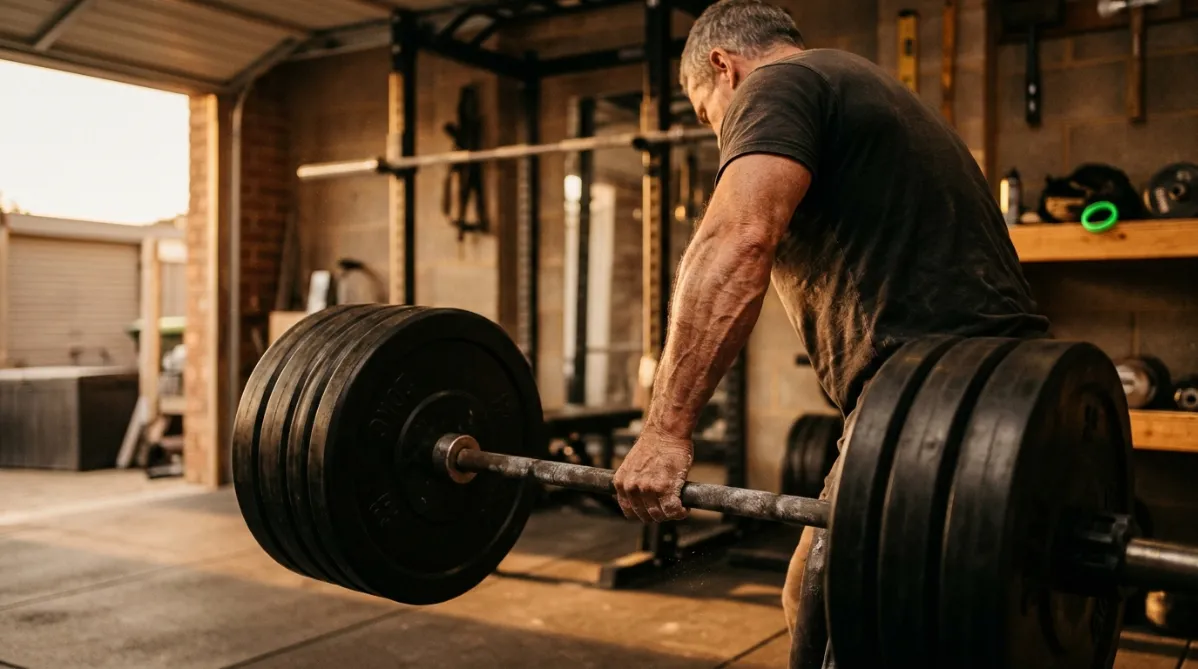
Approach 3, the human outcome, in palette B, warm.

Low three-quarter rear angle, shot with a 50mm lens at shallow depth of field. A middle-aged person's forearm and hand grip a loaded barbell mid-deadlift, the tendons and the muscle of the forearm clearly defined, with chalk dust hanging in the air. Their face is out of frame. The setting is a plain home garage gym with a rubber floor and a rack softly blurred in the background. Low golden-hour sunlight comes through an open roll-up door and rakes across the skin and the knurled steel, casting long warm shadows. Amber, copper and honey tones dominate, with matte black plates for contrast. A tiny electric green silicone wristband or a small green pen injector resting on a nearby shelf adds a subtle accent. The mood is determined, quiet and hopeful.
Metabolism

On Tirzepatide? Lifting Weights Saved 1.1 kg of Lean Mass

Rex Meridian · · 4 min read

Tirzepatide can strip off more than 22 kg in 40 weeks. A new randomized trial shows that, without lifting, about 4.7 kg of that loss was lean soft tissue, and strength went backward. Lifting three times a week changed that picture.

The trial, published in Nature Medicine (online ahead of print, 2026), is one of the clearest human tests yet of whether resistance exercise protects the body's lean tissue during incretin-based weight loss.

The Setup: 120 People, 40 Weeks, One Drug

Researchers at the University of Western Australia and collaborating institutions enrolled 120 adults with overweight or obesity. Everyone received tirzepatide. Participants were then randomized to one of two arms:

  • Tirzepatide alone (T): usual activities
  • Tirzepatide + resistance exercise (T+REx): thrice-weekly resistance exercise training

The intervention ran 40 weeks. Tirzepatide was reported as safe, and most participants tolerated up-titration to 15 mg weekly, the top dose. Adherence to the resistance exercise program was 91%.

This was a human randomized controlled trial, not an animal or cell study. The trial is registered (ACTRN12623001236684).

The Headline Numbers

Weight and fat loss: the same in both groups

Lifting did not slow the drug's main effect.

  • Weight loss: T = -22.61 kg vs T+REx = -22.28 kg (P = 0.694)
  • Total fat mass loss: T = -17.19 kg vs T+REx = -17.98 kg (P = 0.700)

The between-group fat difference was -0.77 kg (95% CI -2.14 to 0.60 kg), so there was no meaningful gap.

Lean mass: where lifting made a difference

  • Total lean soft tissue mass: T = -4.67 kg vs T+REx = -3.57 kg (P < 0.001)
  • Between-group difference: 1.09 kg (95% CI 0.43 to 1.75 kg)
  • Appendicular lean soft tissue mass (arms and legs): T = -3.55 kg vs T+REx = -2.92 kg (P < 0.001)

The lifters did not gain lean mass. They lost less of it. By my own arithmetic from the reported figures, that is roughly a quarter less lean loss than the drug-only group. The paper's abstract describes the effect as attenuation, and that is the accurate word.

Strength: down on the drug alone, up with lifting

The strength results were the starkest.

Test Tirzepatide alone Tirzepatide + REx
Bench press -4.09 kg +4.68 kg
Lat pulldown -4.42 kg +8.58 kg
Knee extension -4.42 kg +5.88 kg

All differences versus tirzepatide alone were significant (P < 0.001). Without training, upper and lower body strength fell. With training, it rose on every test.

The Training Protocol: What the Abstract Tells Us

The abstract confirms only a few details:

  • Frequency: three times per week
  • Duration: 40 weeks
  • Adherence: 91%
  • Muscle groups assessed: bench press (upper body push), lat pulldown (upper body pull) and knee extension (lower body)

It does not report sets, repetitions, loads or progression. Those details should be in the full paper, so check it before copying a specific program. The tested exercises suggest a sensible template: a push, a pull and a leg movement.

Practical Takeaways

1. Plan on three sessions a week. That is the schedule that produced the results, and participants stuck to it 91% of the time.

2. Cover the whole body. The strength gains showed up in pushing, pulling and leg exercises, so a full-body plan is a reasonable approach.

3. Expect to protect muscle, not necessarily build it. Both groups lost lean mass. Lifting reduced the loss by about 1.1 kg.

4. Don't expect lifting to cost you fat loss. Weight and fat loss were statistically similar between groups.

5. Protein. The abstract says nothing about protein intake, so this trial can't give a protein target. General sports-nutrition and sarcopenia guidance emphasizes adequate protein alongside resistance training. Discuss specific amounts with a clinician or dietitian.

6. Dose. Most participants reached 15 mg weekly, but the dose is set by a prescriber, not by this trial. Lifting is an add-on, not a reason to change your dose.

Who It's For

The findings are most relevant to adults with overweight or obesity taking tirzepatide (Mounjaro/Zepbound). The concern about losing muscle is especially important for older adults, who have less lean tissue to spare and are more vulnerable to weakness and falls. The abstract does not report the participants' ages or run a subgroup analysis for older people, so it does not show that the results hold for them. Older adults and anyone with joint, heart or other medical conditions should check with a clinician and ideally get coaching before starting a lifting program.

Caveats Worth Knowing

  • "Lean soft tissue" is not pure muscle. It includes water and organ tissue. Strength gains support a functional benefit, but the measure is not a direct muscle count.
  • Some lean mass was still lost. Lifters lost 3.57 kg of lean soft tissue, so resistance exercise attenuates the loss without eliminating it.
  • Duration. The data cover 40 weeks. What happens after stopping the drug or the training is not addressed in the abstract.
  • Disclosures. Several authors reported speaker honoraria or advisory roles with pharmaceutical companies, including Eli Lilly, which makes tirzepatide. All honoraria were paid to the University of Western Australia. One author is a shareholder and clinical advisor to ProGenis Pharmaceuticals.

The Bottom Line

Tirzepatide delivers large weight and fat loss on its own, but it also took lean mass and strength with it. Adding lifting three times a week for 40 weeks kept the fat loss the same, cut lean mass loss by about 1.1 kg and reversed the strength decline. For people on a GLP-1-class drug, this trial argues for making resistance training part of the treatment plan. This article is for information only and is not medical advice.
Original study

Read the original research on pubmed.ncbi.nlm.nih.gov →

This article summarizes published research for general information. It is not medical advice.

RM

Written by

Rex Meridian

Rex Meridian writes for Biocracked: biohacking science, longevity & human performance.

Related Articles

Approach: conceptual metaphor. Palette: D, bold color field.

A single steel dumbbell sits in the center of a saturated tomato-red seamless backdrop. A thick, taut rope of frayed tan fibers wraps around its handle, and a few strands are visibly thinning and unraveling at one end while the rest stay dense and intact, standing for muscle being preserved while weight drops. Shot at a low three-quarter angle with a shallow depth of field, so the knurled grip texture is crisp and the background melts into smooth red. Hard, directional studio light from the upper left casts a sharp, short shadow on the glossy red surface. One thin electric green cable tie is cinched around the rope. The mood is punchy, tense and editorial, with no people and no text.
peptides

What to Pair With Tirzepatide to Keep Muscle? Mice Have a Clue

BY NOVA CHEN ·

Tirzepatide can strip off weight fast, but what happens to your muscle? A new mouse study tested the drug alone and stacked with time-restricted feeding and resistance training. The full stack accelerated weight and fat loss, resistance training preserved muscle and strength, and TRF plus tirzepatide improved glucose tolerance. The liver benefits, however, were the same across all treatments. This is animal-only research in obese female mice, so treat it as a promising signal, not a human protocol.

**Approach: Conceptual metaphor. Palette: D, bold color field.**

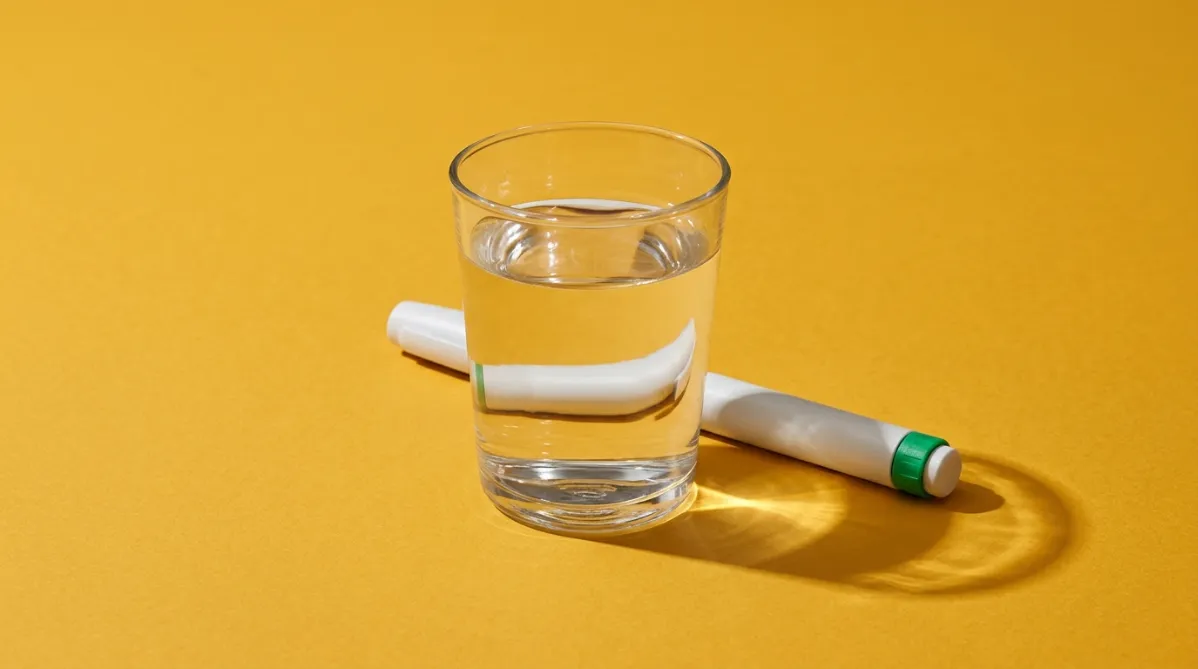
A single clear glass of water sits on a saturated mustard-yellow backdrop, shot at a slight low three-quarter angle. A hand-held pen injector rests beside it, its body a matte white with a small electric green dial ring as the only green accent. Hard but clean studio light from the upper left throws a crisp, defined shadow across the yellow surface. Through the glass, the injector is refracted into two slightly offset images, suggesting a signal that is split and hard to read. The mood is calm, questioning and balanced, with no drama. The background is fully warm and bright, with no blue cast. The surface has a subtle paper-like texture. There is no text, no label and no face.
metabolism

Do Ozempic and Mounjaro Cause Depression? What 20 Studies Found

BY DR. SYNAPSE ·

Do Ozempic and Mounjaro cause depression or suicidal thoughts? A new systematic review of 20 studies plus EMA and FDA assessments says the best evidence doesn't show it. Randomized data, including two large 2025 meta-analyses, found no increased suicidality, depression, or anxiety with semaglutide or tirzepatide. The scarier signals came from study designs that can't separate drug effects from obesity-related distress, baseline psychiatric risk, and reporting bias. But trials excluded many psychiatric patients, so surveillance still matters for high-risk groups and rare long-term outcomes.

**Approach:** Lab in action. **Palette:** Bold color field, mustard yellow.

A close, slightly high three-quarter view of a hand in a magenta-purple nitrile glove holding a clear 12-well cell culture plate. Each well is filled with salmon-pink culture medium. A multichannel pipette hovers over one well, with a single droplet caught just before it falls. The background is a seamless, saturated mustard-yellow surface and wall, with a soft shadow under the plate. Bright, even studio light comes from the upper left, giving crisp highlights on the plastic rims and a soft glow through the liquid. The depth of field is shallow, so the far wells blur gently. A tiny electric-green cap on a tube sits in the corner of the frame. The mood is calm, precise and curious, with a clean, graphic, editorial feel. No text or labels.
peptides

Semaglutide Didn't Shrink Human Muscle Cells. So Why the Muscle Loss?

BY DR. SYNAPSE ·

Does semaglutide really eat your muscle? A new GeroScience study put the drug straight onto primary human muscle cells from older adults with obesity, and the cells didn't waste. No atrophy genes switched on, no secretome alarms, and GIP even thickened myotubes after eight days. Semaglutide did modestly dial down glycolytic ATP production, and GLP-1 receptors were barely detectable. The findings point toward indirect causes of lean mass loss, like calorie deficit and reduced loading, though a dish is not a body.

Approach: Macro science. Palette: B, warm.

Extreme macro photograph of a clear glass vial of blood plasma held in a gloved hand, shot at a slight low angle so the camera looks up through the tube. The plasma is cloudy and creamy at the top, where large fat-rich particles gather, and it clears to translucent golden amber toward the bottom, showing the drop in triglyceride particles. Tiny suspended droplets catch the light as bright specks. Warm honey-colored backlight from a low window-like source glows through the liquid and casts copper highlights across the glass. The background is a soft blur of warm brown and amber, with a faint electric green reflection on the rim of the vial cap. The mood is calm, precise and cautious, with a shallow depth of field and a real clinical texture on the glass. No text or labels.
metabolism

Retatrutide Cut Large Triglyceride Particles 84%—But Read This First

BY DR. SYNAPSE ·

Retatrutide is best known for weight loss, but a new post hoc analysis of two phase 2 trials looked at what it did to the blood. Large triglyceride-rich lipoprotein particles fell by up to 84.4% in adults with type 2 diabetes, and ApoB dropped by roughly 21–24%. In the trial without diabetes, hsCRP fell 54.8% and IL-6 fell 29.6%, but those changes were not significant in the diabetes trial. The abstract reports no Lp(a) results and no per-dose breakdown. This is an unapproved prescription-class drug, not a supplement, and these are biomarkers, not proof of fewer heart attacks.

This page is available in