Biocracked
Approach: Macro science. Palette: D, bold color field.

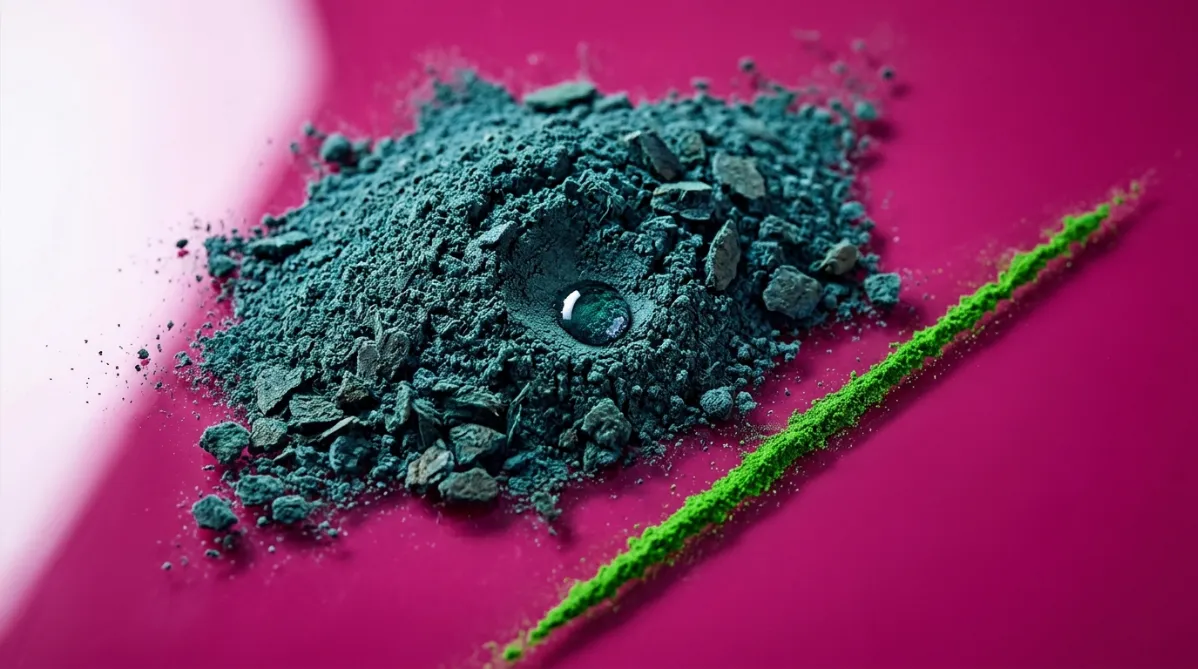
Extreme close-up photograph, shot at a slight 30-degree overhead angle with a macro lens and shallow depth of field. A heaped pile of dry spirulina powder and a few crumbled dark blue-green flakes sit on a glossy, saturated magenta acrylic surface. A single bead of water has landed on the powder and darkened a small patch, showing the fine granular texture and the tiny fibrous strands of the algae. A thin line of vivid electric green powder trails off the pile across the magenta like a barely visible measurement mark. Light comes from a large softbox at the left, giving crisp highlights on the grains and soft, neutral-warm shadows with no blue cast. The background falls off into smooth magenta blur. The mood is precise, curious and slightly skeptical, with a modern editorial look.
Supplements

Spirulina Lowers CRP in Meta-Analysis, But There's a Catch

Nova Chen · · 4 min read

Spirulina is one of the most popular green powders in the supplement aisle, and a new meta-analysis gives it a real, statistically significant win on one of the best-known inflammation markers in medicine. The same paper also contains a reality check that most headlines will skip. Here is what the research found, what it didn't, and who might reasonably care.

The Headline Finding: Spirulina Moved CRP

Researchers pooled data from randomized clinical trials of spirulina supplementation in adults aged 18 and older. The review was published in the International Journal for Vitamin and Nutrition Research in 2026. The team searched the Cochrane Library, ClinicalTrials.gov, ISI Web of Science, Scopus and PubMed through August 2025. Eight studies met the inclusion criteria.

Pooled across those trials, spirulina significantly reduced serum C-reactive protein (CRP) compared with placebo:

  • Weighted mean difference: -0.09 mg/L
  • 95% confidence interval: -0.16 to -0.02

Because the confidence interval does not cross zero, the result is statistically significant. CRP is a widely used blood marker of systemic inflammation, which is why this finding is getting attention in the "inflammaging" conversation. That term refers to the low-grade, chronic inflammation thought to rise with age and contribute to age-related disease.

The Catch: The Drop Is Small

A reduction of 0.09 mg/L is modest. The confidence interval runs from a very small drop (0.02 mg/L) to a slightly larger one (0.16 mg/L). The abstract does not say whether the change is clinically meaningful, and it makes no claims about disease outcomes. This is a lab-marker result, not evidence that spirulina slows aging, prevents heart disease or extends lifespan.

The authors' own conclusion is cautious. They call for further high-quality RCTs to confirm the benefit.

What Didn't Reach Significance: TNF-α and IL-6

The review also looked at two other inflammatory mediators. Neither showed a statistically significant change:

Marker Weighted mean difference 95% CI
TNF-α -0.43 pg/mL -1.44 to 0.59
IL-6 -0.44 pg/mL -0.98 to 0.1

Both intervals include zero, so the data cannot rule out no effect. The IL-6 interval only barely crosses zero, which is suggestive but not conclusive. The honest summary is that spirulina has a significant CRP signal and no confirmed effect on these two cytokines.

Doses and Durations Used in the Trials

The abstract reports the following ranges across the eight trials:

  • Dose: 1 g/day to 8 g/day
  • Duration: 3 to 16 weeks

That is a wide spread. The abstract does not break results down by dose or duration, so it does not tell us the best dose or whether higher doses work better. It also does not address time of day, whether to take spirulina with food, or which formulation is best. Anyone who gives a precise protocol based on this paper is going beyond the data. The most defensible takeaway is that the trials tested daily intakes in the 1 to 8 g range, over weeks to a few months.

Who Might This Be Relevant For?

The review covered adults aged 18 and older, and the abstract does not single out any specific health condition or subgroup. So this should not be read as a recommendation for any one group. Some general points follow.

  • Adults interested in dietary approaches to inflammation may find the CRP result a reasonable reason to discuss spirulina with a clinician, as one low-risk option among many lifestyle strategies. The abstract does not assess safety or side effects, so "low-risk" is an assumption, not a finding.
  • People with elevated CRP or an inflammatory condition should not treat spirulina as a replacement for medical care. The review did not test it that way.
  • People on medication or with medical conditions should check with a healthcare professional before starting any new supplement.

Why You Should Treat the Result With Caution

The most important caveat is in the abstract itself: heterogeneity was significant for all the inflammatory mediators analyzed. In plain terms, the trials disagreed with one another more than chance would explain. That could reflect differences in dose, duration, participant health, spirulina product quality or study design. The authors used a random-effects model (DerSimonian and Laird), which accounts for some of this variability, but it does not fix it.

Other limits are worth keeping in mind:

  • Small evidence base. Eight trials is not a large pool, and the abstract doesn't give participant numbers or a risk-of-bias assessment.
  • Marker, not outcome. Lower CRP does not automatically translate into better health outcomes.
  • Mixed results across markers. Only CRP reached significance.
  • No head-to-head dosing data in the abstract to guide how much to take.

The review was registered in PROSPERO (CRD42024606496), which is a plus for transparency.

The Bottom Line

Spirulina earns a cautious thumbs-up for CRP. The meta-analysis found a statistically significant but small reduction (-0.09 mg/L) versus placebo, using doses of 1 to 8 g/day for 3 to 16 weeks. It did not find significant effects on TNF-α or IL-6, and the heterogeneity across trials was significant. As a result, spirulina is best viewed as a promising, unproven add-on for inflammation rather than an anti-aging fix. Bigger, better-controlled trials will show whether this small signal holds up.
Original study

Read the original research on pubmed.ncbi.nlm.nih.gov →

This article summarizes published research for general information. It is not medical advice.

NC

Written by

Nova Chen

Nova Chen writes for Biocracked: biohacking science, longevity & human performance.

Related Articles

**Approach: Macro science. Palette: B, Warm.**

Extreme macro close-up of turmeric-orange curcumin powder and fine crystalline particles, photographed at a slight 30-degree overhead angle with a very shallow depth of field. A small mound of vivid saffron-gold powder sits in the foreground, sharply detailed, with individual grains and tiny glinting crystal facets. Beside it, a single droplet of translucent amber liquid on a glass slide holds suspended nanoparticle-like specks that catch the light like fine dust. Warm golden side lighting from the left throws soft copper shadows and a honey-colored glow across the background bokeh. A tiny electric-green reflection glints on the edge of the glass slide. The mood is warm, precise and quietly hopeful, with a real microscopy-lab feel. Photorealistic, no text.
supplements

Nanocurcumin Cuts Inflammation Markers, but Healthy People Gain Little

BY NOVA CHEN ·

Nanocurcumin, a nanoparticle form of turmeric's active compound, was designed to fix curcumin's notoriously poor absorption. A new systematic review of 32 randomized trials finds it can lower inflammatory markers like CRP, IL-6, and TNF-α, most often at around 80 mg per day. But the benefit appears tied to disease: healthy people generally saw no significant change, while those with conditions such as NAFLD, kidney disease, and autoimmune disorders did more often. The authors also warn of heavy variation in formulations, doses, and trial lengths, so the results are promising but far from definitive.

Approach 3, the human outcome, in palette C, natural.

Low-angle side view of an older adult's lower legs and walking shoes mid-stride on a long outdoor paved path in a park, shot with a shallow depth of field. The face is out of frame. Late-morning daylight filters through green trees and casts dappled light across weathered skin, worn grey sneakers and the pavement. Two faint chalk-white distance marks on the path sit in soft focus ahead, suggesting a measured walk test. Plant greens, warm earth-brown soil edges and natural skin tones dominate, with a tiny electric green detail on the shoe's lace tip. The mood is calm, honest and measured, hopeful but cautious, and the image feels like documentary photography with crisp texture and no staged gloss.
supplements

Urolithin A for Muscle: What 5 Human Trials Actually Show

BY DR. SYNAPSE ·

Urolithin A supplements like Mitopure are marketed as a way to renew mitochondria and protect aging muscle. A new meta-analysis pooled every randomized human trial it could find, just five studies with 236 participants. Only the 6-minute walk test could be combined, showing a +17 m gain that wasn't statistically significant and rested on low-certainty evidence. Strength, endurance, and mitochondrial findings were too inconsistent to pool and are best viewed as hypothesis-generating. Here's what the data say, who might still try it, and how to weigh the cost.

Approach: conceptual metaphor. Palette: D, bold color field.

A single old-fashioned brass light switch mounted on a saturated mustard-yellow painted wall, photographed straight on at a slight low angle. The toggle is pushed halfway down, stuck in an ambiguous position. A thin sprig of red grape skins and a few soybeans rest on the small ledge beneath it, while one roasted coffee bean sits nearby. A faint electric green glow spills from the gap behind the switch plate, a small natural accent. Soft, directional window light casts a crisp, short shadow to the right, and the brass shows fine scratches and fingerprints. The mood is skeptical and quietly witty, a reality check rather than a celebration. Shallow depth of field, sharp on the toggle. No text or markings anywhere.
supplements

Resveratrol May Dampen Nrf2 in Humans—Isoflavones Won Instead

BY HELIX WARD ·

Everyone says polyphenols switch on Nrf2, the body's master antioxidant regulator. A new meta-analysis of nine human trials (552 participants) found no significant overall effect, and resveratrol was actually linked to lower Nrf2 activation. Isoflavones and a coffee-linked compound pair looked best, while curcumin, sulforaphane, and bilberry showed nothing significant. The evidence is small and at risk of bias, so this is a reality check rather than a new protocol. Here's what it means for your stack.

**Approach:** Macro science. **Palette:** D, bold color field.

Extreme close-up of a small mound of white taurine crystals, needle-like and prismatic, shot at a 35-degree angle with a macro lens and shallow depth of field. The front crystals are razor sharp, with faceted edges that catch light and show tiny internal fractures. The mound sits on a glossy, saturated tomato-red acrylic surface that reflects a soft, blurred mirror image of the crystals. A large softbox from the upper left gives crisp highlights and warm red bounce in the shadows. A single crystal near the focal point carries a faint electric green (#00e676) refraction glint. The background melts into an out-of-focus gradient of deep red and orange. The mood is precise, energetic and confident, with a clean scientific feel. No text, no labels, no containers.
supplements

Taurine's 1.5–3 g Sweet Spot: What 34 Trials Found on Sugar and BP

BY NOVA CHEN ·

Taurine is best known for its anti-aging buzz, but a new meta-analysis of 34 randomized trials looked at everyday health markers instead. Supplementation was linked to lower fasting glucose, HbA1c, triglycerides, cholesterol, blood pressure and inflammation. The benefits clustered at 1.5–3 g per day, and the duration findings were surprising: glucose and lipids improved most after 8 or more weeks, while blood pressure and inflammation looked better in shorter trials. The effects are modest and the trials were varied, so here is what the paper does and doesn't show, and who might want to be cautious.

This page is available in