Biocracked
**Approach: Macro science. Palette: D, bold color field (deep magenta).**

An extreme close-up photograph of a real spermidine crystalline powder deposit, pale ivory needle-like crystals fanning out in clustered rosettes, shot with a macro lens at a shallow 30-degree overhead angle. The crystals sit on a smooth, saturated magenta acrylic surface that fills the whole frame. Soft, directional studio light from the upper left creates crisp highlights along the crystal edges, translucent glints inside the needles, and short, clean shadows on the magenta. Depth of field is razor-thin, so the front cluster is sharp and the background dissolves into creamy pink bokeh. One tiny crystal tip catches a faint electric green reflection. The mood is precise, curious and quietly skeptical, like a specimen under evaluation. No text, no labels, no hands.
Supplements

A Year of Spermidine Raised Precuneus Blood Flow, Not Memory

Dr. Synapse · · 4 min read

The short version

A new exploratory MRI analysis of the SmartAge randomized trial reports that 12 months of spermidine supplementation (0.9 mg/day) was associated with higher blood flow in the precuneus, a region central to memory and self-referential thought. It was also associated with steadier white-matter microstructure in the cingulate gyrus. The catch is important: the changes did not track with memory performance, and the parent SmartAge trial did not find a memory benefit. Published in Aging and Disease (Schwarz et al., 2026), this is a hypothesis-generating result, not proof that spermidine protects the aging brain.

What the researchers did

SmartAge was a randomized, double-blind, placebo-controlled trial in adults aged 60 to 90 with subjective cognitive decline (SCD), meaning they felt their thinking was slipping even when standard testing might not clearly show impairment. SCD is a group of interest because it can, in some people, precede measurable decline.

Participants took either 0.9 mg of spermidine per day or placebo for 12 months. This MRI analysis included 75 participants and examined vascular brain health markers:

  • Cerebral blood flow (CBF)
  • White-matter microstructure (fractional anisotropy, FA)
  • White-matter hyperintensities (WMH)

The team also looked at brain volume and cortical thickness. Statistical models were adjusted for age, sex, and baseline measures.

What they found

Precuneus blood flow. Compared with placebo, the spermidine group showed a CBF increase of 4.9 ml/100 g/min in the precuneus (95% CI 1.0 to 8.9; P=.015; partial eta squared .11). That is a moderate effect size for a small sample, but the confidence interval is wide, so the true effect could be small.

Posterior cingulate. A similar direction appeared in the posterior cingulate gyrus (3.7 ml/100 g/min), but it did not reach conventional significance (95% CI -0.5 to 7.8; P=.08).

White-matter microstructure. FA in the cingulate gyrus white-matter bundle stayed stable with spermidine but declined with placebo (difference .016; P=.029). Lower FA is generally read as reduced fiber-tract organization, so "holding steady" is the interesting part. Still, this reflects the placebo group worsening as much as the treatment group improving.

Unrelated changes. CBF and FA changes were not substantially associated with each other, suggesting they may reflect separate processes, or simply noise.

What did not change

This part matters as much as the headline:

  • No meaningful between-group differences in global or regional brain volume
  • No differences in cortical thickness
  • No differences in white-matter hyperintensities
  • No association between regional MRI changes and memory performance
  • No association with subjective cognitive complaints
  • No association with plasma soluble intercellular adhesion molecule-1 (sICAM-1), a vascular inflammation marker

The parent SmartAge trial also did not show a memory benefit from spermidine. So the imaging signal currently has no behavioral counterpart.

How to read this honestly

It is exploratory. This is a secondary analysis, and the authors explicitly state the findings are preliminary and need independent confirmation. Many outcomes were tested across many brain regions. With multiple comparisons, a few nominal p-values around .015 to .03 can appear by chance, and the abstract does not suggest correction strong enough to rule that out.

The sample is small. Seventy-five people split across two arms gives limited power and unstable effect estimates, as the wide confidence intervals show.

Perfusion is an indirect marker. Higher blood flow in a region is not automatically beneficial. It could reflect improved vascular function, altered neural activity, or measurement variability. Without a link to cognition, its meaning remains unclear.

Biologically plausible, though. Spermidine is a polyamine linked in animal studies to autophagy, mitochondrial function, and vascular health. A perfusion and white-matter signal in regions vulnerable early in Alzheimer's-type changes, like the precuneus and posterior cingulate, fits that story. Plausible is not the same as demonstrated in humans.

Practical considerations

Dose. The trial used 0.9 mg of spermidine per day, a modest amount comparable to what dietary intake can supply. Higher doses were not tested here, so there is no basis to assume more is better.

Food sources. Spermidine occurs naturally in wheat germ, which is among the richest sources, along with aged cheese, soybeans and natto, mushrooms, legumes, and some whole grains. Supplements in trials are often wheat germ-derived extracts.

Who it might be for. The study population was older adults (60 to 90) with subjective cognitive decline. Nothing here supports spermidine as a treatment for dementia or as a memory enhancer in healthy adults. People with wheat allergy or celiac disease should check supplement sources, and anyone on medications or with medical conditions should consult a clinician first.

Takeaways

  • Twelve months of 0.9 mg/day spermidine was linked to higher precuneus blood flow (+4.9 ml/100 g/min vs placebo) and more stable cingulate white-matter FA.
  • No effects were seen on brain volume, cortical thickness, or white-matter hyperintensities.
  • MRI changes were not tied to memory, subjective complaints, or sICAM-1.
  • The parent trial found no memory benefit.
  • Results are exploratory, based on 75 people, and need independent replication.
  • Bottom line: an intriguing vascular signal worth following up, not a reason to expect cognitive gains today.

What comes next

The key tests are larger, pre-registered trials with imaging as a primary outcome, longer follow-up, and cognitive measures sensitive enough to detect change. If the perfusion effect replicates and eventually connects to clinical outcomes, spermidine could earn a place in brain-health strategies. Until then, it remains a promising but unproven candidate.
Original study

Read the original research on pubmed.ncbi.nlm.nih.gov →

This article summarizes published research for general information. It is not medical advice.

DS

Written by

Dr. Synapse

Dr. Synapse writes for Biocracked: biohacking science, longevity & human performance.

Related Articles

**Approach: Conceptual metaphor. Palette: Bold color field (saturated orange).**

A single halved orange sits on a seamless saturated tangerine-orange backdrop, shot from a low three-quarter angle with a macro lens. The flesh is shrunken and dried on one side, with the juice vesicles collapsed and pulled back from the rind. The other half is plump and glistening. The shrunken side leaves a visible gap inside the peel, which suggests lost brain volume. Hard, directional studio light from the upper left throws a crisp, warm-neutral shadow across the backdrop. Tiny droplets of juice catch the highlights. A thin electric green leaf stem rests beside the fruit as a small accent. The mood is vivid and clean, with a quiet tension between fullness and depletion. There is no text and no blue cast.
longevity

Low Blood Vitamin C Linked to Smaller Brain Volume in Older Adults

BY DR. SYNAPSE ·

A study of 2,044 older Japanese adults found that lower plasma vitamin C was independently linked to less gray matter relative to head size and weaker default mode network connectivity on 3T MRI. The associations held after adjusting for age, diabetes, blood pressure, smoking, drinking and physical activity. But the design is cross-sectional and observational, so it cannot prove that vitamin C supplements prevent brain shrinkage. Here is what the findings mean, who is most at risk of low levels, and how to reach healthy vitamin C status through food and sensible supplementation.

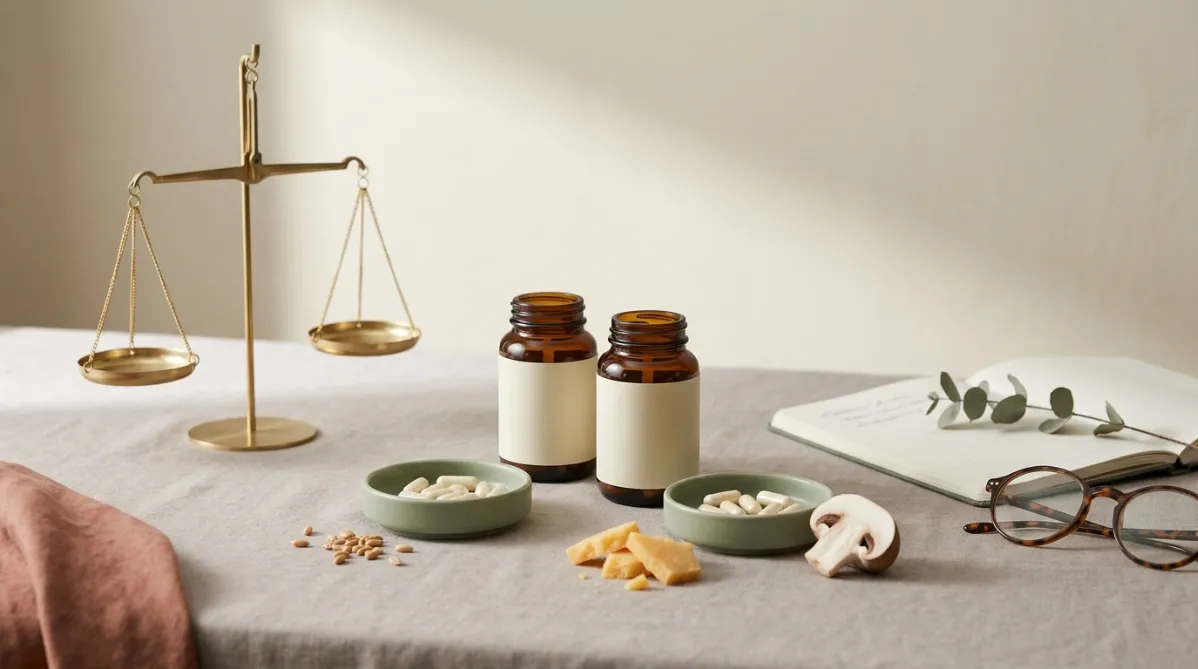
A wide, minimalist editorial still life on a soft, warm-gray linen surface lit by gentle diffused morning window light. At center sit two identical small amber glass supplement bottles, one slightly in front of the other, with plain matte cream labels and no readable text. In front of them, two matching shallow ceramic dishes in muted sage green hold identical small ivory capsules. The capsules are nearly indistinguishable, which quietly suggests placebo versus active. Beside the dishes, a few wheat germ grains, a small cluster of aged cheddar-toned cheese shards, and a halved ripe mushroom hint at natural spermidine food sources. They are arranged with careful negative space.

On the left, a delicate balance scale in brushed brass sits perfectly level, its two small pans empty and even, as a subtle visual metaphor for "no difference." On the right, a neat open notebook with soft blurred pencil lines and a single sprig of dried eucalyptus lies beside a pair of thin round tortoiseshell reading glasses, suggesting older adults and memory without showing any people.

The background is a softly blurred pale oat-colored wall with a long gentle shadow cast diagonally across the scene from a window. The color palette is muted and modern: warm cream, sage green, amber, soft brass, and dusty terracotta accents. Shallow depth of field keeps the bottles and scale crisp while the edges melt into a creamy blur. The mood is calm, thoughtful, and quietly skeptical, like a trendy health and science journal feature. Fine film grain, a subtle matte finish, and a balanced asymmetrical composition leave open space in the upper right for headline overlay. Photographed from a slightly elevated three-quarter angle, high-end editorial photography style.
supplements

Spermidine for Memory? A 12-Month Trial in 100 Older Adults Found No Edge Over Placebo

BY DR. SYNAPSE ·

Spermidine has been hyped as a brain-protecting supplement on the strength of autophagy research and animal studies. The SmartAge trial put it to a rigorous test in 100 older adults with subjective cognitive decline, giving about 0.9 mg per day for 12 months. The primary memory outcome did not beat placebo (difference -0.03; P = .47), and secondary outcomes were also null. Exploratory hints on inflammation and verbal memory remain unconfirmed. Here is what the result means for anyone considering a spermidine supplement, and where the study's limits lie.

Approach 4, conceptual metaphor, in palette D, bold color field. A single old brass pocket watch, photographed from a slightly high three-quarter angle, sits on a saturated mustard-yellow seamless backdrop. The watch case is cracked open and its glass is gone. One half of the gear train is clean and polished. The other half is corroded, with a dull green-black patina. A few fine droplets of clear liquid sit on the corroded gears, and one tiny electric green (#00e676) glint of oxidation shows at the edge of the damage. Hard but slightly diffused studio strobe from the upper left casts a crisp, short shadow on the yellow. The macro lens gives a shallow depth of field, with the sharpest focus on the split between healthy and damaged gears. The mood is cautionary, precise and quietly unsettling. No text or numerals appear on the dial.
longevity

The Anti-Aging Compound Spermidine Has a Dark Side in Old T Cells

BY DR. SYNAPSE ·

Spermidine is widely promoted as an anti-aging polyamine, but a new mouse-derived cell study found it can sabotage a specific group of old immune cells. In senescence-like CD49d- CD8+ T cells, it cut mitochondrial respiration, depleted antioxidant reserves, and fragmented mitochondria, while neighboring CD49d+ cells were untouched. Cells from young mice responded differently, which makes age a key variable. This is preclinical work, not evidence of harm in humans, but it challenges the idea that spermidine helps every aging cell. Here's what the paper found and what it does and doesn't mean for you.

Approach: Conceptual metaphor, palette D (bold color field).

A single halved blood orange and a single halved yellow kiwi-style golden kiwi sit side by side on a saturated magenta seamless backdrop, shot from a low three-quarter angle with shallow depth of field. Between them, a thin, slightly cracked glass pane stands upright, partly dividing the two fruits to suggest "association, not cause." Glistening juice vesicles in the orange flesh catch crisp, directional studio light from the upper left, throwing a sharp, short shadow across the glossy magenta surface. A tiny electric green sprig of a fresh leaf rests at the base of the glass as the only green accent. Colors are juicy, vivid and contrasting: magenta, orange, gold. Mood is curious, clean and quietly skeptical, with a food-as-evidence feel. Photorealistic, tactile textures, no text or labels.
research

Vitamin C and E Linked to 18% Lower Alzheimer Risk, With a Catch

BY NOVA CHEN ·

In the Rotterdam Study of 5,395 older adults, higher dietary vitamin C and vitamin E intake were each linked to roughly 18% lower Alzheimer risk per standard deviation. The pattern looked strongest among smokers, where beta carotene and flavonoids also stood out. But this was an observational study of food intake, not pills, so it shows association rather than cause. Some of the headline smoker numbers also have confidence intervals that cross 1.0. Here is what the data actually say, which foods supply these nutrients, and where supplements do and do not fit.

This page is available in