Biocracked
Approach: 3, the human outcome, here as an animal-science moment. Palette: C, natural.

An old female lab mouse with slightly greying, ruffled fur sits upright on a researcher's open gloved palm, photographed at eye level in a close side-on view with a shallow depth of field. Behind it, a softly blurred animal facility window pours in real morning daylight, giving the scene a pale green-grey and warm-wood setting. The nitrile glove is a vivid electric green (#00e676), the single saturated accent. The mouse's whiskers and pink ears catch the light, and the researcher's white coat sleeve is just visible. Tones are natural: skin, soft cream bedding, sage walls. The mood is calm, careful and quietly hopeful, and it conveys age and care rather than drama. The image has no text, no labels and no readable writing.
Longevity

Ozempic's Active Ingredient Extended Lifespan in Old Mice. Here's Why

Dr. Synapse · · 4 min read

Semaglutide, the active ingredient in Ozempic and Wegovy, just did something in old mice that no weight-loss drug is supposed to do: it appeared to slow the biology of ageing and extend lifespan. The catch is that it did so in a way that only partly overlaps with simply eating less.

The finding comes from a new paper in Nature (2026) from researchers at UC Berkeley, with collaborators at the University of Copenhagen and the National Institute on Aging. It is a mouse study, and it should be read as one. Still, it gives a possible mechanistic framework for why GLP-1 drugs seem to help far beyond blood sugar and body weight.

What the researchers actually did

The team treated 20-month-old female C57BL/6 mice with semaglutide for three months. That is late life for a laboratory mouse, so the intervention was not started in youth or middle age.

According to the abstract, the treatment:

  • improved physiological function
  • attenuated hallmarks of ageing
  • modulated nutrient sensors and conserved genetic regulators of ageing

When treatment continued, lifespan was extended. The abstract does not give the size of the effect, so this article does not quote one.

The calorie restriction comparison

Calorie restriction (CR) is the most reliable lifespan-extending intervention in laboratory animals. It slows ageing and lowers the burden of many age-related diseases. Because GLP-1 drugs suppress appetite, an obvious question is whether semaglutide just works as CR with a syringe.

The researchers tested this directly with a longitudinal comparison against matched calorie restriction. The results were nuanced:

  • Overlap with CR: Semaglutide preserved baseline function and reproduced many of CR's functional benefits by attenuating age-associated decline.
  • Where it looked different: In exploratory drive, spatial memory and glucose control, semaglutide-treated mice showed improvements above baseline and more favourable trajectories than CR.

The authors describe GLP-1R activation as a "calorie restriction mimetic" that also shows effects "beyond those attributable to reduced calorie intake." In other words, eating less probably explains part of the story but not all of it.

Why this matters

GLP-1 medicines have shown benefits beyond glucose and weight control, and the abstract notes that the biological basis of these broader effects is poorly understood. This study offers a candidate explanation: the drug may engage the same nutrient-sensing and ageing-regulatory pathways that CR does. If so, some of the broad benefits seen in patients could reflect a slowing of ageing processes rather than a collection of unrelated side benefits.

That is a hypothesis grounded in mouse data, not a settled mechanism in people.

What this does not mean for people

The limits matter here:

  • It is animal research. Mouse lifespan results often fail to translate to humans, and this study does not tell us whether semaglutide extends human lifespan.
  • Only female mice were reported. The title and abstract specify females, so the findings should not be assumed to apply to males, let alone to men.
  • One strain, one starting age. The work used C57BL/6 mice started at 20 months.
  • Late-life start in mice is not a human equivalent. Mapping mouse months onto human years is imprecise.
  • Possible conflict of interest. The Regents of the University of California filed a patent application on GLP-1 receptor agonists for healthy ageing. That does not invalidate the work, but it is worth knowing.

For people already taking a GLP-1 drug for diabetes or obesity, the study is not evidence that they are slowing their own ageing. It is also not a reason to start or stop a prescription.

Practical takeaways: dose, timing and who it's for

People reasonably want actionable guidance from a headline like this. The honest answer is that the paper does not provide it.

  • Dose: The abstract gives no dosing information, and a mouse dose cannot be converted into a human regimen by guesswork. Nothing here supports an "anti-ageing dose" of semaglutide.
  • Timing: In mice, treatment began late in life (20 months) and ran for three months before continuing for the lifespan analysis. That is a study design, not a recommendation for when humans should begin anything.
  • Who it's for: Semaglutide is currently prescribed for type 2 diabetes and obesity. Nothing in this study establishes it as a longevity therapy for healthy people, and the researchers' own framing is that this is a mechanistic framework, not a clinical protocol.

The practical message for now is to treat GLP-1 therapy as a medical decision made with a clinician, based on established indications, and to regard longevity as a possible bonus that still needs human trials.

What to watch next

The key next steps are replication, testing in male mice and other strains, and, most importantly, human studies designed to measure ageing outcomes rather than weight or glucose. The finding that semaglutide outperformed matched CR on exploratory drive, spatial memory and glucose control also deserves follow-up. It hints that GLP-1 receptor activation may reach biology that simple calorie reduction does not.

For now, this is a strong preclinical signal in a top journal, and a reminder that the drugs reshaping obesity treatment may be touching something more fundamental than appetite.

Source: Feng Y, et al. "Late-life semaglutide treatment slows ageing and extends lifespan in female mice." Nature 2026;657(8131):469-476. doi:10.1038/s41586-026-10940-7.

Original study

Read the original research on pubmed.ncbi.nlm.nih.gov →

This article summarizes published research for general information. It is not medical advice.

DS

Written by

Dr. Synapse

Dr. Synapse writes for Biocracked: biohacking science, longevity & human performance.

Related Articles

Approach: Macro science, the human outcome angle through tissue. Palette: D, bold color field.

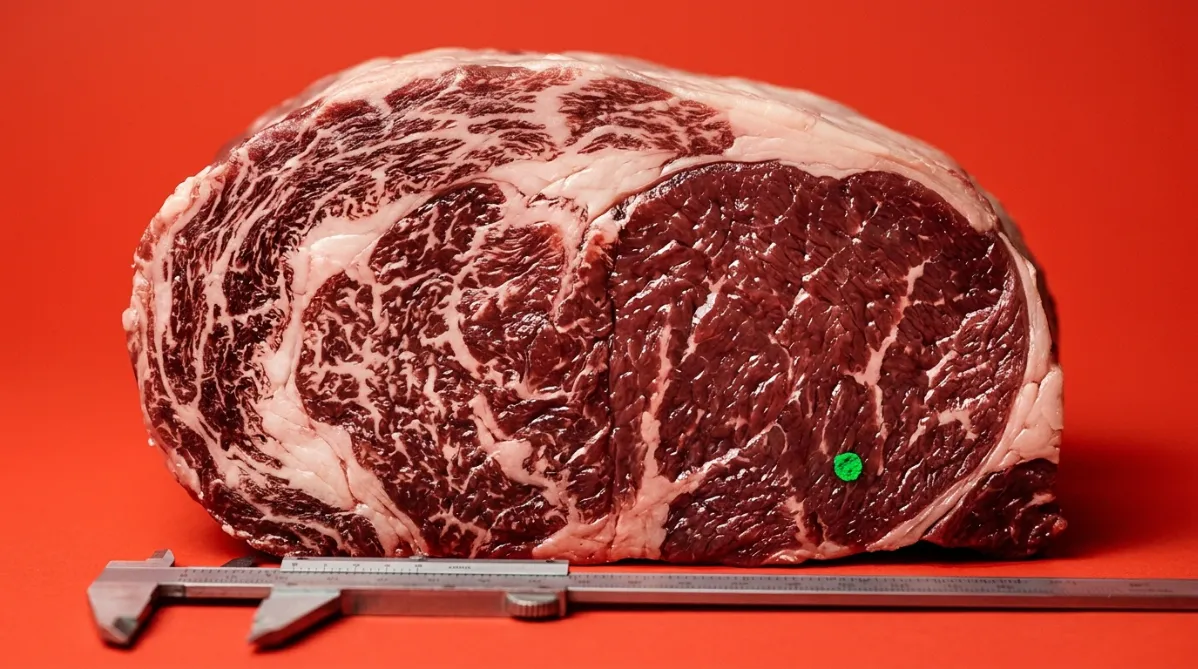
Extreme close-up of a cross-section of raw beef thigh muscle, used as a stand-in for human thigh tissue. It is shot straight on and slightly from above, on a saturated tomato-red seamless backdrop. Fine white fat marbling threads run through the dark red muscle fibers. On one half the marbling is dense and lacy, and on the other it is sparse and clean, so the contrast reads as a before and after. A thin, translucent calipers-style steel ruler lies along the edge, with no markings readable. Lighting is soft, directional studio light from the upper left, with crisp highlights on the glistening fibers and gentle warm shadows. A single small electric green surgical marker dot sits on the tissue. The mood is analytical, tense and uncertain, with shallow depth of field and sharp detail on the fat texture.
longevity

High-Dose Semaglutide and Thigh Muscle: What the MRI Shows

BY HELIX WARD ·

A new MRI sub-analysis of the STEP UP trial examined what 72 weeks of high-dose semaglutide (7.2 mg) does to body composition, including the thigh muscles. Fat loss was large, about 11 liters versus placebo, and fat infiltration within thigh muscle fell significantly. Thigh muscle volume dropped by about 1.1 L, a change that missed statistical significance (p = 0.07) but whose confidence interval leans toward loss. With only 55 scanned participants, just six on placebo, and Novo Nordisk involvement, the findings are suggestive rather than conclusive. Here's what the data show, what they can't, and how to protect your muscle on a GLP-1.

**Approach:** Lab in action. **Palette:** Bold color field, mustard yellow.

A close, slightly high three-quarter view of a hand in a magenta-purple nitrile glove holding a clear 12-well cell culture plate. Each well is filled with salmon-pink culture medium. A multichannel pipette hovers over one well, with a single droplet caught just before it falls. The background is a seamless, saturated mustard-yellow surface and wall, with a soft shadow under the plate. Bright, even studio light comes from the upper left, giving crisp highlights on the plastic rims and a soft glow through the liquid. The depth of field is shallow, so the far wells blur gently. A tiny electric-green cap on a tube sits in the corner of the frame. The mood is calm, precise and curious, with a clean, graphic, editorial feel. No text or labels.
peptides

Semaglutide Didn't Shrink Human Muscle Cells. So Why the Muscle Loss?

BY DR. SYNAPSE ·

Does semaglutide really eat your muscle? A new GeroScience study put the drug straight onto primary human muscle cells from older adults with obesity, and the cells didn't waste. No atrophy genes switched on, no secretome alarms, and GIP even thickened myotubes after eight days. Semaglutide did modestly dial down glycolytic ATP production, and GLP-1 receptors were barely detectable. The findings point toward indirect causes of lean mass loss, like calorie deficit and reduced loading, though a dish is not a body.

**Approach: Conceptual metaphor. Palette: D, bold color field.**

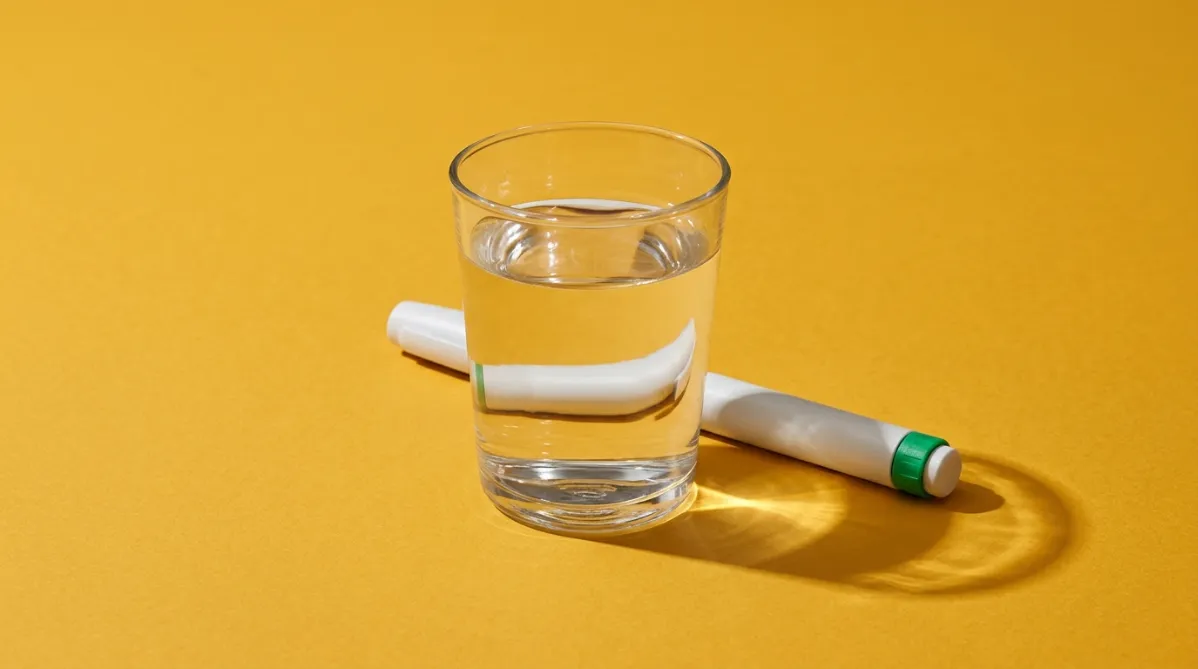
A single clear glass of water sits on a saturated mustard-yellow backdrop, shot at a slight low three-quarter angle. A hand-held pen injector rests beside it, its body a matte white with a small electric green dial ring as the only green accent. Hard but clean studio light from the upper left throws a crisp, defined shadow across the yellow surface. Through the glass, the injector is refracted into two slightly offset images, suggesting a signal that is split and hard to read. The mood is calm, questioning and balanced, with no drama. The background is fully warm and bright, with no blue cast. The surface has a subtle paper-like texture. There is no text, no label and no face.
metabolism

Do Ozempic and Mounjaro Cause Depression? What 20 Studies Found

BY DR. SYNAPSE ·

Do Ozempic and Mounjaro cause depression or suicidal thoughts? A new systematic review of 20 studies plus EMA and FDA assessments says the best evidence doesn't show it. Randomized data, including two large 2025 meta-analyses, found no increased suicidality, depression, or anxiety with semaglutide or tirzepatide. The scarier signals came from study designs that can't separate drug effects from obesity-related distress, baseline psychiatric risk, and reporting bias. But trials excluded many psychiatric patients, so surveillance still matters for high-risk groups and rare long-term outcomes.

Approach: conceptual metaphor. Palette: D, bold color field.

A single steel dumbbell sits in the center of a saturated tomato-red seamless backdrop. A thick, taut rope of frayed tan fibers wraps around its handle, and a few strands are visibly thinning and unraveling at one end while the rest stay dense and intact, standing for muscle being preserved while weight drops. Shot at a low three-quarter angle with a shallow depth of field, so the knurled grip texture is crisp and the background melts into smooth red. Hard, directional studio light from the upper left casts a sharp, short shadow on the glossy red surface. One thin electric green cable tie is cinched around the rope. The mood is punchy, tense and editorial, with no people and no text.
peptides

What to Pair With Tirzepatide to Keep Muscle? Mice Have a Clue

BY NOVA CHEN ·

Tirzepatide can strip off weight fast, but what happens to your muscle? A new mouse study tested the drug alone and stacked with time-restricted feeding and resistance training. The full stack accelerated weight and fat loss, resistance training preserved muscle and strength, and TRF plus tirzepatide improved glucose tolerance. The liver benefits, however, were the same across all treatments. This is animal-only research in obese female mice, so treat it as a promising signal, not a human protocol.

This page is available in