The Supplement That Quieted Inflammation, and Maybe Something Else
NMN (nicotinamide mononucleotide) is marketed as an anti-aging, energy-boosting NAD+ precursor. A new human muscle-biopsy study suggests it may also be a double-edged sword for people who train hard. NMN dampened inflammatory signaling in exercised muscle. It also coincided with the loss of a mitochondrial boost that the placebo condition showed 24 hours after the workout.
The paper, published in the Journal of the International Society of Sports Nutrition (2026), is small and early. It still raises a question the supplement aisle rarely asks: is less inflammation always better after training?
What the Researchers Actually Did
- Study type: randomized, placebo-controlled, counterbalanced crossover trial
- Sample: 11 untrained men, average age 22.8 years
- Intervention: NMN at 1,200 mg per day or placebo for 7 days, with a 3-week washout between conditions
- Exercise: blood flow restriction resistance exercise (BFR-exercise)
- Measurements: multiple muscle biopsies before and after the session
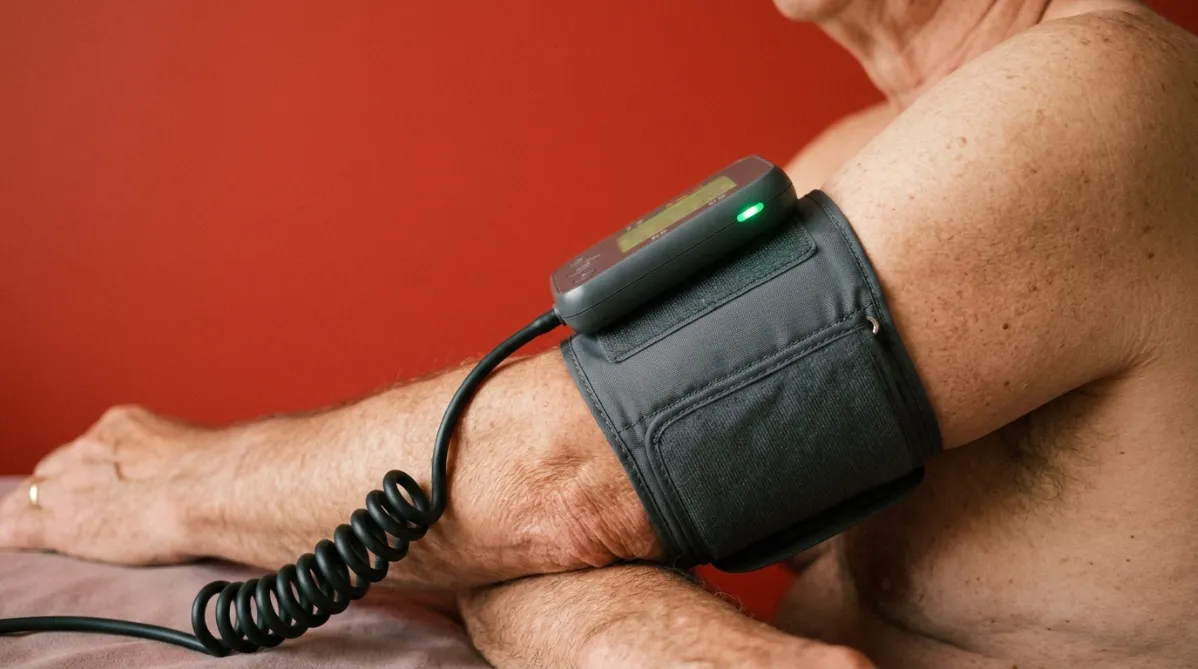
BFR training uses a cuff to restrict blood flow while lifting, usually with lighter loads. In this study it caused real muscle damage. Muscle necrosis was significant right after exercise (0 h) and resolved within 24 hours in both conditions.
The Striking Findings
1. NMN muted inflammatory signals
NMN suppressed the exercise-induced increases in TNF-α and IL-10 mRNA. The authors read this as attenuated inflammatory signaling. This matches earlier animal work in which NMN inhibited acute inflammation in injured tissue.
2. Repair-related timing looked slower
NMN delayed the rise in p21 mRNA. The authors suggest this points to delayed myogenic differentiation, the process by which muscle precursor cells mature into repairing fibers. The clearance of infiltrating cells from damaged regions was also moderately delayed.
3. The mitochondrial twist
In the placebo condition, mitochondrial content in exercised muscle rose by 171% after 24 hours of recovery. With NMN, that adaptation was abolished.
Imaging suggested a possible explanation. Staining for TOM20 and myeloperoxidase (MPO) showed that infiltrating phagocytes carried substantially more mitochondria than the cytoplasm of the muscle fibers. The mitochondria appeared to form a gradient toward damaged regions. A COX4 stain in muscle from one additional participant supported the same picture.
The authors' interpretation is that NMN, by suppressing inflammatory signaling, may also suppress the transfer of mitochondria from phagocytes to repairing fibers. This is a hypothesis drawn from correlational imaging, not a demonstrated mechanism.
Why This Matters
Inflammation after hard training is often treated as the enemy. This study is a reminder that part of it may be a repair program. If the immune cells that flood a damaged region also deliver mitochondrial material, then turning the response down could cost you something. The tradeoff the authors raise is a quieter inflammatory profile against a blunted mitochondrial rebound.
Honest Limitations
- Tiny sample: 11 participants, all young, untrained men. The results may not apply to women, older adults, or trained athletes.
- Short exposure: NMN was taken for only 7 days. Longer use could behave differently.
- Molecular readouts: Key inflammatory and differentiation findings were based on mRNA, not protein levels or functional outcomes.
- No performance data: The abstract reports no strength, recovery rate, or hypertrophy outcomes, so we can't say whether the changes affect results.
- Mechanism is inferred: The phagocyte-to-muscle mitochondrial transfer idea rests on imaging patterns. One extra participant was used for COX4 confirmation.
- One exercise type: The findings concern a single BFR session, not a long training program.
The authors reported no conflicts of interest.
Practical Takeaways
Dose studied: 1,200 mg per day for 7 days. This is a research dose, not a recommendation, and the abstract does not say how it was timed relative to training.
Who might find this interesting: Anyone considering NMN around intense training, and people trying to understand how NAD+ boosters interact with exercise adaptation.
Who may want to be cautious or skip it for now:
- People using NMN specifically to enhance training recovery or adaptation. This study shows no benefit in that respect, and it shows a possible downside for mitochondrial adaptation.
- Anyone doing damaging workouts such as BFR or heavy eccentric training who wants the full post-exercise mitochondrial response.
- Anyone expecting that a lower inflammatory marker means faster recovery. In this study, the delays suggest otherwise.
Bottom line: This is a hypothesis-generating study, not a reason to panic or to change your routine. If you take NMN for other reasons, talk to a clinician and consider how it fits with your training. Larger trials with functional outcomes in diverse groups are needed before anyone can say whether NMN helps or hinders muscle recovery.