Biocracked
**Approach: Human outcome. Palette: warm (B).**

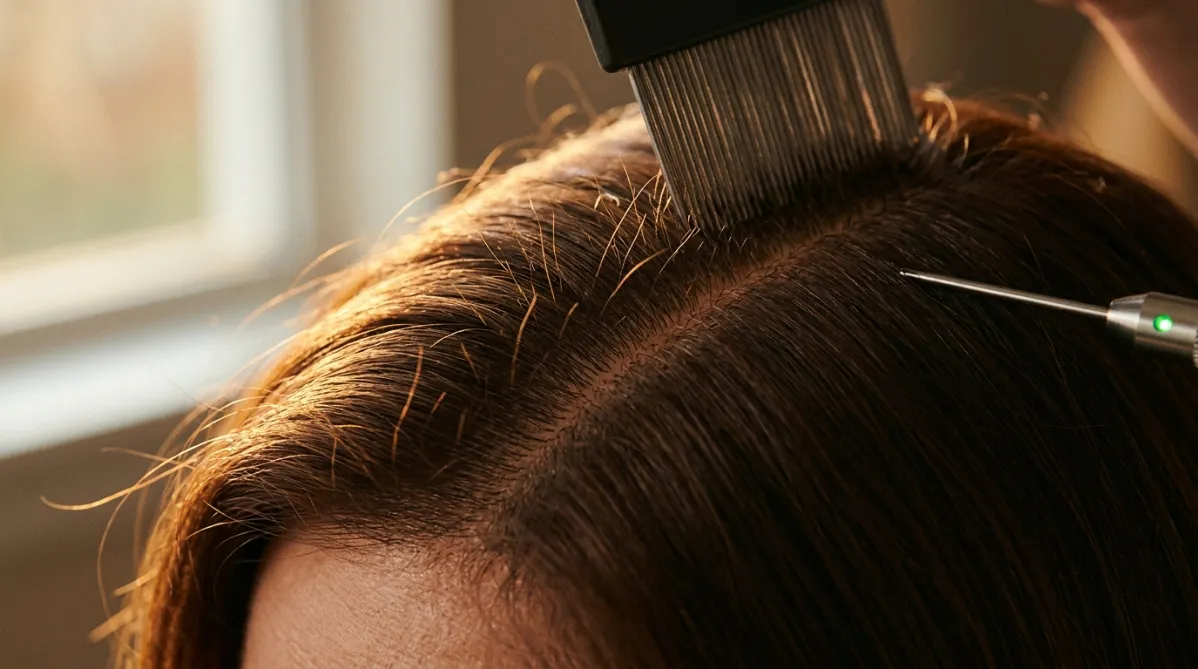
Extreme close-up, slightly high angle, of a woman's scalp parting in her 40s. Dense, glossy chestnut-brown hair is split by a fine comb. Short new hairs rise from the visible scalp skin, and a few strands catch the light. Faces and identity are out of frame. Low golden-hour window light enters from camera left and rim-lights the strands in honey and copper. Shadows stay warm brown, with no blue cast. The shallow depth of field blurs the background hair into soft amber bokeh. A thin steel trichoscopy probe tip sits at the edge of the frame, and a tiny electric green LED glints on its housing as the only accent. The mood is hopeful but scrutinizing, like a clinical check-up with a cautious eye.
Supplements

NMN Boosted Hair Density 57% in a Human Trial—With a Big Catch

Nova Chen · · 4 min read

A popular longevity supplement may have a new use: your hair. In what appears to be the first human trial of NMN (nicotinamide mononucleotide) for hair, growing-phase hair density rose from about 56 to about 88 hairs per square centimeter in 12 weeks. That is roughly a 57% jump. But there was no placebo group, and that changes how much weight the number can bear.

What the study actually did

The paper, published in Cosmetics in 2025 (12(5):204), comes from Fukumoto and colleagues. The authors are linked to Mitsubishi Corporation Life Sciences, which makes an NMN ingredient.

The design was simple:

  • Type: single-arm, pre-post pilot (everyone got NMN; there was no comparison group)
  • Participants: 15 healthy Japanese women aged 40-50
  • Duration: 12 weeks
  • Intervention: oral NMN made by Torula yeast fermentation, reported at 500 mg per day
  • Measurements: TrichoScan analysis of the hair growth cycle, scanning electron microscopy (SEM) of the hair shaft and cuticle, hair metabolites and hormones, and visual analog scale (VAS) questionnaires

The 500 mg figure comes from an interview the company gave to trade press. The same company's consumer product reportedly recommends 250 mg per day, so the trial dose is not the same as the retail dose.

The headline numbers

Measure Before After Significance
Anagen (growth-phase) hair elongation density 55.9 hairs/cm² 87.7 hairs/cm² p = 0.03
Hair diameter 75.3 µm 78.8 µm p < 0.01

The density change is large on paper. The diameter change is much smaller, about 3.5 µm or roughly 5%, but it was statistically stronger. Thicker strands and more hairs in the growth phase would point the same way if they held up in a controlled trial.

The researchers also reported:

  • Better cuticle condition on SEM imaging
  • Metabolomic shifts in amino acids and energy metabolism in hair
  • No marked change in hair hormone levels
  • Subjective gains in elasticity, gloss and volume, along with less perceived fatigue and less perceived hair loss

Why NMN, and why hair?

NMN is a precursor to NAD+, a molecule involved in cellular energy metabolism. NAD+ levels decline with age, which is the main reason NMN has become a staple of the longevity-supplement world. Hair follicles are metabolically busy and cycle through growth, regression and rest. The idea is that supporting follicle energy metabolism could favor the growth phase.

The metabolomic changes in amino acids and energy pathways fit that story. They do not prove it. The paper reports associations in a small group, not a demonstrated mechanism. The absence of hormone changes does suggest the effect, if real, is not working through the hormonal routes targeted by conventional hair-loss drugs.

The big caveat: no placebo

This is the part to take seriously before spending money.

  • No control group. Without a placebo arm, there is no way to separate the effect of NMN from seasonal variation in hair shedding and growth, regression to the mean, measurement variability, or expectation effects.
  • Tiny sample. Fifteen people is a pilot, not a verdict.
  • Industry link. The authors are tied to an NMN supplier. That does not invalidate the data, but it is a reason to wait for independent replication.
  • Narrow population. Healthy women aged 40-50 only. The study did not test men, older or younger women, or people with diagnosed hair-loss conditions.
  • Not a baldness trial. It did not examine male-pattern baldness, and nothing here supports claims about reversing it.
  • Subjective outcomes. The VAS improvements in gloss, volume and fatigue are self-reported and open to placebo effects, especially since participants knew they were taking the supplement.
  • Short duration. Twelve weeks says little about whether gains persist or what happens after stopping.

Hair counts can also shift for reasons unrelated to any treatment, so a 57% change in a single-arm study should be read as a signal worth testing, not a measured treatment effect.

Practical takeaways

Dose: The trial used 500 mg per day of Torula yeast-fermented NMN. The sponsor's consumer product reportedly suggests 250 mg per day. No study has established a hair-specific optimal dose, so the trial dose is the only human reference point.

Timing: The study ran 12 weeks, so any realistic evaluation would need at least that long, given hair's slow growth cycle. The paper as summarized here does not establish a best time of day.

Who it might interest: Healthy women in their 40s who are curious about hair quality and already comfortable with NMN as a general supplement. Treat it as an experiment, not a proven treatment.

Who should skip it, or ask a clinician first:

  • Anyone looking for a proven fix for pattern baldness or medically diagnosed hair loss, because this trial does not address those conditions
  • Anyone whose hair loss is sudden or patchy, which warrants a medical workup for thyroid, iron and other causes
  • Pregnant or breastfeeding women, and people on medications or with chronic conditions, who should get medical advice first, since this study did not evaluate those groups
  • Anyone expecting dramatic results based on one uncontrolled pilot

The bottom line

The first human NMN hair trial produced eye-catching numbers: denser growth-phase hair, slightly thicker strands, healthier-looking cuticles and happier participants. It is also a 15-person, single-arm, industry-linked pilot with no placebo. The honest reading is that NMN for hair is an interesting hypothesis that now has a first human data point. A randomized, placebo-controlled trial with a larger and more varied group is needed before anyone can say it works.
Original study

Read the original research on doi.org →

This article summarizes published research for general information. It is not medical advice.

NC

Written by

Nova Chen

Nova Chen writes for Biocracked: biohacking science, longevity & human performance.

Related Articles

**Approach:** Conceptual metaphor. **Palette:** Bold color field (mustard yellow).

Straight-on, slightly elevated camera view of a pair of identical brass balance scales on a saturated mustard-yellow seamless backdrop. The pans sit perfectly level. One pan holds a small mound of fine white crystalline powder, the other holds an almost identical mound. A third, smaller pan lies tipped and lighter off to the side. Between the scales, a single translucent glass tube coils like a gut, with a tiny electric green (#00e676) glow inside it. This is the only green in the frame. Lighting is soft, directional studio light from the upper left, with crisp, gentle shadows on the yellow surface and warm metallic highlights on the brass. Mood: playful, curious, quietly skeptical. Photorealistic with sharp macro detail on the powder grain and the glass.
supplements

NMN vs NR: First Human Head-to-Head Finds a Tie and a Gut Twist

BY NOVA CHEN ·

For years, NMN has been sold as the premium upgrade to NR. The first human head-to-head trial of NMN, NR and nicotinamide now suggests the two pricey options performed comparably at raising blood NAD+, while nicotinamide did not. The twist: gut microbes appear to convert NR and NMN into nicotinic acid, a potent NAD+ booster in blood experiments. That raises awkward questions about price, niacin and your microbiome. Here's what the 65-person study did and didn't show, including its 14-day, open-label, Nestlé-funded limits.

A softly lit editorial still life on a pale oat-colored linen surface, shot from a slightly elevated three-quarter angle in a wide landscape frame. At center-left, a small matte white ceramic dish holds a modest pile of fine off-white powder, with a tiny brushed-brass measuring spoon resting beside it. Next to the dish stands a minimalist amber glass supplement bottle with a plain cream label and no readable text. A few capsules spill casually across the linen, some translucent and some opaque ivory.

On the right side of the composition, a ripe blood orange cut in half and a handful of raw almonds sit on a light ash-wood board. A sprig of fresh rosemary adds a muted green accent. A sheer glass of water catches the light and throws a soft, rippled caustic pattern across the fabric.

In the background, out of focus, a woman's hand in a soft sage-green knit sleeve rests near a ceramic mug. This suggests a calm morning routine without showing a face. Behind her, a tall window casts diffused, golden-hour light from the upper left, with gentle shadows and a creamy, shallow depth of field.

The palette is warm and restrained: oat, ivory, terracotta, sage, and amber, with a single pop of coral from the blood orange. A thin, abstract line of muted terracotta paint, like a brushed arc, sweeps across the upper right background. It subtly evokes a rising curve without becoming a literal chart.

The mood is calm, trustworthy, and contemporary, like a premium wellness and science journal feature. The image has crisp focus on the powder and bottle, natural film-like grain, soft contrast, and generous negative space in the upper third for headline overlay. It looks like a high-end editorial photograph with no text, logos, or futuristic elements.
metabolism

NMN's First Human Win: 250 mg a Day Lifted Muscle Insulin Sensitivity by About 25% in Prediabetic Women

BY DR. SYNAPSE ·

NMN has long been a darling of the longevity market, but human evidence was thin until a 2021 Washington University trial published in Science. In postmenopausal women with prediabetes who were overweight or obese, 250 mg of NMN daily for 10 weeks improved muscle insulin sensitivity by roughly 25%. Muscle insulin signaling and genes tied to muscle remodeling also improved, while the placebo group saw no change. But the benefit was narrow, and the study did not show NMN lowering blood sugar or reversing prediabetes. Here's what the trial found, who it applies to, and what it didn't change.

Approach 4, conceptual metaphor, in palette D, bold color field.

A single AA-style cylindrical battery, shown as a real physical object with a matte metal casing, stands upright at the center of a saturated tomato-red seamless paper backdrop. Its top half is bright and glossy, while the lower half is scuffed and dull. A thin, crisp line of electric green liquid light fills the clear gauge window along its side, stopping about three-quarters of the way up. Three smaller, identical dead batteries lie tipped over in the foreground, slightly out of focus, to suggest the rival compounds. The camera sits at a low three-quarter angle with a shallow depth of field. A hard, warm key light from the upper left casts a sharp, long shadow across the red surface. The mood is punchy and skeptical: one cell charged, the others spent.
supplements

NMN vs NR vs NADH: One Lifted Endurance, None Fixed Fatigue

BY NOVA CHEN ·

A new network meta-analysis of 27 studies and 1,599 adults compared NMN, NR, NADH and nicotinamide, and the results are not what supplement marketing promises. NMN showed a dose-dependent boost in endurance, with a standardized mean difference of 1.02 at the high dose. NADH led for cognition, but mostly in cognitively impaired groups and with a result sensitive to influential studies. The surprise is that no precursor significantly improved perceived fatigue or sleep. Here is how the ranking breaks down, what the limits are, and who should or shouldn't bother.

Approach: conceptual metaphor. Palette: bold color field.

A single oversized brass balance scale sits on a saturated tomato-red seamless backdrop, photographed at a low three-quarter angle. One pan holds a small, glowing ember-orange coal that is cooling and dimming to grey ash at its edges, standing for inflammation. The other pan holds a tightly coiled, freshly cut green plant sprout with a tiny electric green (#00e676) tip, standing for repair and growth. The scale tips slightly toward the ember, leaving the viewer unsure which side is better. Hard but clean studio key light from upper left casts a crisp, graphic shadow across the red surface. Brass shows real fingerprints and fine scratches, and the ash has a visible powdery texture. The mood is tense, thoughtful and questioning, with the whole image shot at shallow depth of field and the fulcrum in sharp focus. No text, no markings on the scale.
supplements

NMN Calms Muscle Inflammation After Training—But at What Cost?

BY NOVA CHEN ·

NMN is sold as a cellular-energy booster, but a new muscle-biopsy study found a surprising tradeoff. After a damaging blood flow restriction workout, 1,200 mg/day of NMN suppressed inflammatory signals like TNF-α and IL-10. It also delayed a repair-related marker and erased the 171% mitochondrial increase seen with placebo. The study is tiny (11 untrained young men), so it can't settle anything. It does challenge the assumption that less post-workout inflammation is always better.

This page is available in