Biocracked
Approach: conceptual metaphor. Palette: bold color field, a saturated teal backdrop.

A single brass door key sits in the lock of a matte white ceramic cup on a seamless saturated teal surface, shot at a low three-quarter angle with shallow depth of field. A thin curl of steam rises from the cup. A second, identical key lies snapped in half on the surface in front of it, as if the first key's lock has been jammed. The cup is a sculptural latte cup with a swirl of crema. The light is a soft, hard-edged studio key from the upper left, casting a crisp, long shadow across the teal. A tiny electric green (#00e676) bead of light glints on the brass key's tip. The mood is quiet, curious and slightly tense, a mechanism being blocked. No text, no logos, photorealistic, with real metal and ceramic textures.
Supplements

Luteolin Hits Caffeine's Sleep Switch—Your Latte May Undo It

Nova Chen · · 4 min read

Big caveat first: this is a mouse study. Nothing below has been shown in humans. Now, the interesting part.

Most "natural sleep aids" claim to calm the brain through GABA, the same system targeted by benzodiazepines and Z-drugs. Luteolin, a common plant flavonoid, appears to skip that route. In mice, it seems to work on the adenosine receptors that caffeine blocks. If that carries over to people, your afternoon coffee could be working against it.

What the study did

A Korean team (Kim, Custodio, Cheong, Kim and Jung) published the work in Biomolecules & Therapeutics in 2019. Luteolin was already known for neuroprotective activity in models of epilepsy and Alzheimer's disease, but its effect on sleep was barely explored.

The researchers ran three kinds of tests:

  • Pentobarbital-induced sleep model: mice were given luteolin orally at 1 and 3 mg/kg, then a sedative, and the team measured how fast they fell asleep and how long they stayed asleep.
  • EEG/EMG recordings: brain and muscle recordings to classify sleep stages and wakefulness.
  • Mechanism tests: pharmacological antagonists and receptor binding assays to work out where luteolin acts.

What it found

The headline results, as reported in the abstract:

  • Luteolin at 1 and 3 mg/kg decreased sleep latency and increased total sleep time in the pentobarbital model.
  • EEG/EMG recordings showed more non-REM (NREM) sleep and less wake time.
  • The 3 mg/kg effect was not affected by flumazenil (which blocks the benzodiazepine site on GABA-A receptors) or bicuculline (which blocks the GABA binding site).
  • The effect was almost completely blocked by caffeine, by DPCPX (a selective A1 receptor antagonist) and by SCH-58261 (a selective A2A receptor antagonist).
  • In binding assays, luteolin bound both A1 and A2A receptors, with reported IC50 values of 1.19 and 0.84 (listed in the abstract as μg/kg). It did not bind benzodiazepine or GABA-A receptors.

The unusual IC50 units are worth noting. An IC50 normally has a concentration unit, so read those values as "binds at low potency thresholds" and check the full paper before quoting them.

The logic is clean. If GABA blockers don't stop the effect but adenosine blockers do, adenosine signaling is the likely route. Adenosine builds up the longer you're awake and drives "sleep pressure," and caffeine works by occupying its receptors. Luteolin appears to bind the same receptors, but in a way that promotes sleep.

The coffee connection (an inference, not a finding)

The study did not test coffee, and it did not test timing. What it showed is that caffeine, used as a pharmacological tool, almost completely blocked luteolin's hypnotic effect in mice. The takeaway about afternoon coffee is a reasonable extrapolation, not a result.

If luteolin and caffeine compete for the same receptors, then caffeine still in your system at bedtime could plausibly blunt any benefit. Caffeine's half-life varies widely between people, so "afternoon" is a rough guess. Whether a normal cup of coffee reaches the receptor blockade used in the mouse experiment is unknown.

The catch: limitations you need to know

  • Mice only. Rodent sleep architecture and drug metabolism differ from ours, and mice are nocturnal.
  • Sedative-induced sleep. The first model used pentobarbital, which tests hypnotic potentiation rather than natural insomnia.
  • No human trial. There is no controlled evidence that luteolin improves sleep in people.
  • Absorption is an open question. Flavonoids are generally known for modest oral bioavailability, so mouse doses don't map neatly onto supplements.
  • Short-term data. Tolerance, long-term safety and next-day effects weren't addressed in the abstract.

There is some loosely supportive human data. A 2025 NHANES analysis (J Nutr Biochem 2025;143:109944) linked the highest tertile of luteolin intake to roughly 15% lower risk of sleep problems. That is observational, based on diet recall, and can't show cause and effect. People who eat more luteolin-rich plants may simply have healthier habits overall.

How to use it (cautiously)

None of this is dosing advice, since no human protocol exists. Here is how a biohacker might reason about it.

Dose: The ergo-log write-up that surfaced this paper estimated a human-equivalent dose of roughly 15–25 mg. That figure is an estimate from ergo-log's conversion of the 1–3 mg/kg mouse doses, not something the study or any human trial established. Treat it as a ceiling for cautious self-experimentation, not a recommendation.

Timing: The mechanism suggests taking it in the evening and keeping caffeine well away from it. Moving your last coffee earlier is a sensible test, and it helps sleep anyway.

Form: Luteolin is sold as a standalone supplement and appears in blended flavonoid products. It is also found in foods such as celery, parsley and peppers, though food amounts are usually small and variable. Check the label for actual milligrams per serving.

Who it might suit: Healthy adults curious about non-GABA approaches who already have sleep hygiene sorted and want to run a careful n=1 trial.

Who should skip it:

  • Pregnant or breastfeeding women, and children
  • Anyone taking sedatives, sleep medications, anticonvulsants or other CNS-active drugs
  • Anyone with a medical condition or on regular medication, unless a clinician has approved it
  • Anyone with chronic insomnia, who should get a proper evaluation rather than self-treat

Bottom line

The finding is pharmacologically neat: a plant compound that appears to bind adenosine A1 and A2A receptors, increases NREM sleep in mice, and has its effect wiped out by caffeine and by selective adenosine blockers. It is also very early, with no human trials behind it. If you experiment, keep caffeine away from the dose, change one variable at a time, and track your results.

Original study

Read the original research on pubmed.ncbi.nlm.nih.gov →

This article summarizes published research for general information. It is not medical advice.

NC

Written by

Nova Chen

Nova Chen writes for Biocracked: biohacking science, longevity & human performance.

Related Articles

Approach: Macro science, with the human outcome as a quiet secondary cue. Palette: C (Natural).

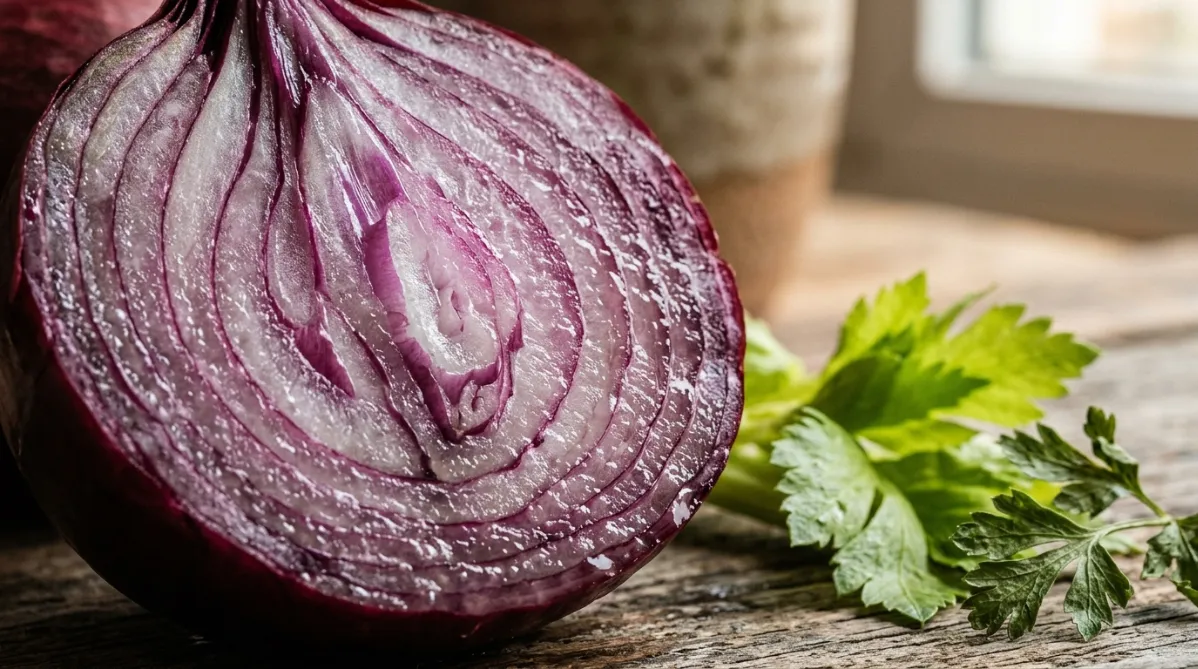
Extreme macro photograph of a halved red onion and fresh celery leaves, the real dietary sources of isorhamnetin and luteolin. The onion's glossy magenta-violet layers and translucent cell walls fill the left two-thirds of the frame, with fine droplets of juice catching the light. A few crisp green celery leaves and a sprig of dried parsley rest in soft focus to the right. Shot at a slight low angle, shallow depth of field, 100mm macro look. Soft morning daylight from a window behind and to the side gives a warm rim light and gentle translucency through the onion layers. The palette is earthy: plum, sage green, and warm wood tones, with one small electric green highlight on a celery leaf edge. The mood is calm, fresh, and quietly curious, with a hint of rest.
supplements

The Overlooked Flavonoid Linked to Better Sleep Isn't Quercetin

BY NOVA CHEN ·

Everyone talks about quercetin, but a large U.S. survey analysis points to two lesser-known flavonoids tied to better sleep: isorhamnetin and luteolin. People in the top tertile of isorhamnetin intake had about 25% lower odds of sleep disorders and reported longer sleep. Luteolin showed a smaller link, around 15% lower odds. But this is a cross-sectional study of 10,162 adults based on dietary recalls of foods, not supplements, so it cannot prove cause and effect. Here is what the numbers show, what they don't, and what a sensible takeaway looks like.

Approach 4, conceptual metaphor, in palette C, natural.

A single ceramic cup of freshly brewed green tea sits on a weathered wooden windowsill, photographed from a low three-quarter angle at eye level. Steam curls upward and catches soft, directional morning daylight from a window on the left. The tea is clear amber-green, with a few loose unfurled tea leaves resting on the saucer. Behind the cup, a softly out-of-focus garden of leafy green plants and a bright, hazy sky gives shallow depth of field. The wood has realistic grain and small chips, and the ceramic has a matte, slightly speckled glaze. A single tea leaf in the foreground has a faint electric green tint where light passes through it. The mood is calm, quiet and unhurried, with warm skin-tone wood against cool plant greens. No text, no labels.
supplements

L-Theanine Calms Without Sedation: What Doses Actually Work

BY NOVA CHEN ·

L-theanine, the amino acid in tea, is said to calm you without making you drowsy, and a new Frontiers in Nutrition mini-review tests that claim against human trial evidence. It reports doses of 100-400 mg for small cognitive gains (especially with caffeine), 200-400 mg/day for stress without sedation, and 200-450 mg/day for better sleep quality. The effects are small, and the paper does not report a pooled sample size. Both authors work for a British American Tobacco subsidiary that sells L-theanine products. Here is what the numbers say, who it may suit, and who should skip it.

Conceptual metaphor in a bold color field palette: a single brass balance scale sits dead center on a saturated mustard-yellow seamless backdrop, photographed at eye level with a 85mm lens and shallow depth of field. One pan holds a small mound of coarse white magnesium salt crystals, the other pan holds a rumpled, empty pillow-soft wad of grey linen, and the beam hangs almost level but wavering, suggesting uncertainty. A thin electric green thread loops from the beam's pivot as a subtle accent. Soft, large-source studio light from camera left casts a gentle, defined shadow to the right across the yellow surface. Crisp metal reflections, visible salt crystal facets. Mood: skeptical, calm, quietly questioning, clean and editorial.
supplements

Magnesium for Sleep? 12 Trials Say the Hype Outruns the Evidence

BY NOVA CHEN ·

Magnesium is marketed as a natural sleep aid, but a new systematic review of 12 randomized controlled trials in adults says the evidence doesn't support it as a routine insomnia treatment. Results were inconsistent across questionnaires, EEG, actigraphy and wearables, and certainty was low to very low. The review used narrative synthesis rather than a meta-analysis because the trials differed so much in forms, doses and populations. Some adults may still see modest subjective benefits, particularly those with low intake. Here's what the paper found, what it didn't, and how to approach a magnesium trial sensibly.

Approach: conceptual metaphor. Palette: warm.

A single ceramic mug on a wooden bedside table, filled with a pale, cloudy collagen drink, with a thin ribbon of steam rising from the surface. Camera angle is a low three-quarter view at table height, shallow depth of field. Behind the mug, a rumpled bed with crisp cotton sheets dissolves into soft bokeh. A small brass alarm clock stands beside it, its hands blurred and its face unreadable. Light comes from a warm amber bedside lamp, casting honey-gold highlights on the rim and long copper-toned shadows across the grain of the wood. Powder grains lie scattered on the table next to the mug, one tiny speck of electric green on the lamp's cord switch. The mood is quiet, drowsy and unhurried, the last calm minutes before sleep.
supplements

Is Your Collagen a Sleep Aid? Glycine Trials Say Maybe

BY NOVA CHEN ·

You bought collagen for your skin, but a new scoping review asks whether its glycine might also help you sleep. Glycine supplements reliably raise blood glycine, and all three glycine sleep trials found a benefit on at least one outcome. Collagen peptides showed fewer awakenings in one placebo-controlled trial and lower fatigue in another, yet failed to beat alpha-lactalbumin in head-to-head comparisons. Nobody has tested whether glycine is actually the mechanism. Here's the dose, the timing, and the limits you should know.

This page is available in