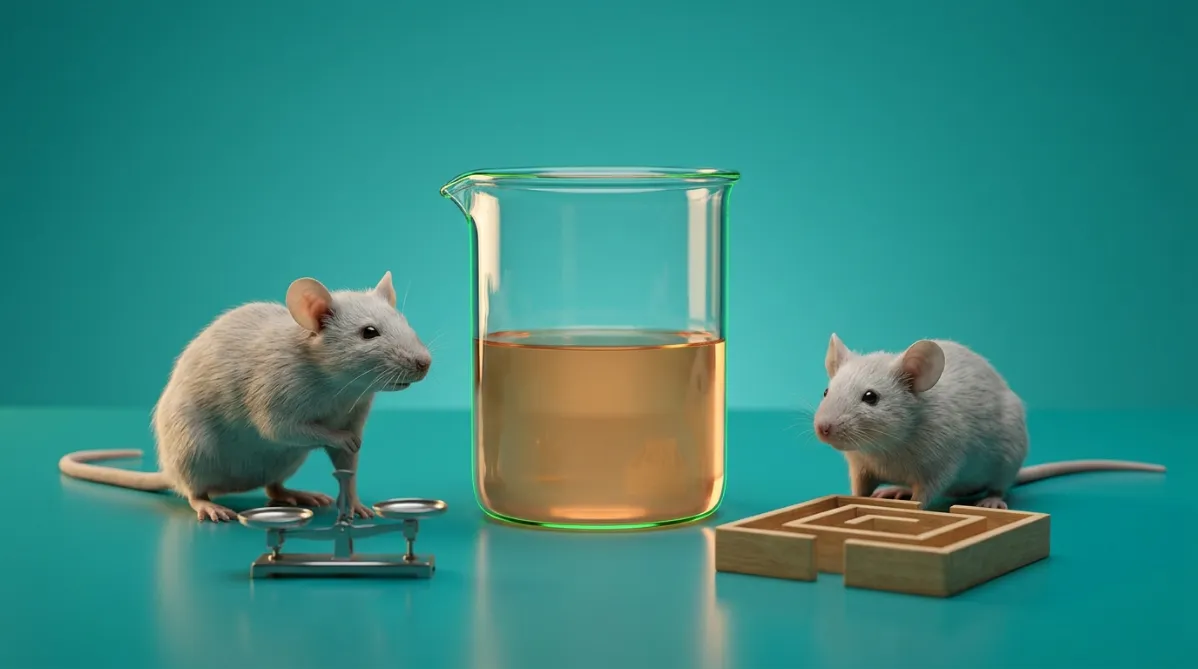
A ketone ester gave aged mice a very different payoff depending on sex: leaner bodies in males, better memory performance in females. The catch is that it was a mouse study. Nobody should read it as a recommendation to start buying ketone drinks.
The finding comes from a University of California, Davis team led by Roslund, Coates and senior author Carolyn Slupsky. It adds a new wrinkle to the idea that you can get some of the ketogenic diet's metabolic signal without giving up carbs.
What the researchers actually did
The team gave a diet containing the ketone monoester (R)-3-hydroxybutyl (R)-3-hydroxybutyrate to 24-month-old male and female C57BL/6 mice. That is very old for a laboratory mouse. The supplementation was described as short-term. The goal was to see how the ester affected physical function, metabolism and age-related memory.
The motivation is practical. The ketogenic diet raises β-hydroxybutyrate (β-HB), a molecule that works as both an energy source and a signaling compound with immune-modulating effects. But the authors note that clinical evidence for ketogenic and ketone-based approaches in cognitive aging and Alzheimer's disease is mixed. Strict carbohydrate restriction may also be hard for older adults to sustain. Supplements that raise β-HB, such as medium-chain triglycerides and ketone esters, have been floated as alternatives. Until now, how they behave differently in males and females during aging has been poorly defined.
The shared result: more ketones, lower glucose
In both sexes, the ketone ester diet raised postprandial β-HB and lowered postprandial glucose. The supplement did what it was designed to do biochemically. After that, the sexes diverged.
The split: fat loss in males, memory signals in females
Males: the intervention changed body composition. The mice had lower body fat and higher relative lean mass. Note the wording. This is a shift in composition, and the abstract doesn't say the males simply lost weight.
Females: the intervention was associated with fewer primary errors on the Barnes maze, a spatial learning and memory test. It was also associated with lower hippocampal IL-1β expression. IL-1β is an inflammatory signaling molecule, and the hippocampus is a brain region central to memory.
The words "associated with" matter here. The abstract reports a pattern, not proof that lower IL-1β is why the females performed better.
Under the hood: different metabolic fingerprints
The sex-specific effects came with differences in fasting metabolite profiles across tissues and biofluids. The researchers also found altered hippocampal oxylipins, which are lipid-derived signaling molecules involved in inflammation. Together, these suggest males and females process the same ketone load differently, though the abstract doesn't say how.
What is a ketone monoester?
The compound used, (R)-3-hydroxybutyl (R)-3-hydroxybutyrate, is a ketone monoester. Your body can break it down into β-HB, the main circulating ketone, without you eating a ketogenic diet. Products built on this type of ester are sold as drinks or shots, and they are marketed for energy, focus and performance. Mouse chow containing a compound is not the same as a human drinking a commercial product, so don't treat this study as validating any specific brand.
What we know in humans (and what we don't)
The study itself is clear on this point: further studies are needed to determine whether ketone monoester supplementation has similar sex-specific effects in humans. Nothing in the paper establishes a human dose, timing or benefit.
From the broader human literature, the general picture is that ketone esters can raise blood β-HB quickly and can lower blood glucose in the short term. Clinical evidence for cognition in aging and Alzheimer's disease, as the authors themselves say, remains mixed. Drinks of this type are also commonly reported to taste unpleasant and to cause stomach upset in some people. Check the product label and the research on that specific product rather than relying on this paper.
Practical takeaways
- Dose and timing: the study offers no human dose or timing guidance. Mice ate a ketone-ester-containing diet, and scaling that to a human drink isn't straightforward. If you try a commercial product, follow its label and start low.
- Who might cautiously experiment: generally healthy adults curious about ketones who want to avoid strict keto and are willing to discuss it with a clinician first. Treat it as an experiment, not a treatment for memory decline.
- Who should probably skip it or ask a doctor first: people with diabetes or on glucose-lowering medication, since the ester lowered glucose in mice. Also people with a history of eating disorders, kidney or liver conditions, or who are pregnant or nursing. Anyone managing Alzheimer's or another diagnosed condition shouldn't swap in a supplement for medical care.
- Manage expectations: the mouse data suggest men and women might not respond the same way. Don't assume a benefit seen in one sex applies to you.
The bottom line
This is an early, compelling hint that sex may shape how aging bodies respond to ketone supplementation. It is also exactly that: a hint, from aged mice, in a short-term study. The authors call for more work on mechanisms, physiological changes and translational relevance. Until human trials arrive, the ketone drink that apparently helped old female mice navigate a maze and old male mice carry less fat remains a research question, not a recommendation.
Source: Roslund KJ, Coates LC, et al. "Ketone ester supplementation in aged mice produces sex-specific cognitive and metabolic effects." GeroScience, 2026. DOI: 10.1007/s11357-026-02546-8. PubMed: 42776386. The authors declare no competing interests.