Quercetin gets most of the attention in the flavonoid aisle. A 2025 analysis of U.S. national survey data points to two less famous relatives: isorhamnetin and luteolin. People who consumed more of them reported fewer sleep disorders. Isorhamnetin also tracked with longer sleep. Before anyone buys a bottle, though, the study design matters a great deal.
What the researchers actually did
The paper, published in the Journal of Nutritional Biochemistry (Qi et al., 2025), is a cross-sectional analysis of the U.S. National Health and Nutrition Examination Survey (NHANES). It used the 2007-2010 and 2017-2018 cycles and included 10,162 participants.
Intake of 29 different flavonoids was estimated from the average of two 24-hour dietary recall interviews. The outcomes were sleep disorders and sleep duration. The team used survey-weighted generalized linear models and restricted cubic splines to look for linear and nonlinear patterns. They also ran sensitivity and stratified analyses to test how robust the results were.
Of 29 compounds, two stood out for sleep disorders, and a few others showed patterns with sleep duration.
The headline numbers: isorhamnetin
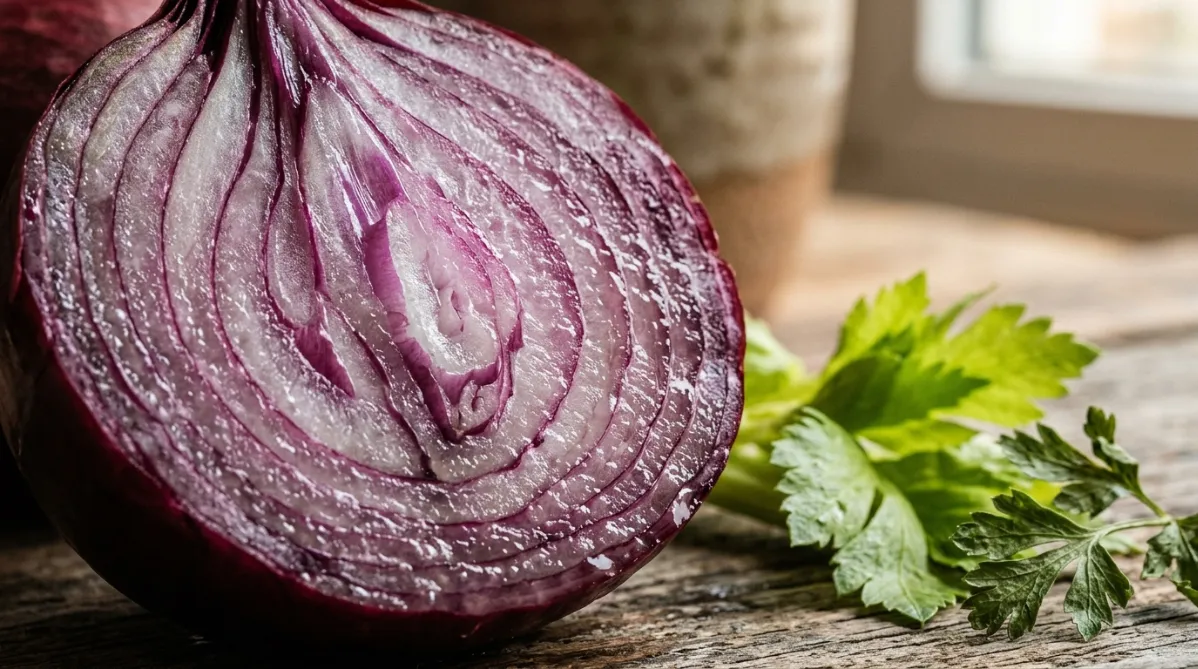
Isorhamnetin is a methylated metabolite of quercetin. It occurs in foods such as onions, pears and sea buckthorn. After adjustment for covariates:
- Highest vs. lowest tertile of intake: odds ratio (OR) for sleep disorders of 0.754 (95% CI 0.651-0.874; P for trend <.001). That is roughly 25% lower odds.
- Continuous intake: OR of 0.944 (95% CI 0.893-0.999), a small effect with a confidence interval that only just excludes 1.
- Sleep duration: higher isorhamnetin tertiles were positively associated with sleep duration (β = 0.125; 95% CI 0.042-0.208; P for trend = .004). The relationship was nonlinear (P non-linear = .0001), so more was not simply better in a straight line.
The supporting act: luteolin
Luteolin also showed an inverse association with sleep disorders:
- Highest vs. lowest tertile: OR 0.851 (95% CI 0.732-0.989; P for trend = .031), roughly 15% lower odds.
- Continuous intake: OR 0.903 (95% CI 0.822-0.991).
The luteolin findings are statistically significant but modest. The upper confidence limits sit close to 1, so they deserve more caution than the isorhamnetin tertile result. Earlier animal work has suggested luteolin may promote sleep, which gives the finding some biological plausibility. Animal data is a long way from proof in humans, though.
The authors also reported that eriodictyol showed a nonlinear relationship with sleep duration, alongside isorhamnetin.
Who seemed to benefit most?
Stratified analyses suggested the associations were not uniform. Luteolin's effect varied across body mass index levels. Isorhamnetin's effect differed by age, gender and race. The abstract does not spell out which groups showed stronger or weaker links, so these should be treated as hypotheses to test, not as guidance on who should eat what.
Foods vs. supplements: an important distinction
The intake figures came from dietary recalls, which means foods and beverages, not supplement capsules. Nothing in this study tests an isorhamnetin or luteolin pill. A person eating more onions, pears or herbs differs in many ways from a person who takes an extract. Diet quality, activity level, and other plant compounds and nutrients may all travel together with higher flavonoid intake.
This matters because a flavonoid-rich diet can be a marker of a generally healthier lifestyle, and healthier lifestyles go with better sleep. Statistical adjustment helps but cannot fully remove that confounding.
Limitations to keep in mind
- Cross-sectional design. Intake and sleep were measured at roughly the same time, so the study cannot show that flavonoids improve sleep. Reverse causation is possible: people with poor sleep may change what they eat.
- Self-reported outcomes. Sleep disorder status and sleep duration were not measured with sleep-lab equipment.
- Dietary recall error. Two 24-hour recalls capture only a snapshot of usual intake, and recalls are prone to misreporting.
- Residual confounding. The models adjusted for covariates, with dummy variables used for missing values, but unmeasured factors can remain.
- Many compounds tested. With 29 flavonoids examined, some chance findings are possible, though the authors report sensitivity analyses supporting robustness.
- No human trial data. There are no randomized controlled trials establishing an effective dose of isorhamnetin or luteolin for sleep.
On the plus side, the sample is large and nationally representative, the models account for the survey's weighting, and the authors declared no competing interests.
Practical takeaways
Dose: No evidence-based supplemental dose exists for sleep. The study does not provide one, and nobody should infer a dose from it. Any milligram figure on a supplement label for this purpose is extrapolation.
Timing: The study did not examine timing, such as evening versus morning intake, so there is nothing to base a recommendation on.
A reasonable food-first approach: If you want to act on this, the low-risk move is simply to eat more flavonoid-containing plant foods. Onions and pears are mentioned as isorhamnetin sources. Luteolin is found in a range of vegetables and herbs. This fits general healthy-diet advice and does not depend on this one study being right.
Who it may be relevant for: Adults curious about diet and sleep, and anyone already looking to add more plants to their meals.
Who should skip or check first:
- People considering concentrated flavonoid supplements, especially if pregnant or breastfeeding, or taking prescription medication. Talk to a clinician or pharmacist first, because plant extracts can interact with drugs.
- Anyone with persistent insomnia, loud snoring, or daytime sleepiness. These call for medical evaluation, not a supplement experiment.
- Anyone expecting a quick fix. The observed associations were modest.
The bottom line
This study adds isorhamnetin and luteolin to the list of dietary compounds worth studying for sleep, and it hints that quercetin's lesser-known cousins may matter. It does not show that either compound improves sleep, and it says nothing about supplements. The next step is well-designed trials that test specific foods or defined doses against placebo and measure sleep objectively. Until then, the evidence supports food-first curiosity, not a new supplement purchase.