Biocracked
Approach: macro science (with a conceptual split). Palette: D, bold color field.

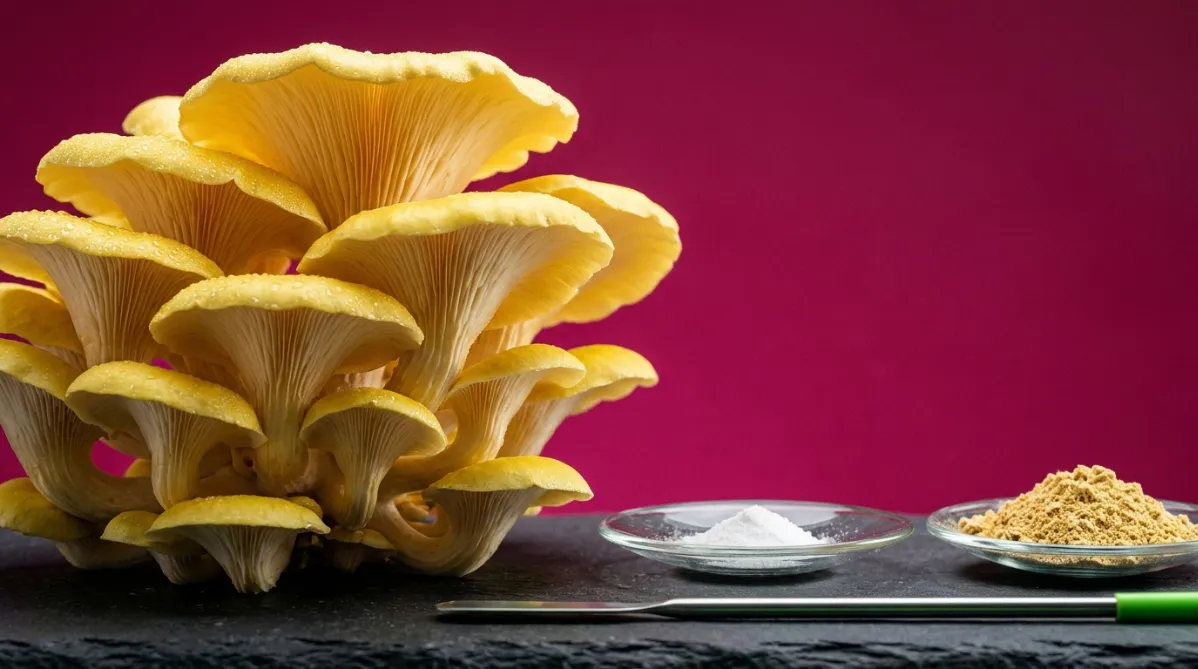
Extreme close-up photograph of a cluster of golden oyster mushrooms (Tamogitake), their ruffled, canary-yellow caps and fine gill structures sharply detailed, shot at a slight low three-quarter angle against a saturated magenta backdrop. In the foreground, a small glass watch dish holds a pinch of fine white crystalline powder, the isolated compound, sitting plain and inert beside a heap of fawn-yellow dried mushroom powder in a second dish. Soft directional studio light from the upper left gives the caps a translucent glow and creates crisp, short shadows. Tiny dew-like droplets cling to the gills. A single thin electric green stem of a lab spatula glints at the edge of the frame. Mood: curious, vivid, quietly skeptical, with the mushroom clearly outshining the isolate. No text or labels.
Research

This Mushroom Cut Liver Fat in Rodents—Its Star Compound Didn't

Nova Chen · · 4 min read

Rodent-only research. Everything below comes from experiments in rats and mice. None of it shows that golden oyster mushrooms lower liver fat, cholesterol, or disease risk in people.

Ergothioneine has become one of the most talked-about compounds in the longevity world, and mushrooms are its best-known dietary source. So a new rodent study has a plot twist for supplement shoppers. The mushroom lowered liver fat in the animals. The purified ergothioneine, given on its own, did not.

The paper, published in Food, Nutrition and Health (DOI: 10.1007/s44403-026-00089-6), tested Tamogitake, also sold as golden oyster mushroom (Pleurotus cornucopiae var. citrinopileatus). It compared the whole mushroom with isolated ergothioneine, and the results suggest the mushroom does something the single compound can't account for.

The Setup: A Mushroom Famous for One Molecule

Tamogitake is an edible mushroom rich in ergothioneine, a sulfur-containing amino acid. Ergothioneine has been linked in earlier research to anti-inflammatory effects and improved cognitive function, largely through its antioxidant activity. The authors point out that the benefits of eating Tamogitake itself were still unclear. They wanted to know what the mushroom does to lipid metabolism, meaning how the body handles cholesterol and triglycerides (triacylglycerol).

Experiment 1: Rats and a 5% Mushroom Diet

The team fed four-week-old male Sprague-Dawley rats an AIN-76-based diet containing 5% dried Tamogitake powder. Some diets also contained 0.5% added cholesterol, and the feeding lasted four weeks.

The rats eating Tamogitake showed:

  • Significantly lower liver weight
  • Significantly lower hepatic cholesterol
  • Significantly lower hepatic triacylglycerol

These effects appeared with or without the added dietary cholesterol. The researchers also checked hepatic mRNA expression of HMG-CoA reductase, the rate-limiting enzyme in cholesterol synthesis (and the statin target), and CYP7A1, a key enzyme in converting cholesterol to bile acids. Neither changed. The mushroom's effect therefore doesn't seem to come from the most obvious gene-level switches in liver cholesterol metabolism, and the mechanism remains open.

Experiment 2: The Plot Twist in Obese Mice

The second experiment was harder on the mushroom. The researchers used three-week-old male KK-Ay mice, a model of obesity and hyperglycemia whose livers accumulate excess lipids. For 52 days, the mice ate diets with 0.5% cholesterol plus one of two additions:

  1. 5% Tamogitake powder, or
  2. 0.05% pure ergothioneine.

The mushroom's liver-lowering effect on cholesterol and triacylglycerol reproduced in these mice, even though their livers were prone to fat buildup. The ergothioneine diet did not produce that effect.

The abstract doesn't say how the ergothioneine dose compared with the amount in the mushroom powder, so it would be wrong to read this as proof that ergothioneine does nothing in the liver. The authors' own conclusion is more measured: the benefits of Tamogitake "cannot be attributed to ergothioneine alone."

A Clue From the Fecal Data

The researchers also measured what the animals excreted. Fecal excretion of apparent total cholesterol and free fatty acids tended to be higher with Tamogitake feeding, but not with ergothioneine feeding. Bile acid excretion was not increased.

The word "tended" matters here, because it signals a trend rather than a firm effect. Still, it hints that something in the whole mushroom may reduce how much fat and cholesterol the body keeps, perhaps by affecting absorption or handling in the gut. This is speculation, since the paper doesn't establish the mechanism. Mushrooms contain fibers and many other compounds besides ergothioneine, and the study doesn't pin down which one is responsible.

Blood glucose and serum insulin did not differ significantly among groups. The mushroom's effect was on liver lipids, not on glycemic measures, at least in this experiment.

Why This Matters for the Supplement Conversation

The broader lesson is familiar in nutrition science. A food is not just its most famous molecule. When a headline compound gets isolated and sold in capsules, there's an implicit assumption that the capsule delivers the food's benefits. This study is a small, animal-based counterexample. In these rodents, the whole mushroom did something the purified compound did not.

The finding doesn't make ergothioneine supplements useless, and it doesn't test the cognitive or anti-inflammatory effects reported elsewhere. It says that, for liver fat in these models, ergothioneine wasn't the active ingredient, or at least not the only one.

Practical Takeaways

Whole food vs. isolated ergothioneine

If the goal is to get what the mushroom offers, this study favors the mushroom over the isolate. Whole foods contain many compounds that may work together, and this experiment supports that idea, but only in animals.

How to eat golden oyster mushrooms

The paper used dried powder, not cooked dishes, so it offers no guidance on preparation. As general culinary practice, golden oyster mushrooms are typically cooked, for example sautéed, roasted, or added to soups and stir-fries, and cooking mushrooms thoroughly is standard food-safety advice. Don't expect a stir-fry to replicate the experiment.

Why 5% of the diet is a lot

In the rodent diets, the mushroom powder made up 5% of the feed. That is a constant, substantial share of everything the animals ate, every day, for four weeks in rats and 52 days in mice. It is not a garnish or a weekly side dish. Rodent diets are also formulated differently from human diets, so there is no simple conversion to a human portion, and this article doesn't offer one. The study doesn't establish a human dose.

Who might care

People worried about fatty liver or high cholesterol will find this topic interesting, but it is not a treatment. Fatty liver disease and lipid disorders need proper evaluation. If you have risk factors, such as obesity, high blood sugar, or abnormal liver tests, see a doctor rather than relying on a mushroom powder or a supplement.

The Bottom Line

This study shows that, in rats and obese mice, golden oyster mushroom powder lowered liver cholesterol and triglycerides, and pure ergothioneine at 0.05% did not. The fecal data hint at a gut-level mechanism, and the lack of change in HMG-CoA reductase and CYP7A1 expression suggests the mushroom isn't acting through those obvious routes. Whether any of this applies to people, at realistic portions, is an open question that only human trials can answer.
Original study

Read the original research on doi.org →

This article summarizes published research for general information. It is not medical advice.

NC

Written by

Nova Chen

Nova Chen writes for Biocracked: biohacking science, longevity & human performance.

Related Articles

Approach: macro science. Palette: warm (amber and copper).

Extreme close-up of a freshly sliced king oyster mushroom stem and gill edge, shot at a slight 30-degree overhead angle with a macro lens and shallow depth of field. The pale cream flesh shows individual fibrous hyphae and glistening moisture beads. Warm low-angle golden light rakes across from the left, turning the gill ridges into amber and copper lines with deep honey-brown shadows. A single tiny droplet on the cut surface catches a pinpoint of electric green reflection, as if lit from a hidden source. Background melts into out-of-focus burnished orange and chocolate tones. The mood is quiet, intimate and investigative, with real organic texture and no text.
longevity

Mushroom 'Longevity Vitamin' Raised NAD+ in Aged Rats via H2S Switch

BY HELIX WARD ·

Ergothioneine, the mushroom compound nicknamed the 'longevity vitamin,' just got a mechanism to match its buzz. In a Cell Metabolism study, aged rats given ET ran farther, gained vascularization and muscle, and showed higher muscle NAD+. The effect traced back to a hydrogen sulfide pathway: CSE, persulfidation, and the enzyme cGPDH. Knock out CSE or cGPDH and the benefits vanished. But this is animal and lab work, and the effective rat dose scales to roughly 10x what supplements typically provide.

Approach: Conceptual metaphor, palette D (bold color field).

A single halved blood orange and a single halved yellow kiwi-style golden kiwi sit side by side on a saturated magenta seamless backdrop, shot from a low three-quarter angle with shallow depth of field. Between them, a thin, slightly cracked glass pane stands upright, partly dividing the two fruits to suggest "association, not cause." Glistening juice vesicles in the orange flesh catch crisp, directional studio light from the upper left, throwing a sharp, short shadow across the glossy magenta surface. A tiny electric green sprig of a fresh leaf rests at the base of the glass as the only green accent. Colors are juicy, vivid and contrasting: magenta, orange, gold. Mood is curious, clean and quietly skeptical, with a food-as-evidence feel. Photorealistic, tactile textures, no text or labels.
research

Vitamin C and E Linked to 18% Lower Alzheimer Risk, With a Catch

BY NOVA CHEN ·

In the Rotterdam Study of 5,395 older adults, higher dietary vitamin C and vitamin E intake were each linked to roughly 18% lower Alzheimer risk per standard deviation. The pattern looked strongest among smokers, where beta carotene and flavonoids also stood out. But this was an observational study of food intake, not pills, so it shows association rather than cause. Some of the headline smoker numbers also have confidence intervals that cross 1.0. Here is what the data actually say, which foods supply these nutrients, and where supplements do and do not fit.

Approach: the human outcome. Palette: bold color field.

Close-up of an older person's weathered hands, shot from slightly above and to the side, wrapped around an electric green enamel mug against a flat saturated mustard-yellow wall. The fingers show a faint tremor. The mug and knuckles are sharp, while the fingertips and the surface of the tea have a soft motion blur. The face is out of frame, with only a grey wool cardigan cuff visible. Low-angle, soft window light from the left casts a gentle warm shadow on the wall and picks out the skin's creases, veins and age spots. The mood is quiet and sober, with a hint of disappointment. The image is photorealistic and uncluttered, with generous empty yellow space on the right, no text and no pills.
research

The Biggest NAD+ Booster Trial in Parkinson's Just Backfired

BY LYRA VOSS ·

Nicotinamide riboside (NR), sold as Niagen and Tru Niagen, is one of the most popular longevity supplements on the market. It has now faced its largest test in a neurological disease, and it lost. In the phase 3 NOPARK trial, published in JAMA in October 2026, people with early Parkinson disease who took NR did slightly worse than those on placebo. The effect was small, but the direction was the opposite of what the field hoped for.

Approach: macro science, a lithium-themed image built around the actual metal and tissue. Palette: bold color field in saturated teal.

Extreme close-up photograph of a single freshly cut piece of silvery lithium metal, its surface partly tarnishing to grey and matte black at the edges, resting on a thin slice of translucent brain tissue on a glass microscope slide. The slice shows fine pink-grey folds and a few dark clumped plaque-like specks. The backdrop is a smooth saturated teal field, with the slide placed diagonally. Shallow depth of field keeps the metal edge razor sharp while the tissue softens toward the corners. Lighting is a crisp, slightly warm side light from the left, with a small specular highlight on the metal and a soft shadow on the teal. A tiny electric green reflection glints in the glass edge. The mood is quiet, investigative and precise. Shot from a low 30-degree angle, with no text or labels.
research

The Trace Mineral That Vanishes From the Brain Before Alzheimer's

BY DR. SYNAPSE ·

A landmark Nature study from Harvard found that lithium was the only metal significantly depleted in the brains of people with mild cognitive impairment. In mice, cutting lithium by about half triggered amyloid buildup, tau pathology, inflammation, and memory loss, while low-dose lithium orotate prevented it. The compound appears to evade the amyloid plaques that trap other lithium salts. But the supplement results are mouse-only, with no human trial yet, and lithium carries real kidney, thyroid, and interaction risks. Here is what the study shows, what it doesn't, and what to watch next.

This page is available in