Biocracked
**Approach: Macro science. Palette: Bold color field (saturated magenta).**

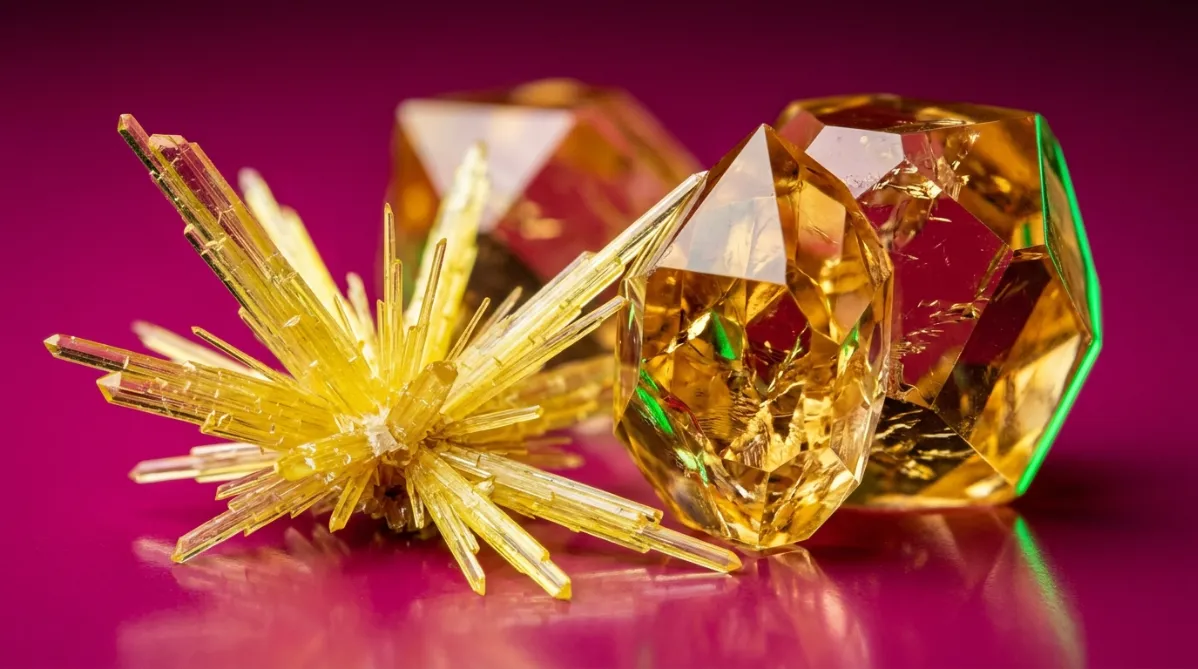
Extreme macro photograph of fisetin-like yellow needle crystals growing from a single point, with two larger, more geometric, translucent amber-gold crystals standing slightly apart as the "upgraded" versions. The crystals show real facets, internal fractures and sharp refractive edges. They rest on a glossy, saturated magenta surface that fills the background in a smooth gradient and reflects a faint mirror image of the crystals. Shot from a low three-quarter angle with a shallow depth of field, so the foreground crystal tips are razor sharp and the rest melts into soft magenta bokeh. Lighting is a crisp, warm-white key from the upper left, with strong specular highlights and a thin rim of electric green (#00e676) light catching one crystal edge. Mood: precise, curious, and slightly skeptical, like a lab specimen under scrutiny.
Longevity

Fisetin Not Strong Enough? Scientists Built Two Upgraded Versions

Dr. Synapse · · 4 min read

If you take fisetin for "cellular cleanup," a new paper from the University of Minnesota has an awkward message: the researchers say fisetin's efficacy is suboptimal and its bioavailability is poor. So they built two upgraded cousins. The catch is that you can't buy them, they've only been tested in cells and mice, and the people who made them stand to profit.

What the researchers actually did

The study, published in Aging Cell, comes from a team including Laura Niedernhofer and Paul Robbins at the Masonic Institute on the Biology of Aging and Metabolism. They started with fisetin, a natural flavonoid that has already moved into clinical trials as a senolytic. Senolytics are agents meant to selectively eliminate senescent cells, the "zombie" cells that stop dividing but linger and are linked to aging and many age-related diseases.

The authors' premise is blunt. Fisetin is promising, but they describe it as limited by suboptimal efficacy and poor bioavailability. Using what they call an integrative phenotypic drug discovery approach, they developed two fisetin-derived flavonoid compounds, SR29384 and SR31133.

Phenotypic drug discovery means screening compounds for a desired effect in cells or organisms, here the clearance of senescent cells, rather than designing a drug against one pre-chosen target.

The headline findings

According to the abstract, the new compounds:

  • Showed enhanced senolytic activity compared with the fisetin starting point
  • Targeted a broad range of senescent cell types
  • Reduced tissue senescence in mouse models of aging
  • Improved healthspan-associated parameters in those mice

The abstract does not give effect sizes, so this article doesn't either. The authors' own summary is that the compounds have "high translational potential," which is a statement of hope, not a demonstrated result in people.

How might they work?

The team combined transcriptomics, machine learning, network pharmacology and molecular docking to guess at the mechanism. Their analysis suggests the compounds may act on:

  • PARP1
  • CDK2
  • Possibly BCL-xL

The result, they propose, is selective induction of apoptosis (programmed cell death) in senescent cells. Note the hedged language: "may target" and "possibly." Much of this evidence comes from computational and network-based methods, which generate hypotheses rather than settle them.

BCL-xL is a protein family member often discussed in senolytic research because senescent cells tend to rely on pro-survival pathways to stay alive. Blocking those pathways can tip them into dying. The paper's cautious wording on BCL-xL suggests that part is still unconfirmed.

Read the fine print: mice, patents and conflicts

This is where the clickbait question "is fisetin useless?" needs a sober answer.

It's preclinical. The work is in cells and mouse models. There are no human data on SR29384 or SR31133 in this paper.

You can't buy these compounds. They are experimental research molecules, not supplements. Anything online claiming to sell them should be treated with serious suspicion.

There's a financial angle. The conflict-of-interest statement says Niedernhofer and Robbins are cofounders of Itasca Therapeutics, a company developing senotherapeutics for aging and age-related diseases. Several authors and the University of Minnesota have also filed a provisional patent on flavonoid analogs, including these two compounds, as a strategy to treat age-related diseases.

That doesn't invalidate the science. Academic-to-biotech pipelines are normal, and the disclosure is exactly what transparency looks like. But it does mean the study should be confirmed independently, and readers should weigh the enthusiastic framing accordingly.

What this means if you take fisetin now

The paper doesn't say fisetin is worthless. It says fisetin progressed to clinical trials but has limits in efficacy and bioavailability, and that motivated the new designs. That's a reasonable reason to temper expectations, not necessarily to panic.

Forms people commonly buy: Fisetin supplements are typically sold as capsules, and some products use liposomal or other enhanced-delivery formulations aimed at the absorption problem. This paper did not test any commercial product, and it gives no guidance on dosing for humans. Doses and schedules on store shelves vary widely, and the study offers no basis for choosing among them.

Who might reasonably follow this research: People interested in senolytics who want to understand where the field is heading, and who are comfortable that current supplement use rests on limited human evidence.

Who should be cautious or skip it:

  • Anyone who is pregnant or breastfeeding
  • People on prescription medications, especially blood thinners, or with serious medical conditions, who should talk to a clinician before taking any senolytic-style supplement
  • Anyone hoping that taking more fisetin will mimic what these new compounds did in mice. The study gives no reason to believe that
  • Anyone tempted to buy "next-generation fisetin" from gray-market sellers

The bigger picture

The study reflects a broader pattern in longevity science: a natural compound shows biological promise, then chemists try to improve on it. Whether SR29384 and SR31133 survive toxicology, pharmacokinetics and human trials is unknown. Many compounds that look strong in mice fail later.

What to watch for next: independent replication, published safety data, and any move toward human trials by Itasca Therapeutics or others. Until then, treat this as a promising lead in the senolytic field, not a reason to change your supplement stack.

This article is for informational purposes and is not medical advice.
Original study

Read the original research on pubmed.ncbi.nlm.nih.gov →

This article summarizes published research for general information. It is not medical advice.

DS

Written by

Dr. Synapse

Dr. Synapse writes for Biocracked: biohacking science, longevity & human performance.

Related Articles

Approach: macro science. Palette: bold color field (violet).

Extreme close-up of fisetin crystals, a small cluster of pale yellow needle-like flavonoid crystals with translucent, faceted edges, resting on a smooth glossy deep violet surface. The camera sits low at a shallow three-quarter angle with a very shallow depth of field, so the front crystals are razor sharp and the rest dissolves into soft magenta-violet blur. Lighting is a single crisp, slightly warm studio key from upper left that makes the crystal edges glow and throws long soft shadows across the violet. A few tiny electric green (#00e676) specks of reflected light catch on the crystal tips. The mood is precise, curious and quietly promising, like a sample under inspection, with plenty of clear violet space on the right side of the frame.
longevity

Fisetin Senolytic Extended Mouse Lifespan—Human Proof Still Missing

BY HELIX WARD ·

Fisetin, a plant flavonoid, emerged as the most potent senolytic among ten compounds in a widely cited 2018 EBioMedicine study. In aged mice, treatment late in life reduced senescence markers, eased age-related pathology and extended both median and maximum lifespan. The catch is that this is mouse and lab evidence, not a completed human longevity trial. This article explains what the researchers found, what the dosing context really means, and who should pay attention as human studies develop.

Approach: macro science. Palette: bold color field.

An extreme close-up microscopy-style photograph of a cross-section of mouse trabecular bone, a honeycomb lattice of fine mineralized struts and open pores, with real fibrous texture and tiny cell clusters on the surface. The tissue is stained a rich magenta-pink and set against a saturated deep teal backdrop, so the two colors contrast strongly. Slightly high-angle view with a shallow depth of field, so the front struts are razor sharp and the lattice melts into soft teal blur behind. Lighting is bright, even and slightly translucent, as if lit from below on a microscope stage, with crisp edge highlights. A few tiny electric green fluorescent dots mark stem cells nestled in the lattice. Mood: precise, hopeful, quietly dramatic. No text, no labels.
longevity

Why Pairing Metformin With Taurine Beat Either Alone in Old Mice

BY NOVA CHEN ·

Metformin and taurine are two of longevity's most talked-about molecules, and a new mouse study tested them together on aging bone. In 18-month-old mice, the combination improved bone mass and trabecular structure more effectively than either compound alone. Bone marrow stem cells from treated animals also formed bone better, divided more, and showed fewer signs of senescence. A gene called Crebrf emerged as a candidate mediator. But this is mouse and cell research only, so it's no reason to change what you take.

Approach: conceptual metaphor. Palette: bold color field, a saturated teal backdrop.

A single brass door key sits in the lock of a matte white ceramic cup on a seamless saturated teal surface, shot at a low three-quarter angle with shallow depth of field. A thin curl of steam rises from the cup. A second, identical key lies snapped in half on the surface in front of it, as if the first key's lock has been jammed. The cup is a sculptural latte cup with a swirl of crema. The light is a soft, hard-edged studio key from the upper left, casting a crisp, long shadow across the teal. A tiny electric green (#00e676) bead of light glints on the brass key's tip. The mood is quiet, curious and slightly tense, a mechanism being blocked. No text, no logos, photorealistic, with real metal and ceramic textures.
supplements

Luteolin Hits Caffeine's Sleep Switch—Your Latte May Undo It

BY NOVA CHEN ·

Most natural sleep aids lean on GABA, but luteolin appears to work through a different switch: the adenosine receptors caffeine blocks. In mice, it shortened sleep latency, lengthened total sleep time and boosted NREM sleep, and caffeine almost completely cancelled the effect. That raises an intriguing question about your afternoon coffee, though the study never tested coffee. This is strictly a mouse study, and the ~15–25 mg human-equivalent figure is only an estimate. Here's what the paper showed, what it didn't, and how a careful biohacker might think about it.

A wide landscape editorial photograph of a minimalist laboratory-meets-wellness still life on a pale, warm-gray stone countertop, softly lit by diffused morning window light from the left. In the center foreground, a small amber glass supplement jar with a plain matte white label sits beside a scattering of fine white powder and a few loose white capsules on a ceramic dish. Next to it rests a clean, open notebook with faint hand-drawn line graphs, two diverging curves rising gently, one slightly higher than the other, drawn in muted sage-green and charcoal ink. A slim brass pen lies across the page.

In the soft-focus midground, a delicate glass beaker filled with clear liquid catches a thin streak of light, casting a gentle caustic shimmer across the stone. A sprig of dried eucalyptus and a small sliver of citrus peel add organic texture. Behind them, an out-of-focus wall of pale oat-colored tiles and a floating wooden shelf holds a few blurred ceramic vessels and a small potted fern.

The color palette is calm and editorial: warm creams, sage green, soft amber, muted terracotta accents, and touches of charcoal. Shallow depth of field with a crisp focus on the jar and notebook, creamy bokeh in the background. Subtle film-like grain, natural shadows, and generous negative space on the right third of the frame, suitable for headline overlay. The mood is thoughtful, measured, and trustworthy, like a contemporary science and wellness journal cover: modern, tactile, quietly optimistic, and grounded rather than hyped.
longevity

Calcium Alpha-Ketoglutarate Extended Female Mouse Lifespan by Up to 16.6%. Here's What That Does (and Doesn't) Mean for Humans

BY DR. SYNAPSE ·

A 2020 Cell Metabolism study found that feeding middle-aged mice a 2% calcium alpha-ketoglutarate diet extended female median lifespan by up to 16.6% and reduced frailty. The effect was smaller in the second cohort (10.5%), and male survival gains were not statistically significant. Researchers link the benefit to lower systemic inflammation and a proposed rise in IL-10. But this was a mouse-only study, and it does not establish that AKG extends human lifespan. Here is what the data show, how they differ from supplement marketing, and why CaAKG belongs on a research watchlist rather than in a proven protocol.

This page is available in