Biocracked
Approach: conceptual metaphor. Palette: bold color field.

A single glass hourglass stands center-frame on a saturated tomato-red seamless backdrop, photographed at a low three-quarter angle just above tabletop level. The upper chamber holds only a thin layer of pale sand, while the lower chamber is heaped with it. A narrow stream of fine grains falls through the neck, and a few of them glow faintly electric green (#00e676) as they pass the waist. Beside it, a second hourglass has been tipped onto its side, its sand motionless. This stands for the age cutoff. Soft, large-source studio light comes from the upper left and casts crisp, warm-grey shadows on the glossy red surface. Fine scratches and dust show on the glass. The shallow depth of field blurs the background hourglass slightly. The mood is playful but precise, curious and a little skeptical.
Supplements

2 Grams of Carnosine Boosted Brain Speed, But Only Under 35

Nova Chen · · 5 min read

A cheap, widely sold amino-acid supplement may have sharpened mental speed in healthy adults. The catch is that the effect showed up in only one age group, and it wasn't the one you'd expect.

Researchers analyzing data from a randomized, placebo-controlled trial found that 2 grams of carnosine a day was linked to better overall cognitive speed and efficiency in adults aged 23 to 35. Adults aged 36 to 50 and 51 to 65 showed few or no significant gains. The paper, published in Neurotherapeutics in 2025, comes from the University of Louisville team behind the NEAT trial.

Before anyone orders a bottle, here is what the study did and didn't show.

The twist: a brain study hiding inside a pollution trial

The cognition result wasn't the point of the original experiment. The parent study, the Nucleophilic Defense Against PM Toxicity (NEAT) trial (NCT03314987), was designed to test whether carnosine could blunt the harmful effects of particulate matter, the fine particles in air pollution. Carnosine is a nucleophilic dipeptide, a type of molecule that can neutralize reactive compounds produced by oxidative stress. That is the rationale for testing it against pollution toxicity.

The cognitive testing was added as a post-hoc secondary outcome. The researchers looked at brain performance after the trial design was set, which matters a great deal for how much weight the finding deserves (more on that below).

How the study worked

  • Design: Randomized, placebo-controlled clinical trial
  • Intervention: Carnosine capsules, 2 g daily, versus a cornstarch placebo
  • Duration: Up to 12 weeks
  • Participants: 299 people randomized. Usable cognitive data came from 242 at the first follow-up (about week 6) and 231 at the second (about week 12)
  • Age strata: 23–35, 36–50 and 51–65 years
  • Cognitive measure: The Cognition test battery, ten individual tests that each engage specific brain systems across a range of domains. Speed, accuracy and efficiency were scored for the whole battery and for each test
  • Testing schedule: Baseline before randomization, then about 6 and 12 weeks into supplementation

The population was also notable for what it lacked. The authors describe it as largely free of susceptibility factors or pre-existing conditions. Earlier work suggested carnosine or beta-alanine might help certain elderly or at-risk groups. This trial asked whether it does anything in generally healthy adults.

What they found

When the researchers split participants by age, the youngest group (23–35) stood out:

  • Statistically significant improvements in overall speed and efficiency at both follow-up visits
  • Significant improvements in seven speed or accuracy scores across the individual tests
  • The two older groups showed few or no significant improvements

The authors concluded that carnosine "selectively improved high-level cognitive performance in young individuals."

The paper's abstract doesn't give effect sizes or per-group sample sizes, so this summary can't say how large the improvements were. "Statistically significant" doesn't tell you whether you'd notice a difference in daily life.

Why the age pattern is odd, and why to be skeptical

Most of the earlier excitement around carnosine centered on older or at-risk people, the groups where declining function leaves more room to improve. A benefit confined to the youngest adults runs against that expectation.

There are good reasons for caution:

  1. It's a post-hoc secondary analysis. The trial wasn't built to answer a cognition question.
  2. It's a subgroup finding. Slicing a trial into three age bands and testing many outcomes raises the odds of a chance result. The abstract doesn't describe how the authors adjusted for multiple comparisons.
  3. No mechanism is established. The abstract doesn't explain why younger brains would respond differently.
  4. It needs confirmation. A trial designed with cognition as the primary outcome, and age effects pre-specified, would be far more convincing.

The result is a hypothesis worth testing, not a recommendation.

Carnosine vs. beta-alanine: what's the difference?

Carnosine is a dipeptide made of two amino acids, beta-alanine and histidine. It is found naturally in muscle and brain tissue, and in meat and fish.

Beta-alanine is one of those two building blocks, and it is the limiting ingredient for making carnosine in muscle. That's why beta-alanine is a staple in sports supplements: taking it raises muscle carnosine. Its best-known side effect is paresthesia, a harmless tingling of the skin, which is why it is often dosed in smaller amounts through the day.

The NEAT trial tested carnosine itself, not beta-alanine. Whether beta-alanine would reproduce any cognitive effect isn't addressed by this study, and raising muscle carnosine isn't the same as raising it in the brain.

What this means for you

The dose tested: 2 g of carnosine per day, for up to 12 weeks. That is the only regimen with data behind this finding. The abstract doesn't specify timing or whether the dose was split, so there's no evidence-based timing advice to give.

Who might reasonably be curious: Healthy adults in roughly the 23–35 range who want to experiment, ideally after checking with a clinician. That is the group where the signal appeared. Even for them, the evidence is preliminary.

Who probably shouldn't expect much: Healthy adults over 35. In this analysis, the 36–50 and 51–65 groups showed few or no significant gains.

Who should skip it or talk to a doctor first: Anyone pregnant or nursing, anyone on medication, and anyone with a chronic condition. The trial population was largely healthy, so it says little about safety or benefit in other groups.

The cheaper alternative: Beta-alanine is generally less expensive and reliably raises muscle carnosine. But it's a different compound, it hasn't been shown here to improve cognition, and you may feel tingling. Treat it as a separate experiment, not a substitute with proven brain benefits.

Realistic expectations: Nothing here suggests carnosine is a "smart pill." The authors themselves frame it as improved performance on a lab test battery in one subgroup.

The bottom line

A randomized trial built to study air pollution produced a surprising side finding. Two grams of carnosine daily for up to 12 weeks was associated with faster, more efficient performance on a cognitive battery in adults aged 23 to 35, with little effect in older groups. It's intriguing, but it comes from a post-hoc subgroup analysis. Until a dedicated trial confirms it, treat it as a lead worth following rather than a reason to change your routine.

Original study

Read the original research on pubmed.ncbi.nlm.nih.gov →

This article summarizes published research for general information. It is not medical advice.

NC

Written by

Nova Chen

Nova Chen writes for Biocracked: biohacking science, longevity & human performance.

Related Articles

Approach 4, conceptual metaphor, in palette C, natural.

A single ceramic cup of freshly brewed green tea sits on a weathered wooden windowsill, photographed from a low three-quarter angle at eye level. Steam curls upward and catches soft, directional morning daylight from a window on the left. The tea is clear amber-green, with a few loose unfurled tea leaves resting on the saucer. Behind the cup, a softly out-of-focus garden of leafy green plants and a bright, hazy sky gives shallow depth of field. The wood has realistic grain and small chips, and the ceramic has a matte, slightly speckled glaze. A single tea leaf in the foreground has a faint electric green tint where light passes through it. The mood is calm, quiet and unhurried, with warm skin-tone wood against cool plant greens. No text, no labels.
supplements

L-Theanine Calms Without Sedation: What Doses Actually Work

BY NOVA CHEN ·

L-theanine, the amino acid in tea, is said to calm you without making you drowsy, and a new Frontiers in Nutrition mini-review tests that claim against human trial evidence. It reports doses of 100-400 mg for small cognitive gains (especially with caffeine), 200-400 mg/day for stress without sedation, and 200-450 mg/day for better sleep quality. The effects are small, and the paper does not report a pooled sample size. Both authors work for a British American Tobacco subsidiary that sells L-theanine products. Here is what the numbers say, who it may suit, and who should skip it.

Approach: conceptual metaphor. Palette: D, bold color field.

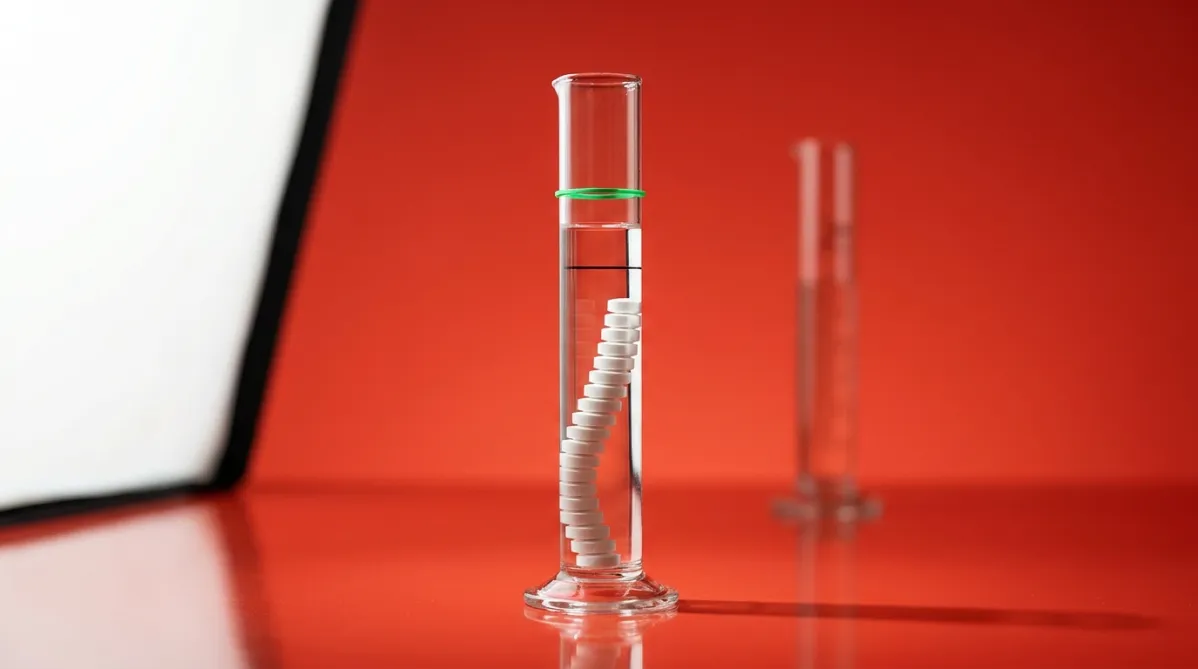
A single brass dial-style dosing syringe-free metaphor: a tall glass measuring cylinder, photographed straight on at eye level, filled with clear liquid and a column of stacked white tablets that rises in even steps and then stops short of a thin painted line, as if a staircase of doses has been held back. The glass cylinder stands on a glossy surface against a saturated tomato-red seamless backdrop. Soft large-softbox light from the left gives crisp highlights on the glass and a clean, short shadow on the right. A tiny electric green (#00e676) rubber band circles the cylinder near the top limit. Shallow depth of field blurs a second, taller cylinder in the background. Mood: controlled, restrained, quietly hopeful. No text, no markings legible.
supplements

Magtein Cut Opioid Dose Creep in Cancer Patients? What the Trial Found

BY NOVA CHEN ·

A magnesium supplement best known as a brain and sleep booster just showed up in a cancer pain trial. In 83 advanced cancer patients on oral opioids, those taking magnesium-L-threonate (L-TAMS, the compound sold as Magtein) saw their morphine doses climb about half as much over 90 days as those on placebo. The supplement also eased opioid-induced constipation. But this was a small, single-center study in a very specific group, and it is not a reason to change any medication without a doctor. Here is what the paper found, what it didn't, and who should be talking to a clinician.

Approach: conceptual metaphor. Palette: D, bold color field.

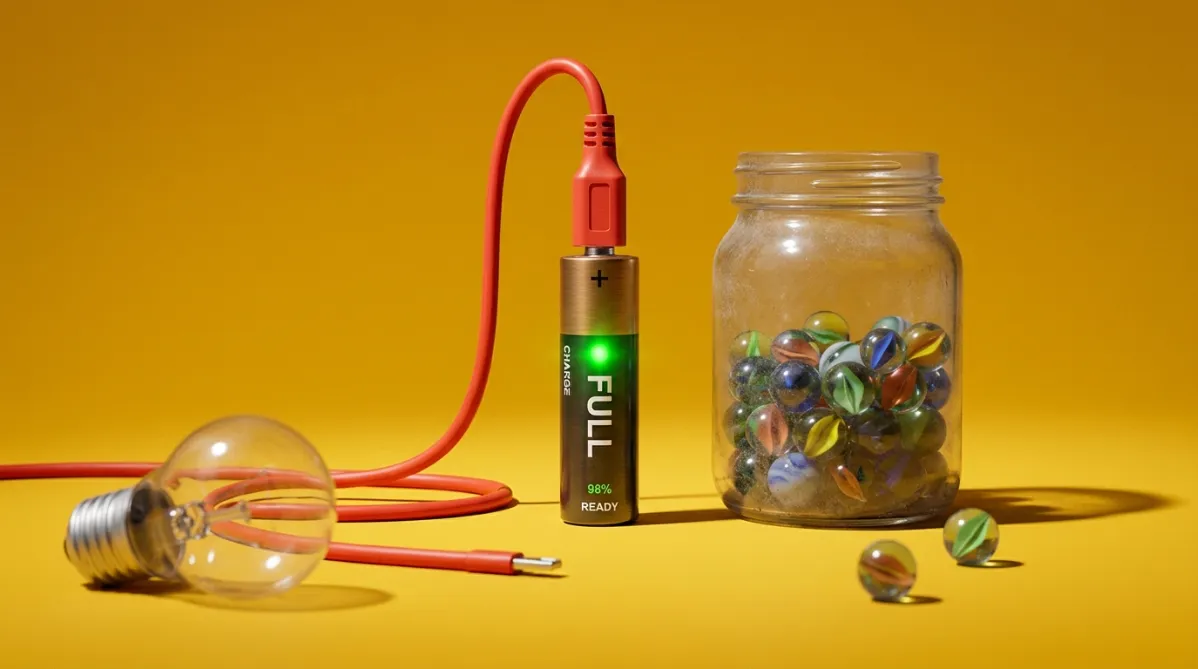
A single AA-style cylindrical battery stands upright, fully charged, on a seamless saturated mustard-yellow backdrop. Beside it sits a matching, untouched, slightly dusty glass jar of marbles, so the charge shows no visible link to any result. More precisely, a bright tomato-red extension cord plugs into the battery's top. Its other end curls away unconnected, lying on the floor beside an unlit incandescent bulb. A small electric green LED glows on the battery's side as the only green accent. Camera: low three-quarter angle, 50mm lens, shallow depth of field, with the bulb softly blurred in the foreground. Lighting: hard, clean studio key light from the upper left, with crisp shadows falling to the right on the yellow surface. Mood: puzzled, wry, a full power source that fails to light anything.
supplements

Nicotinamide Riboside Doubled NAD+ but Failed to Boost Memory

BY NOVA CHEN ·

A supplement doubled a key molecule in the blood, and memory didn't budge. In a 12-week randomized trial of older adults with amnestic mild cognitive impairment, nicotinamide riboside raised NAD+ twofold but did not improve cognition, total brain blood flow, or blood pressure. There was one tantalizing exploratory hint of increased hippocampal blood flow, but it's far from proof. Here's what the study really shows, where its limits are, and what it means if you're thinking about buying an NAD+ booster.

**Approach: Conceptual metaphor. Palette: D, bold color field.**

A saturated mustard-yellow seamless backdrop. In the center, shot from a slightly high three-quarter angle, a single old brass balance scale stands on a matte surface. One pan holds a small, glossy, translucent green glass sphere with a faint electric green (#00e676) glow inside, standing for the peptide's promise. The other pan holds a plain grey stone of similar size. The beam is almost level but tilts slightly toward the green side, so the result looks real but not decisive. Hard, directional studio light from the upper left casts crisp, defined shadows across the yellow. Fine scratches and patina show on the brass. The background is clean and the framing is wide, with open space on the right. The mood is curious, skeptical and balanced.
peptides

N-PEP-12 Brain Peptide: Memory Gains at 90 Days, But There's a Catch

BY NOVA CHEN ·

A 276-person randomized trial of the peptide supplement N-PEP-12 found that attention scores diverged from placebo over time in adults aged 50-75 with memory and focus complaints. At 90 days, both the 45 mg and 90 mg groups showed bigger gains in alertness, attention and memory omissions, with Digit Span scores also improving. But the main treatment effect wasn't significant on its own (p = 0.133), and the endpoint-level findings are officially exploratory. Side effects were infrequent and balanced across groups. Here's what the numbers show, who the evidence applies to, and what's still missing.

This page is available in