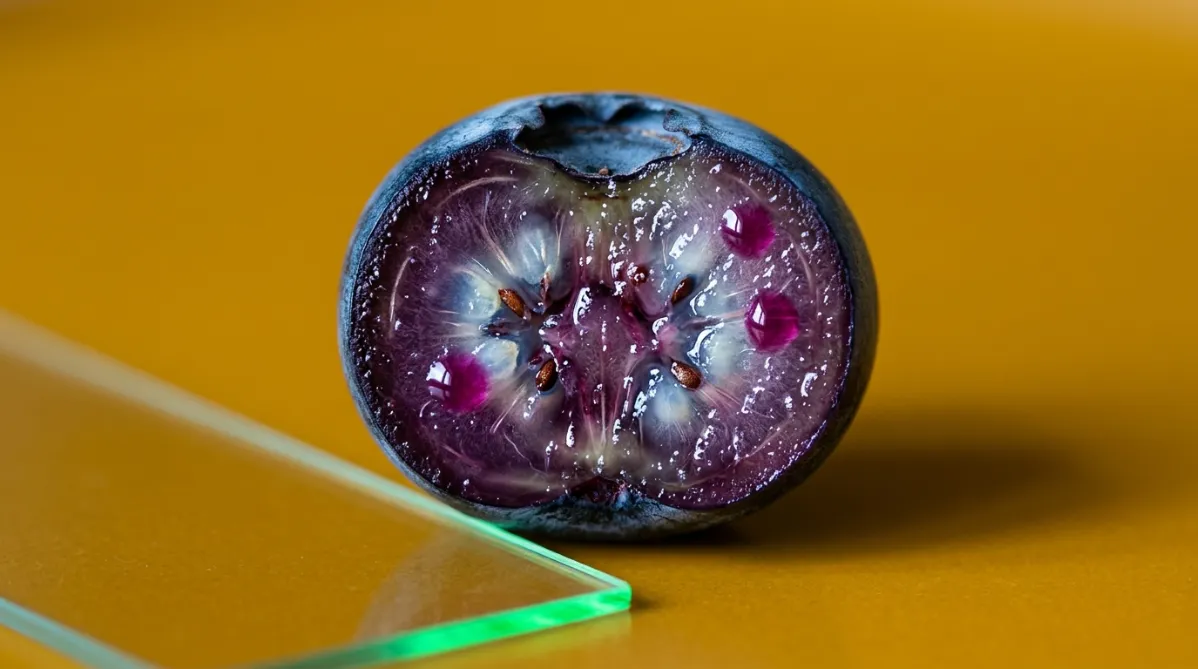
Blueberries may do something remarkable to aging testes. In mice. That caveat matters, and it comes before anything else.
A new study in the Journal of Cellular Physiology reports that a high-anthocyanin blueberry extract reversed signs of testicular aging in middle-aged mice. It also dialed down inflammation and raised NAD+, a molecule longevity researchers watch closely. It is a striking result. It is also a rodent study, and the abstract leaves out several details you would want before changing your supplement routine.
The Big Caveat: This Is a Mouse Study
Everything below comes from a middle-aged murine model. The researchers, from Nanjing Agricultural University and collaborating institutions in China, tested a Blueberry Anthocyanin Extract (BAE) in mice. They combined physiological monitoring, histopathology, and paired testicular transcriptomics and metabolomics.
No humans were involved, and nothing here shows that blueberries or anthocyanin supplements raise testosterone or protect fertility in men.
What the Researchers Say Happened
According to the abstract, BAE:
- Prevented age-associated physiological deterioration without detectable toxicity.
- Reversed seminiferous tubule degeneration. These are the tubules where sperm are produced.
- Restored sperm kinematics, meaning how sperm move.
The authors frame this as a restorative effect on the testicular "niche," the environment that supports spermatogonial stem cells, the cells that eventually give rise to sperm.
What About Testosterone and Dose?
The abstract does not report testosterone levels. It also does not give a dose, a duration, or a timing schedule for the extract. The full paper may include these details, but they are not in the public abstract, so they are not repeated here.
Anyone claiming this study proves blueberries boost testosterone, or quoting a "proven dose," is going beyond what the available text supports.
Three Mechanisms Working Together
The team says its multi-omics analysis pointed to three coordinated modules rather than one magic pathway.
1. A Growth Signal for Sperm-Producing Stem Cells
BAE engaged adenylyl cyclase-cAMP-PKA signaling, which in turn "licensed" canonical Wnt/β-catenin activity. The result was spermatogonial proliferation, supported by markers including PLZF, PCNA, c-Myc, and Ccnd1. In plain terms, the signals that tell sperm-forming stem cells to divide appeared to switch back on.
2. Calming Inflammaging
"Inflammaging" is the low-grade chronic inflammation that creeps in with age. In this model, BAE suppressed ROS-dependent IKK/NF-κB (p65) activation. It also lowered TNF-α and IL-6 in both testicular tissue and the systemic circulation, which the authors describe as resolving the pro-inflammatory niche.
3. Methionine Cycle Reprogramming and Higher NAD+
BAE reprogrammed the methionine cycle and elevated NAD+. That activated the AMPK-SIRT1-PGC1α axis while restraining leucine- and methionine-driven mTORC1 signaling. The authors argue this couples redox balance to cell-cycle re-entry.
NAD+ is a popular longevity target, but the abstract does not quantify the rise. It also does not say whether the NAD+ change drives the testicular benefits or simply accompanies them.
Why This Is Interesting
The authors call BAE a "dual-action, immunometabolic modulator." It appears to restart the spermatogonial proliferative program while dismantling an inflammatory loop. Few interventions claim to hit growth signaling, inflammation, and NAD+ metabolism at once, and a food-derived compound doing so draws attention.
Still, multi-pathway results from omics data show association. They do not prove which pathway matters most, and the abstract does not describe experiments that isolate each one.
What's Realistic for Humans?
Reasonable takeaways:
- Blueberries are a normal dietary source of anthocyanins. Eating them is a low-risk habit that fits most diets.
- The study supports further research, not a clinical recommendation. The authors themselves describe a "functional-food strategy" as a possibility, not an established benefit.
- Who might watch this space: middle-aged men interested in healthy aging and fertility. They should treat it as early-stage science.
Not proven:
- That anthocyanin extracts raise testosterone in men.
- That they improve human sperm quality or fertility.
- Any human dose, timing, or duration. The abstract provides none, and mouse doses do not translate directly to people.
- That the mouse results would be matched by the amount of anthocyanins in a normal serving of berries.
- Long-term safety of concentrated extracts in humans. "No detectable toxicity" here refers to the mice.
Practical Bottom Line
If you want to act on this, the safe move is to eat berries as part of a varied diet. Don't buy an extract expecting hormonal or fertility benefits.
Men with symptoms of low testosterone, or those trying to conceive, should see a clinician for proper testing. Berries are not a substitute for that. If you are considering a concentrated anthocyanin supplement, especially alongside medications, discuss it with a healthcare professional first.
The science is promising and still early. Human trials would need to show that anthocyanin intake changes testosterone, semen parameters, or inflammatory markers in men. Until then, this is a well-designed hint from mice, not a proven fix.