Biocracked
←

#cellular senescence

1 article
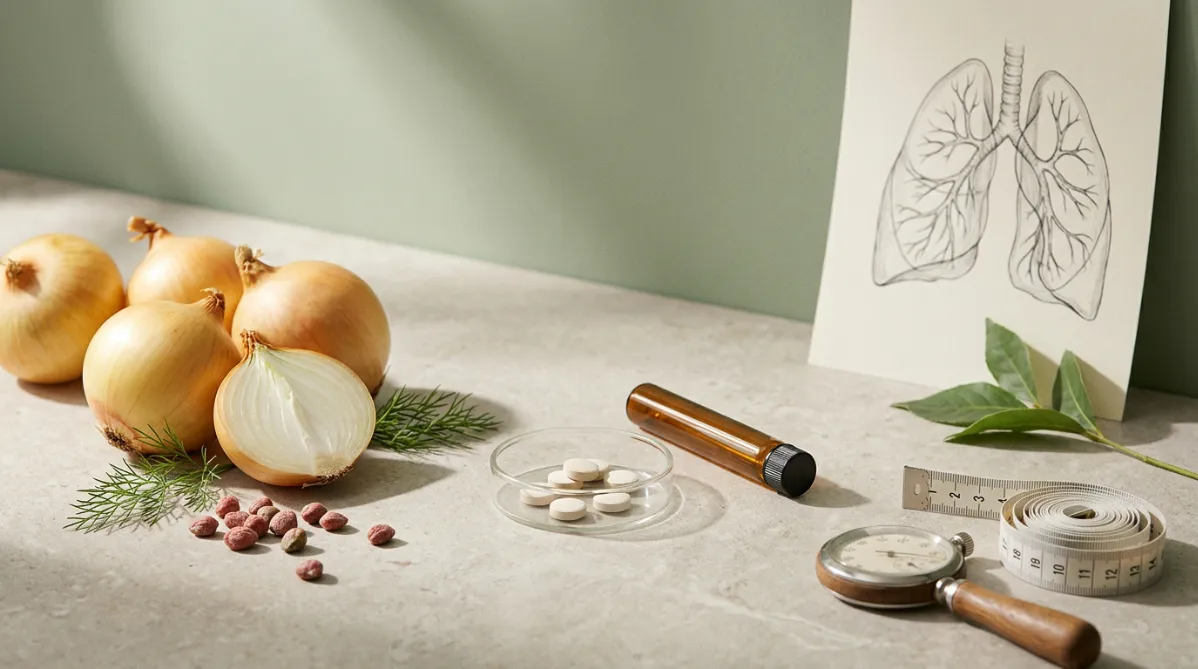
A wide, softly lit editorial still life on a pale warm-gray stone surface, shot from a slightly elevated three-quarter angle. On the left, a small cluster of fresh yellow-gold onions with papery skins, one cut in half to show its pale concentric layers, sits beside a few dusty-red capers and a sprig of dill. These are natural quercetin sources and read as quiet botanical details. In the center, a minimalist glass apothecary dish holds a few small, round, off-white tablets. Beside it, a slim amber glass vial lies on its side with a plain unlabeled cap.

On the right, a neatly arranged clinical element: a vintage-style wooden-handled stopwatch and a crisp paper stride-length measuring tape curled in a loose spiral, hinting at the 6-minute walk test and gait speed measures. Behind these, a softly out-of-focus wall of pale sage green with a subtle shadow of a window frame cast diagonally across it. A single translucent anatomical line drawing of lungs, rendered in fine charcoal ink on cream paper, leans against the wall, its delicate branching bronchi echoing the veining of a nearby green leaf.

Lighting is soft morning daylight from the upper left, creating gentle long shadows and a calm, thoughtful mood. The palette is muted and modern: butter yellow, sage, cream, warm gray, with small accents of terracotta and amber. Shallow depth of field keeps the tablets and onion sharp while the background melts into a creamy blur. Generous negative space across the upper right makes room for headline overlay. The composition feels like a contemporary science journal or wellness-research magazine cover: clean, tactile, restrained, with subtle film grain and natural color grading. No text, no logos, no people, no futuristic elements.
longevity

The First Humans to Take Dasatinib + Quercetin: What a 14-Patient IPF Pilot Did (and Didn't) Show

BY DR. SYNAPSE ·

In 2019, researchers reported the first-ever human use of the senolytic combination dasatinib plus quercetin, in 14 patients with idiopathic pulmonary fibrosis. After three weeks of intermittent dosing, participants showed meaningful gains in 6-minute walk distance, gait speed and chair-stand time, even though lung function itself did not change. The pilot also logged one serious adverse event and frequent respiratory, skin and GI complaints. But this was an open-label, uncontrolled study of a cancer drug paired with a pharmacologic-dose flavonoid, not a supplement protocol. Here's what the trial actually tested, what it found, and how to read it critically.

This page is available in