Biocracked
←

#caspase-3

1 article
**Approach 1 (macro science), Palette D (bold color field).**

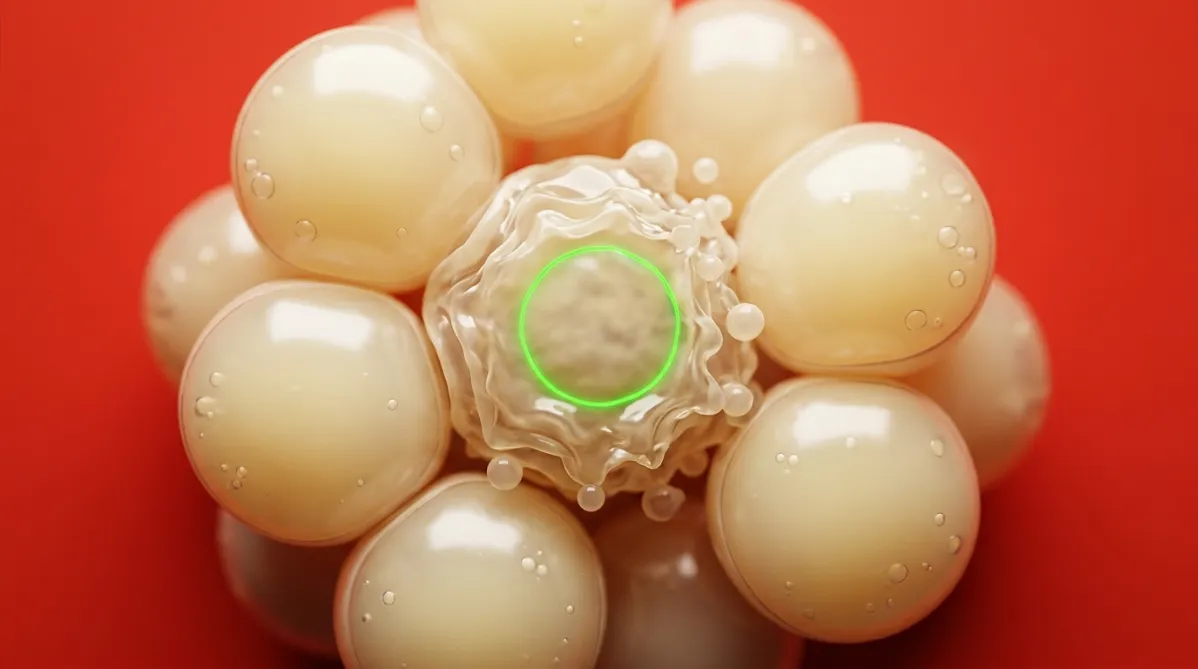
Extreme close-up microscopy-style photograph of a cluster of fat cells (adipocytes), rendered as translucent, pearly spheres with thin membranes and tiny lipid droplets inside. One cell in the center is visibly shrinking and blebbing, its membrane crinkled and fragmenting into small beads, the look of apoptosis. A few of the surrounding cells are intact and glossy. The cells sit against a saturated tomato-red backdrop, so the pale yellow-cream spheres stand out sharply. The camera looks straight down at shallow depth of field, with the focal plane on the dying cell and the edges softly blurred. Soft, diffuse top light gives gentle highlights and warm shadows, with no blue cast. One thin electric green fluorescent ring around the central cell's nucleus is the only green accent. The mood is analytical, precise and quietly skeptical.
research

How does CBL-514 work? Here's the science

BY DR. SYNAPSE ·

CBL-514 is not framed as a fat-melting or fat-burning drug. The proposed claim is that it inhibits the survival kinase DYRK1b and pushes fat cells toward apoptosis through caspase 3 and Bax/Bcl-2. That evidence comes from unpublished company reports cited in the Phase 2a and Phase 2 papers, and the chemical structure has not been disclosed. The 2025 Phase 2 trial measured ultrasound fat volume, photos, and safety, with no human biopsy or caspase data. This article separates the molecular hypothesis from what was actually measured in people, including the high dropout and single-blind design.

This page is available in