Biocracked
←

#c. elegans

1 article
Approach: conceptual metaphor, with palette D (bold color field).

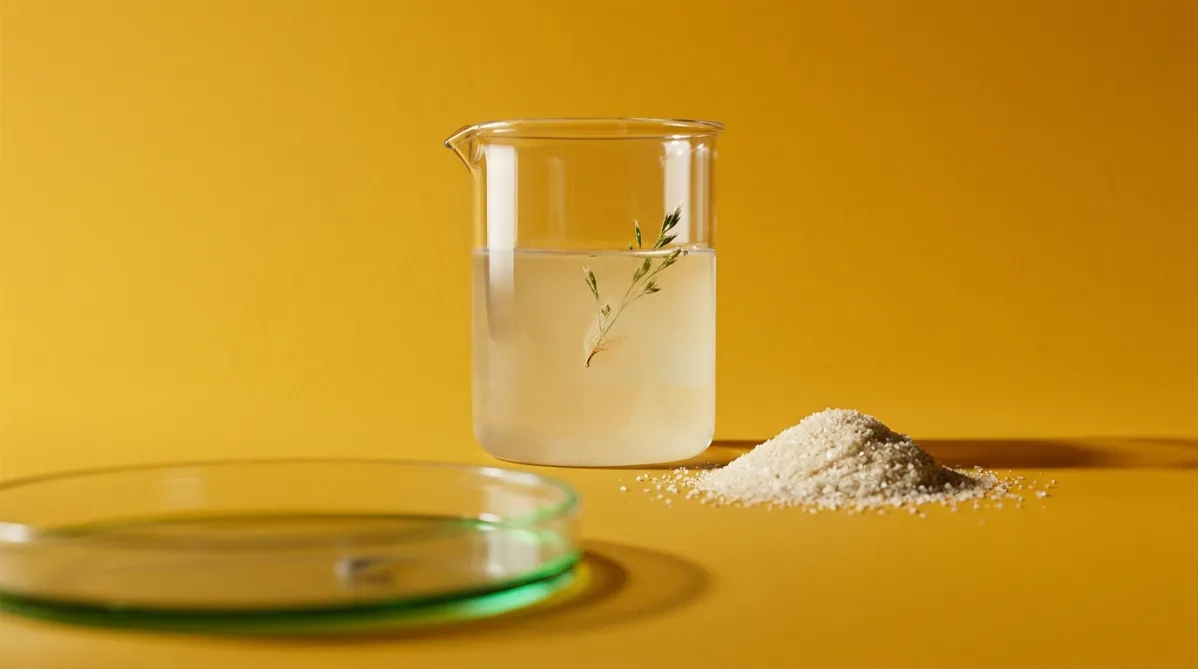
A single clear glass beaker sits on a saturated mustard-yellow seamless backdrop, filled with a slightly cloudy pale liquid. A tiny sprig of wild grass is dissolving at its tip. Beside it, a small pile of coarse, sandy white crystalline powder sits on a matte surface. In the foreground, a real C. elegans petri dish is just visible, softly out of focus, with a thin line of electric green agar glowing at its rim as a small accent. The camera is a low three-quarter angle with a shallow depth of field. Lighting is a hard, warm studio key from the upper left, with crisp, short shadows in deep ochre rather than black. The mood is curious, slightly wary, and playful but scientific. Photorealistic, with real glass reflections and visible grain in the powder. No text or labels.
longevity

A Weed Killer Called Bromoxynil Hints at a Longevity Trick

BY DR. SYNAPSE ·

A herbicide just turned up in a longevity paper, and the reason is stranger than you'd think. Researchers mined rodent pesticide-safety archives and found 27 of 154 substances increased survival at study end. Roughly half of the 15 they examined further disturbed mitochondrial oxygen use, and bromoxynil acted as a mitochondrial uncoupler that improved healthspan markers in worms. But this is archive data, cells and roundworms, not a human finding, and bromoxynil is not something anyone should take. Here's what the study actually shows, why uncouplers come with a warning label, and why the method may matter more than the molecule.

This page is available in