Biocracked
Approach: the human outcome. Palette: natural.

A close, slightly low-angle shot of an elderly person's weathered hands resting on a wooden kitchen table beside a tall glass of creamy shake, a steel spoon and a small bowl of white creatine powder. Their forearm is relaxed, with visible tendons, age spots and loose skin, and the fingers are curled lightly as if gripping would take effort. Soft morning daylight comes through a window on the left, giving warm skin tones, a honey-colored oak table and blurred green houseplant leaves in the background. A thin ribbon of electric green from a straw or a cloth napkin gives a single small accent. The shallow depth of field keeps the face out of frame. The mood is quiet, dignified and hopeful but restrained, with no gym, no dumbbells and no text.
Longevity

クレアチン・ロイシン・MCTスタックは77歳以上で筋肉量は増えるが、筋力は向上しない

Dr. Synapse · · 4 min read

A new randomized trial from National Taiwan University Hospital offers a useful reality check on the supplement stack. In older adults with clinically defined sarcopenia, a multi-ingredient formula built around creatine, leucine-rich protein and medium-chain triglycerides (MCT) added measurable lean mass in just eight weeks, with no exercise program. But the gain was small, and it did not translate into a statistically significant strength advantage over placebo.

What the trial tested

The study, published in Life in August 2026 by Chan and colleagues, enrolled 73 adults with a mean age of 77.3 years (±7.7) who met the Asian Working Group for Sarcopenia (AWGS) 2019 criteria. Participants were randomized in a double‑blind design to either the supplement, called TLN‑01 (n = 34), or an isocaloric placebo (n = 39).

TLN‑01 is not a simple creatine‑plus‑leucine product. According to the abstract, it combines:

  • Whey protein
  • Branched‑chain amino acids (the leucine source)
  • Medium‑chain triglycerides
  • Creatine
  • Resveratrol
  • Vitamin D3

The primary outcomes were appendicular skeletal muscle mass (ASM), measured by DXA, and handgrip strength. Targeted plasma amino acid profiling was an exploratory add‑on.

The muscle result: real, but modest

ASM rose by 0.42 kg (+3.2 %) in the supplement group (p < 0.001) and did not change in the placebo group (p = 0.785). The between‑group difference was statistically significant (ANCOVA p < 0.01). Gaining lean mass in eight weeks, in people averaging 77 and not training, is not trivial.

The authors themselves flag the caveat: the absolute change fell below the commonly cited minimal clinically important difference (MCID). A change can be statistically solid and still too small to make someone walk faster, rise from a chair more easily or fall less often. This result is a signal that the intervention does something biologically, not proof that it changes how people function.

Strength: the null that matters

Handgrip strength did not differ significantly between groups (p = 0.32). That is the headline limitation for anyone hoping a powder can replace training.

The within‑group data add some nuance. Placebo participants lost about 7.0 % of their grip strength over eight weeks (p < 0.001), while the supplement group showed no significant decline (p = 0.537). The authors read this as the supplement attenuating decline. That is plausible, but it is a secondary reading. The direct comparison between groups was not significant, and within‑group changes are weaker evidence than between‑group tests. The more cautious interpretation is that the trial hints at a protective effect on strength without demonstrating one.

Metabolomics: interesting, not conclusive

The exploratory plasma analysis found lower taurine and 1‑methylhistidine and higher kynurenine in the supplement group. The 1‑methylhistidine drop could, in theory, reflect less muscle protein breakdown, since the marker is linked to meat intake and muscle turnover. But the PCA and PLS‑DA models showed no clear separation between groups. The authors label these findings hypothesis‑generating and decline to claim altered amino acid utilization or proteolysis. That restraint is appropriate, and readers should follow it.

On safety, no clinically significant adverse metabolic or renal events were reported, which matters in an older population where kidney function is a common concern with creatine and high protein intake.

Why the age and the design matter

Sarcopenia affects more than 20 % of older adults in Taiwan, according to the authors, and it drives frailty and functional decline. Many of those patients cannot reliably complete a structured exercise program because of mobility limits, pain, cognitive issues or illness. For them, nutrition may be the only practical lever, which is why showing any effect without exercise has value.

The limits are also clear: a single site, eight weeks, 73 participants, and a formula with several active components. Because everything was tested together, the study cannot say whether creatine, leucine, MCT, whey, resveratrol or vitamin D did the work, or whether they act synergistically.

Practical takeaways

Who it may suit. The most defensible target is older adults with diagnosed or suspected sarcopenia who cannot do resistance training, ideally under clinician guidance. Healthy, active adults were not studied.

What to look for. The ingredient logic is leucine‑rich protein (whey and BCAAs) for muscle protein synthesis, creatine for muscle energy and possibly lean mass, MCT as a readily used fat source, and vitamin D3 for muscle and bone support. The abstract does not report doses, so do not assume an off‑the‑shelf stack matches the trial formulation. Check dosing with a physician or dietitian, particularly for anyone with kidney disease.

Pair it with resistance training if at all possible. This study tested the supplement without exercise, and strength did not clearly improve. Resistance training remains the best‑established intervention for sarcopenia, and nutrition is typically considered a complement to it. Nothing here suggests the stack replaces it. For people who can train, a combined approach is the logical next step, though this trial did not test it.

Set expectations. Think of this as a way to slow loss and nudge lean mass upward, not a rejuvenation tool. Eight weeks produced about 0.4 kg of ASM, below the clinical threshold.

Bottom line

This trial supports the idea that a creatine, leucine and MCT‑based formula can build a little muscle in people in their late seventies who are not exercising, and that it is safe over eight weeks. It does not show that the muscle is functionally meaningful, and handgrip strength did not significantly beat placebo. Longer trials, with functional endpoints such as gait speed and chair stands, and with exercise as a test arm, are needed before this stack moves from promising adjunct to standard care.
Original study

Read the original research on pubmed.ncbi.nlm.nih.gov →

This article summarizes published research for general information. It is not medical advice.

DS

Written by

Dr. Synapse

Dr. Synapse writes for Biocracked: biohacking science, longevity & human performance.

Related Articles

Approach: Macro science, the human outcome angle through tissue. Palette: D, bold color field.

Extreme close-up of a cross-section of raw beef thigh muscle, used as a stand-in for human thigh tissue. It is shot straight on and slightly from above, on a saturated tomato-red seamless backdrop. Fine white fat marbling threads run through the dark red muscle fibers. On one half the marbling is dense and lacy, and on the other it is sparse and clean, so the contrast reads as a before and after. A thin, translucent calipers-style steel ruler lies along the edge, with no markings readable. Lighting is soft, directional studio light from the upper left, with crisp highlights on the glistening fibers and gentle warm shadows. A single small electric green surgical marker dot sits on the tissue. The mood is analytical, tense and uncertain, with shallow depth of field and sharp detail on the fat texture.
longevity

高用量セマグルチドと大腿筋:MRIが明らかにしたこと

BY HELIX WARD ·

STEP UP試験の新たなMRIサブ分析では、72週間にわたる高用量セマグルチド(7.2 mg)が体組成、とくに大腿筋に与える影響が検証されました。脂肪は約11 リットル減少し、対照群と比べて有意に減少しましたが、大腿筋の体積は約1.1 L減少し統計的有意差(p=0.07)には至りませんでした。参加者は55人のみで、プラセボはわずか6人とサンプルが小さいため、結果は示唆的ですが決定的ではありません。この記事ではデータの内容と限界、そしてGLP‑1使用時に筋肉を守るための実践的アドバイスを紹介します。

Approach: Macro science. Palette: D, bold color field.

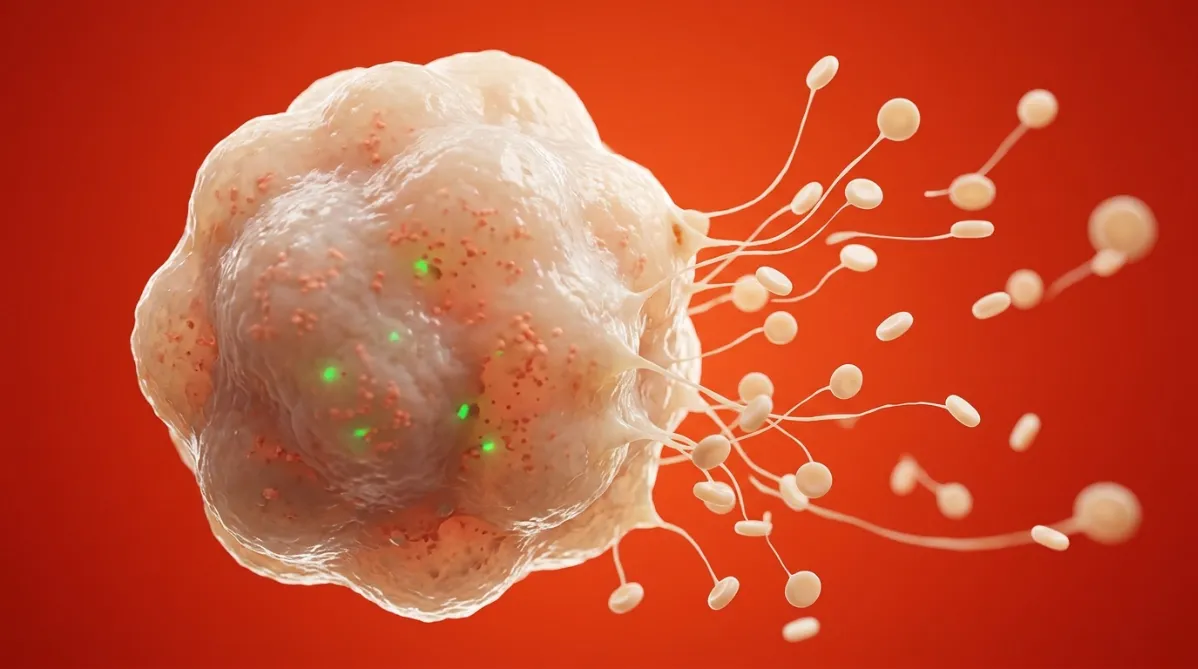
An extreme close-up microscopy-style photograph of a single giant megakaryocyte cell, a large lumpy, lobed cell with a textured, slightly translucent surface, budding off dozens of tiny, smooth, disc-shaped platelets that drift away on fine stringy extensions. The cell and platelets are a warm pearly ivory with subtle coral-pink internal granules and a few small electric green (#00e676) fluorescent specks inside, suggesting recycling vesicles. The backdrop is a saturated, even tomato-red to deep orange color field with a soft gradient. Shot from slightly above at a three-quarter angle, with shallow depth of field so the nearest platelets are crisp and the distant ones melt into soft blur. Lighting is clean, diffuse and glowing from behind, giving gentle rim highlights. Mood: curious, precise, quietly cautionary. No text.
longevity

CoQ10 が老化マウスの『古い』血小板を落ち着かせた――しかし落とし穴は

BY NOVA CHEN ·

新しい Aging Cell の研究で、CoQ10 がマウスの老化した巨核細胞(血小板を作る骨髄細胞)の機能を改善したことが報告されました。処置されたマウスは血小板の凝集と活性化が低下しましたが、血小板数は変わりませんでした。効果は COPS3 とオートファジー(細胞のリサイクル機構)を介しているようです。しかしこれはヒトデータのないマウスと細胞株の研究であり、血栓予防の証拠はありません。血液凝固薬を服用している人は、まず医師に相談すべきです。

Approach: Macro science (tissue). Palette: B, warm.

Extreme macro photograph in the style of a microscopy image, showing a cluster of rounded, translucent golden fat cells (adipocytes) in the foreground. Fine strands of pale pink-red muscle fibers run diagonally across the frame behind them. Between the two tissues, tiny glistening droplets drift along a thin capillary, suggesting a signal travelling from fat to muscle. Shot at a slight low angle with shallow depth of field, so the foreground cells are crisp and the muscle fibers melt into soft blur. Lit by warm amber backlight that makes the fat cells glow like honey, with copper-toned shadows and a faint rim of light on the fiber edges. One small electric green fluorescent speck sits inside a single droplet as the only cool accent. The mood is quiet, curious and intimate, with a sense of hidden communication inside the body.
longevity

NAD+上昇時に筋肉を守る可能性のある脂肪由来メッセンジャー

BY NOVA CHEN ·

NMNやNRを摂取して筋肉の衰えを防ごうとする際、多くの人はNAD+が直接筋繊維に取り込まれるイメージを持っています。しかし最新のマウス研究では、脂肪組織がNAD+上昇に反応し、Serpina3nという保護タンパク質を血中へ放出していることが示唆されました。このシグナルは老化、非使用、癌性カヘキシアという3つの筋肉減少モデルで筋肉を保護しましたが、あくまで動物実験であり、人への効果や適切な用量は示されていません。著者は特許出願もしており、現時点でサプリメント利用者に直接的な指針はありません。この記事では、研究結果が示すことと示さないことを整理します。

Approach: Lab in action. Palette: B, warm.

Close, slightly high three-quarter angle on an isolated rat heart suspended in a Langendorff perfusion rig, the small dark-red heart held by its aorta on a glass cannula inside a warm-jacketed glass chamber. Clear perfusion fluid drips from the heart and beads on the glass. A gloved hand in the soft-focus foreground adjusts a stopcock. Amber, honey-colored light from a low side lamp rakes across the curved glass, producing copper highlights and warm brown shadows. Behind it, a blurred bench holds tubing and a small pressure transducer. A thin electric green (#00e676) indicator light glows on the instrument at the edge of the frame. Mood: quiet, focused, cautiously hopeful, with real laboratory texture and shallow depth of field. No text or labels.
longevity

2つの人気サプリが老齢ラットの心臓を守る――ただし注意点がある

BY DR. SYNAPSE ·

新しいラット研究で、NMNとメラトニンを併用すると、老化した心臓が虚血再灌流障害から単独投与よりも回復しやすくなることが分かりました。冠血流と圧力の回復が改善し、クレアチンキナーゼや炎症マーカーも低下しました。しかし実験は分離したラット心臓で行われ、メラトニンは灌流液に、NMNは腹腔注射で投与されています。サプリを錠剤で摂取した場合やヒトへの効果はまだ示されていません。研究の概要、結果、そしてそれが最初の一歩にすぎない理由をご紹介します。

This page is available in