Biocracked
←

#gip

1 article
**Approach:** Lab in action. **Palette:** Bold color field, mustard yellow.

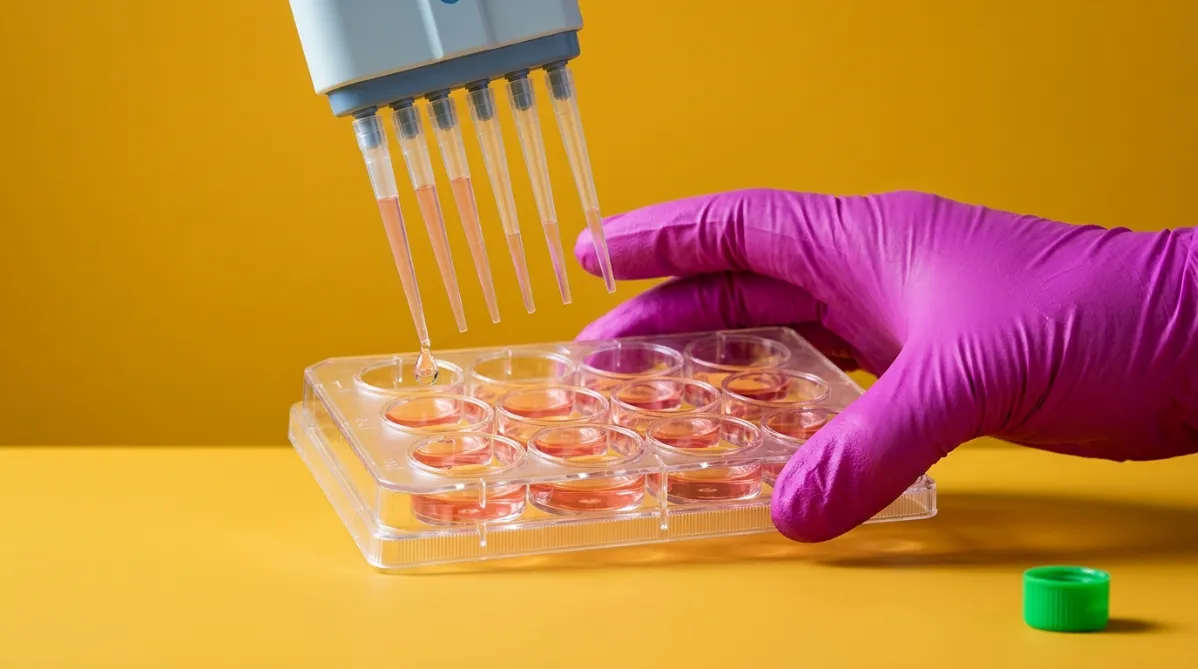
A close, slightly high three-quarter view of a hand in a magenta-purple nitrile glove holding a clear 12-well cell culture plate. Each well is filled with salmon-pink culture medium. A multichannel pipette hovers over one well, with a single droplet caught just before it falls. The background is a seamless, saturated mustard-yellow surface and wall, with a soft shadow under the plate. Bright, even studio light comes from the upper left, giving crisp highlights on the plastic rims and a soft glow through the liquid. The depth of field is shallow, so the far wells blur gently. A tiny electric-green cap on a tube sits in the corner of the frame. The mood is calm, precise and curious, with a clean, graphic, editorial feel. No text or labels.
peptides

Semaglutide n’a pas rétréci les cellules musculaires humaines : pourquoi alors la perte de masse musculaire ?

BY DR. SYNAPSE ·

Le semaglutide « mange‑t‑il » vraiment le muscle ? Une étude publiée dans *GeroScience* a exposé des myotubes humains issus de personnes âgées et obèses directement au semaglutide. Aucun gène d’atrophie n’a été induit, le secretome est resté stable, et le GIP a même augmenté l’épaisseur des fibres après huit jours. Le semaglutide a légèrement réduit la production d’ATP glycolytique, tandis que les récepteurs GLP‑1 étaient à peine détectables. Ces données orientent la perte de masse maigre vers des causes indirectes – déficit calorique, apport protéique insuffisant et moindre sollicitation mécanique – plutôt que vers une toxicité directe du médicament sur le muscle.

This page is available in