Biocracked
←

#5-avab

1 article
Approach 1, macro science, in palette D, bold color field.

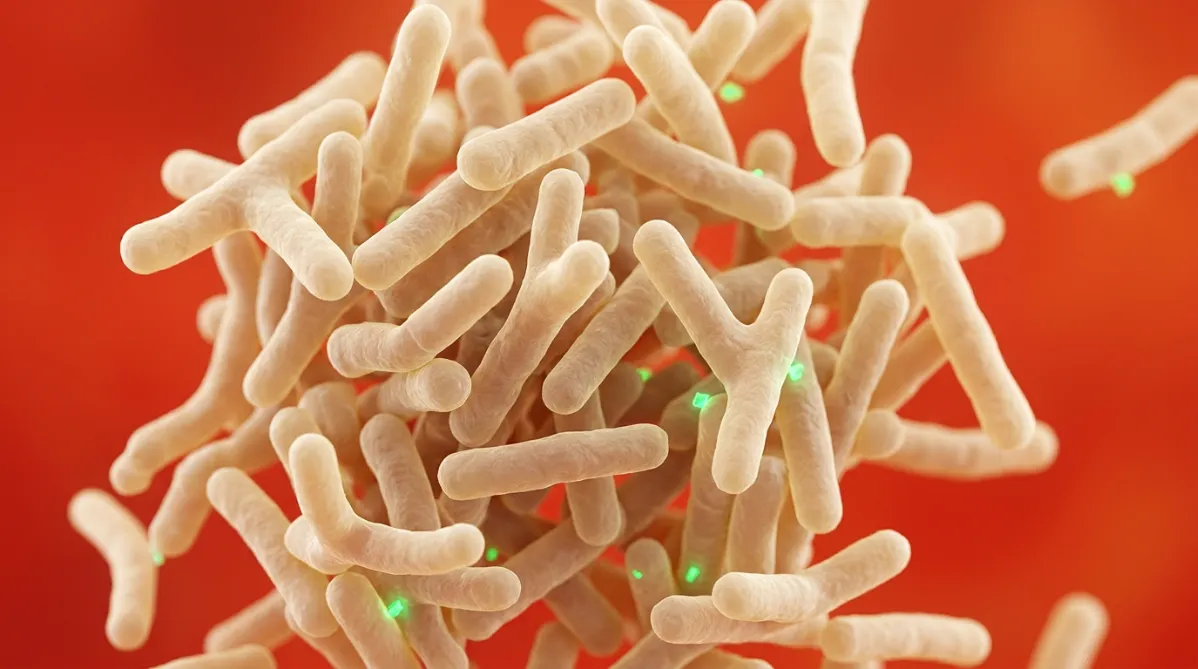
Extreme close-up microscopy-style photograph of a dense colony of rod-shaped, slightly branched Bifidobacterium cells, rendered as real textured organic forms with soft translucent walls and subtle surface detail. The cells are warm cream and ivory, clustered in the center and thinning toward the edges. The whole backdrop is a saturated tomato-red to orange field, smooth and out of focus, so the bacteria stand out in sharp contrast. A few scattered tiny crystalline metabolite specks glow faintly electric green (#00e676) near the colony. Camera angle is straight-on, slightly oblique, with a very shallow depth of field. Lighting is soft, diffuse backlight with gentle rim highlights on the cell edges and no harsh shadows. The mood is vivid, curious and hopeful, scientific but warm, with no blue cast anywhere. No text.
longevity

Ce microbe intestinal produit le 5‑AVAB, une molécule qui apaise l’inflammagénèse

BY NOVA CHEN ·

Un microbe intestinal qui disparaît discrètement avec l’âge pourrait jouer un rôle plus important qu’on ne le pensait. Une étude publiée dans *Nature Aging* identifie *Bifidobacterium pseudocatenulatum* comme étant systématiquement appauvri chez les personnes âgées dans plusieurs cohortes chinoises. Chez des souris naturellement vieillies, une administration orale a atténué l’inflammagénèse multi‑organe et prolongé la santé fonctionnelle. Les auteurs ont relié une partie de cet effet à un métabolite, le 5‑AVAB, qui décline également avec l’âge chez l’humain. Voici ce que montre l’étude, ce qui reste à prouver chez l’homme, et comment lire le battage médiatique avec discernement.

This page is available in