If you've seen an ad for Mitopure or another urolithin A supplement, you've probably been told it "recycles your mitochondria" and helps muscles stay young. The mechanism is real biology. But a new systematic review and meta-analysis pooled every randomized human trial it could find, and the answer to "does it actually improve muscle performance?" is more modest: possibly, but nobody can say yet.
The review, published in Frontiers in Nutrition in 2026 by Dao and colleagues, is the first to gather the randomized controlled trial (RCT) evidence on urolithin A and muscle health. Here is what it found and what that means if you're deciding whether to buy.
What Is Urolithin A?
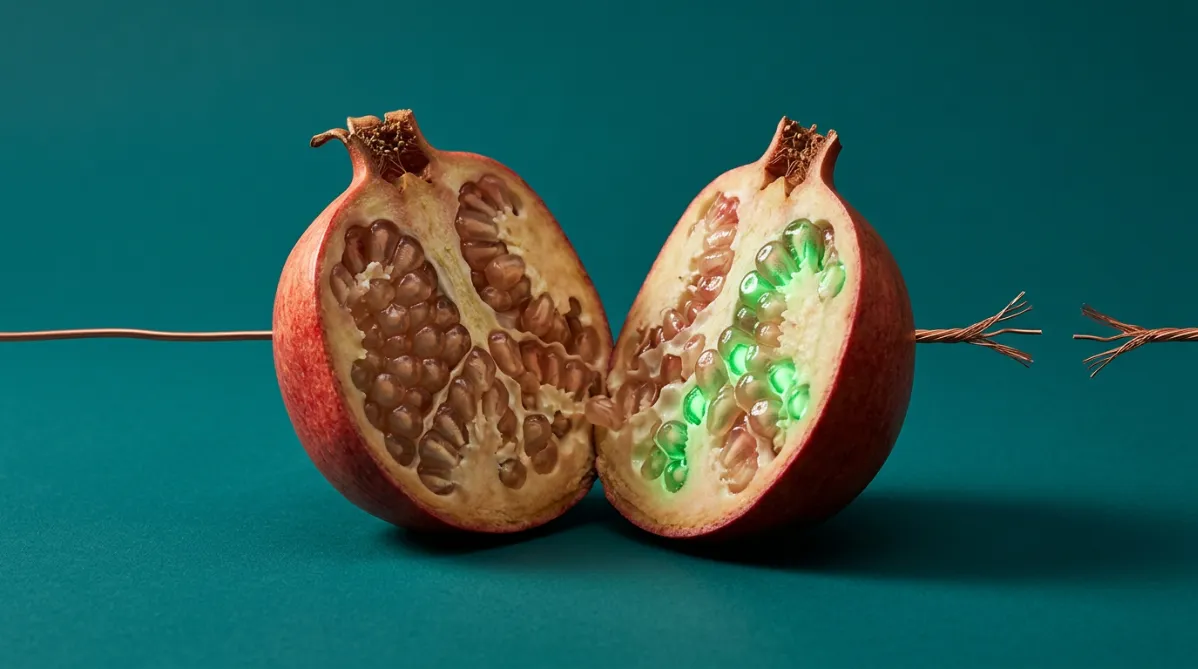
Urolithin A (UA) isn't something you eat directly. It's a metabolite made by certain gut bacteria from ellagitannins and ellagic acid, polyphenols found in pomegranates, walnuts, some berries, and oak-aged foods. Whether you produce meaningful UA from those foods depends on your microbiome. Some people convert ellagitannins to UA efficiently, and many convert them poorly or not at all. That variability is the commercial case for taking UA directly as a supplement.
The scientific interest centers on mitophagy, the cellular housekeeping process that clears out damaged mitochondria. Mitochondrial quality tends to decline with age, and skeletal muscle is energy-hungry tissue. In animal and cell models, UA appears to stimulate mitophagy and improve muscle function. The hypothesis that it could do the same in people is reasonable. It is still a hypothesis.
What the Meta-Analysis Found
The authors searched PubMed, Embase, Web of Science, and Scopus through December 2025 for RCTs comparing oral UA with placebo and reporting muscle-related outcomes. They found only five trials with 236 participants in total. Those trials differed in population, dose, duration, and outcome measures.
That heterogeneity limited what could be combined statistically. Only one outcome, the 6-minute walk test (6MWT), could be pooled, and only from two trials. The results:
- Pooled mean difference: +17.03 meters in favor of UA
- 95% confidence interval: -5.33 to +39.40 m
- p-value: 0.135, not statistically significant
- Sensitivity analysis (splitting the placebo group instead of combining arms): +18.80 m, 95% CI -3.24 to 40.85, p = 0.095, similar
- GRADE certainty: low
The confidence interval is the key detail. It spans a small decline in walking distance to a fairly meaningful gain. The data are consistent with UA doing nothing, and also with it helping moderately. A 17-meter improvement sounds encouraging, but the study can't distinguish it from chance.
The authors also note that the 500 mg and 1,000 mg arms from one trial were combined against a shared placebo group, following Cochrane guidance, to avoid counting placebo participants twice. That is the statistically correct way to do it, but it means the pooled figure blends two doses.
What About Strength, Endurance, and Mitochondrial Markers?
Muscle strength, endurance, aerobic capacity, and biochemical or mitochondrial biomarkers were reviewed narratively, not pooled. The authors describe these findings as "exploratory signals rather than reproducible effects." Some individual trials reported favorable changes, but the populations, doses, and measurement methods varied too much to confirm a consistent benefit. Marketing often cites these individual positive findings, and the meta-analysis explicitly declines to treat them as proof.
Why the Evidence Is Thin
Several problems stack up:
- Small samples. 236 people across five trials is little data for a supplement marketed so widely.
- Short duration. The trials were short-term. Muscle aging unfolds over years, and the studies can't show whether UA changes that trajectory.
- Mixed populations. The participants were clinically heterogeneous, so a result in one group (say, older sedentary adults) may not apply to another (say, trained athletes).
- Inconsistent outcomes. Without standardized endpoints, trials can't be compared or pooled, so scattered positive results can't be turned into a firm conclusion.
- Surrogate markers. Changes in mitochondrial biomarkers don't necessarily mean better muscle function in daily life.
The authors' conclusion is plain: larger, longer, standardized trials in better-defined populations are needed before firm clinical recommendations can be made. Notably, they declared no commercial conflicts of interest, which matters in a field where much of the research is industry-linked.
Practical Takeaways
Doses in the trials. The studies discussed used 500 mg and 1,000 mg per day. If you try UA, those are the doses with human trial data behind them. There's no evidence that going higher helps.
Who might still consider it. Older adults with declining mobility, or people with low dietary ellagitannin intake who want to experiment, are the groups with the most plausible upside. The 6MWT signal points in that direction. The safety profile in the trials appears reasonable, but this review focused on efficacy, so check the individual trials and talk to your clinician, especially if you take medications or have a medical condition.
What to expect. Don't expect a dramatic change in muscle size or strength. The best-case scenario from current data is a modest improvement in walking endurance after months of consistent use, and even that isn't confirmed.
Cost-benefit. Branded UA supplements are premium-priced, often far more than established, better-evidenced options. If your budget is limited, resistance training, adequate protein, sleep, and regular aerobic activity have much stronger evidence for preserving muscle and mitochondrial function. UA is a possible add-on at best, not a substitute. If you're curious, treat it as a low-certainty experiment: set a baseline (walk test, grip strength, or a simple lift), try it for 3 to 4 months, and judge by objective measures, not by how you feel.
The Bottom Line
Urolithin A is a scientifically interesting compound with a plausible mechanism and a promising but unproven human track record for muscle. The most rigorous summary so far shows a directionally positive but statistically inconclusive effect on one walking outcome, with low-certainty evidence behind it. That isn't "it doesn't work," and it isn't "it's proven." It is "we don't know yet," and anyone selling certainty is ahead of the data.