Biocracked
Approach 4, conceptual metaphor, in palette D, bold color field.

A single translucent green tea leaf, its veins backlit, lies on a saturated magenta seamless backdrop beside a small pomegranate rind fragment. Together they form a split, two-part chain: a bright brass chain link made of two interlocking rings, one ring dark amber and one pale green, rests on top. Behind it, one ring has a hairline crack. Shot from a low three-quarter angle with a shallow depth of field, the front link razor sharp and the background softly blurred. Lighting is a crisp, hard key light from the upper left with a soft magenta bounce and a long defined shadow across the surface. The palette is vivid magenta, deep amber, and a small accent of electric green (#00e676) on the leaf edge. The mood is curious and skeptical: promising but unproven, with two parts joined yet not fully tested.
Longevity

Urolithin A + Green Tea EGCG in Alzheimer's Mice: The Catch

Nova Chen · · 4 min read

A pomegranate-derived metabolite and a green tea polyphenol walk into an Alzheimer's mouse model, and the mitochondria seem to respond. That is the short version of a new paper in Mitochondrion (2026). The longer version has a catch, and it matters if you are tempted to read this as a supplement recommendation.

Bottom line up front: this is mouse research. The animals received injections, not oral supplements. The authors themselves say key questions remain open.

What the researchers tested

A team from Texas Tech University Health Sciences Center and AbSynaptex LLC studied humanized amyloid-β knock-in (hAbKI) mice, a model used in Alzheimer's disease research. The two compounds were:

  • Urolithin A (UA): described in the paper as a mitophagy-promoting metabolite. Mitophagy is the cell's process for clearing damaged mitochondria.
  • Epigallocatechin-3-gallate (EGCG): the green tea polyphenol the authors credit with antioxidant, anti-inflammatory and anti-amyloidogenic properties.

Mice started treatment at 3 months of age. They received either UA (2.5 mg/kg) or UA plus EGCG (25 mg/kg) by intraperitoneal injection, three times a week, for four months. The team then assessed a wide panel of measures at 7 months.

What changed in the treated mice

The authors report shifts across several layers of mitochondrial biology.

Fission and fusion. Expression of the fission genes Drp1 and Fis1 went down. Expression of the fusion genes Mfn1, Mfn2 and Opa1 went up. Immunoblotting supported these transcriptional changes.

Biogenesis. Genes tied to making new mitochondria, including PGC1α, Nrf1 and TFAM, were increased.

Mitophagy and autophagy markers. Levels of PINK1, Parkin, ATG5, LC3B, Beclin1 and BCL2 rose.

Structure and energy. Transmission electron microscopy showed longer mitochondria and less fragmentation. Mitochondrial ATP levels rose, while hydrogen peroxide and 4-hydroxynonenal (markers of oxidative stress) fell.

Neuronal and brain-chemistry readouts. Both regimens were associated with:

  • higher synaptic and dendritic measures
  • lower Iba1 and GFAP (markers linked to glial activation)
  • higher NeuN (a neuronal marker)
  • lower soluble Aβ40 and Aβ42
  • better performance on several behavioral tasks

Where the combination stood out

Across multiple mitochondrial and neuronal endpoints, the response was greater with UA plus EGCG than with the regimens described as either treatment alone. The authors conclude that UA modulates several components of mitochondrial quality control in these mice. They also conclude that adding EGCG is associated with broader improvements in mitochondrial and neuronal homeostasis.

The wording is deliberately cautious. "Associated with" is not the same as "caused by," and the abstract does not claim the combination is proven superior in every measure.

The catch: what the study did not show

The authors state plainly that further work is needed to:

  1. Define EGCG's specific contribution. The design suggests the combination did more, but it does not fully separate what EGCG itself is doing.
  2. Directly assess mitophagic flux. The study measured mitophagy- and autophagy-associated markers, which is not the same as showing the cleanup process actually ran faster.
  3. Directly assess mitochondrial respiration. ATP levels were measured, but respiration was not.

Other limits follow from the design:

  • Animal model only. Mice engineered for amyloid-β biology do not capture the full complexity of human Alzheimer's disease.
  • Injection route. Intraperitoneal dosing bypasses digestion and gut metabolism. It says little about what happens after swallowing a capsule.
  • Short window, early start. Treatment began at 3 months and ended at 7 months. The paper does not show whether the effects would hold in older animals or after disease is established.
  • Mostly molecular readouts. Many findings are gene and protein markers, which are useful signals but not clinical outcomes.

Practical takeaways

Dose. There is no established human dose for this combination. The mouse doses (2.5 mg/kg UA and 25 mg/kg EGCG, injected) should not be converted into a supplement plan. For context only, human studies of oral urolithin A in other settings have used roughly 500-1,000 mg per day. Those studies did not test this combination and do not show it works for Alzheimer's-related mitochondrial changes.

Timing. In the mice, dosing was three times per week for four months, starting early. Whether any similar schedule or window makes sense in people is unknown.

Who it's for. Right now, it is for researchers. Nothing in this paper supports using UA or EGCG to prevent or treat Alzheimer's disease. Anyone with a diagnosis, or concerned about memory, should talk with a clinician before adding supplements. As general background not drawn from this paper, concentrated green tea extracts have been linked to liver problems in some people, which is another reason to seek medical advice.

Why it's still worth watching

Mitochondrial dysfunction and weakened quality control are increasingly recognized as contributors to Alzheimer's disease. A pairing that touches fusion, biogenesis, mitophagy-linked pathways and oxidative stress at once is an appealing hypothesis. This paper adds a coherent preclinical signal. The next steps are the ones the authors name: measure mitophagic flux and respiration directly, and isolate EGCG's role. Until then, treat it as a promising mouse finding, not a protocol.

Source: Kshirsagar S, et al. Urolithin A plus EGCG enhances mitophagy associated pathways, mitochondrial dynamics, and bioenergetic function in humanized amyloid-β knock-in mice. Mitochondrion. 2026;92:102237. doi:10.1016/j.mito.2026.102237. PMID: 43009032.
Original study

Read the original research on pubmed.ncbi.nlm.nih.gov →

This article summarizes published research for general information. It is not medical advice.

NC

Written by

Nova Chen

Nova Chen writes for Biocracked: biohacking science, longevity & human performance.

Related Articles

**Approach:** Conceptual metaphor, in a bold color field palette (D).

A single ripe pomegranate, split open, on a saturated teal backdrop. It is the natural source of urolithin A's precursors. The camera sits at a slightly low three-quarter angle, close enough to show glossy, translucent arils. On the left half, the arils sit dull and tightly packed. On the right, a few arils hold a faint electric green glow, as if lit from within, hinting at a selective response in one place and not another. Behind the fruit, a thin copper wire runs across the frame and is unbroken on one side and fraying on the other, standing for arteries versus brain vessels. Soft, directional studio light from the upper left casts crisp shadows. Mood: curious, restrained, quietly hopeful. No text anywhere.
supplements

Urolithin A Didn't Fix Arteries in 4 Weeks, but the Brain Responded

BY NOVA CHEN ·

A double-blind trial of 50 adults aged 40-64 with obesity found that 1,000 mg of urolithin A daily for four weeks did not improve flow-mediated dilation, the study's primary endpoint. Peripheral microvascular measures were also unchanged. Yet task-evoked cerebrovascular hemodynamic responses were significantly greater with urolithin A than with placebo, even though task performance did not budge. Because the brain result is a secondary outcome from a short, small trial, it is a lead rather than a conclusion. Here is what the data show, what they don't, and what it means for anyone considering the supplement.

Approach 1, macro science, in palette D, bold color field.

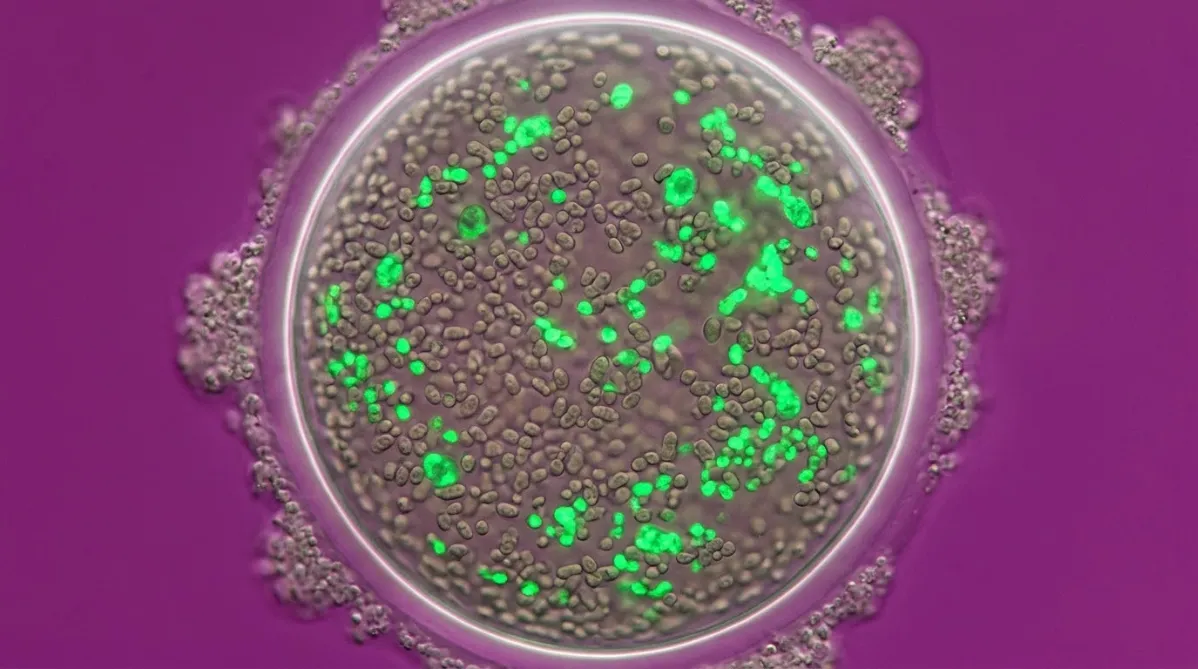
Extreme close-up microscopy-style image of a single mouse oocyte, a translucent spherical egg, shot straight on at its equator. Inside the cytoplasm, hundreds of mitochondria appear as tiny glowing grains. Most are a muted grey-amber, while a scattered subset of small and large organelles glows vivid electric green (#00e676), clustered unevenly to suggest an uneven response. Fine granular cumulus cells cling to the egg's edge, slightly out of focus. The backdrop is a saturated, flat magenta-violet field, with soft rim light wrapping the egg's glassy membrane and shallow depth of field blurring the edges. The mood is quiet, precise and slightly uneasy, a closer look revealing what the averages hid. Photoreal confocal-meets-studio look, with no text and no labels.
longevity

NMN Rejuvenated Hidden Mitochondria in Aged Eggs, But Not Evenly

BY NOVA CHEN ·

Aged mouse eggs looked mitochondrially normal on average, but a new single-organelle study says the averages were hiding something. Specific subpopulations, high-membrane-potential and small mitochondria, carried elevated mtDNA copy number with age. NMN pulled those back toward young levels, yet pushed large mitochondria the opposite way, and in surrounding cumulus cells it overshot young levels in some groups. No fertility or pregnancy outcomes were measured, the work was in mice, and some authors have patent and company ties. Here is what it means, and does not mean, for women weighing NMN for fertility.

Approach 4, conceptual metaphor, in palette D, bold color field.

A single pomegranate, split open, sits at the center of a saturated teal backdrop. It is photographed from a slightly high three-quarter angle with a macro lens. One half is pulled slightly forward and the other stays behind it, which hints at two close siblings. The ruby arils are glossy and densely packed. In the smaller half, a few arils glow with a subtle electric green rim light, as if one has been singled out. Pomegranate is a natural source of the precursors that gut bacteria convert into urolithins. Soft, large-source studio light comes from the upper left. It casts crisp, clean shadows on a seamless teal surface and gives the red fruit sharp specular highlights. A few arils are scattered nearby. The mood is curious, vivid and quietly scientific, with a strong red-against-teal contrast and no text.
longevity

Urolithin D vs. A: The Obscure Sibling That Shielded Mouse Memory

BY NOVA CHEN ·

Urolithin A gets all the attention, but its lesser-known sibling, urolithin D, just showed brain-protective effects in aging mice. In a D-galactose-induced aging model, oral urolithin D improved memory-related outcomes and reduced hippocampal damage, tied to AMPK, PGC-1α and SIRT3 signaling and mitophagy markers. Cell experiments showed that blocking AMPK or PGC-1α erased the benefit. But this is a chemically induced mouse model plus cell work, with no human data, and the study did not compare urolithin D with urolithin A. Here is what it means, where urolithins come from, and what to do (and skip) in the meantime.

Approach 1, macro science, with Palette D, a bold color field.

Extreme macro photograph of a single green tea leaf's surface and a freshly steeped droplet of tea clinging to its serrated edge. The droplet acts as a tiny lens, with faint crystalline EGCG-like needle structures visible inside it. Shot from a low, slightly oblique angle with a shallow depth of field. The backdrop is a smooth saturated tomato-red field that contrasts with the leaf's deep natural green, and a thin electric green highlight runs along the leaf's veins. Soft, bright studio light from the upper left gives crisp specular highlights on the droplet and small warm shadows on the red. The leaf's texture is fine and realistic, with visible veins and microscopic hairs. The mood is vivid, precise and curious, and the image contains no text, labels or logos.
longevity

Tiny Tea Polyphenol Dose Linked to Slower Aging in 11,000 Adults

BY NOVA CHEN ·

A new Aging Cell study found that even low intake of EGCG, the signature polyphenol in green tea, was linked to slower biological aging in nearly 11,000 NHANES adults. People with EGCG intake showed lower PhenoAge acceleration, lower mortality, and longer estimated residual life expectancy than non-consumers. In worms and senescent liver cells, the researchers traced the effect to peroxisomes, the organelles that build up and break down very long-chain fats. Blocking key peroxisome genes erased the benefits in both models. The human data are observational and the mechanism comes from worm and cell work, so this is a promising lead, not proof.

This page is available in