Shatavari has been a staple of Ayurvedic women's health for centuries. A new randomized trial suggests it may do more when it isn't taking the stage alone.
In an 8-week, double-blind, placebo-controlled study of 135 women, a standardized shatavari root extract improved overall sexual function and sexual satisfaction. When shatavari was combined with ashwagandha root extract, the list of improvements got longer: arousal, lubrication, orgasm, mood and happiness all moved relative to placebo.
The trial, led by Ademola and colleagues, was published in the International Journal of Women's Health in 2026 (DOI: 10.2147/IJWH.S561213; PubMed 41710148).
What the researchers tested
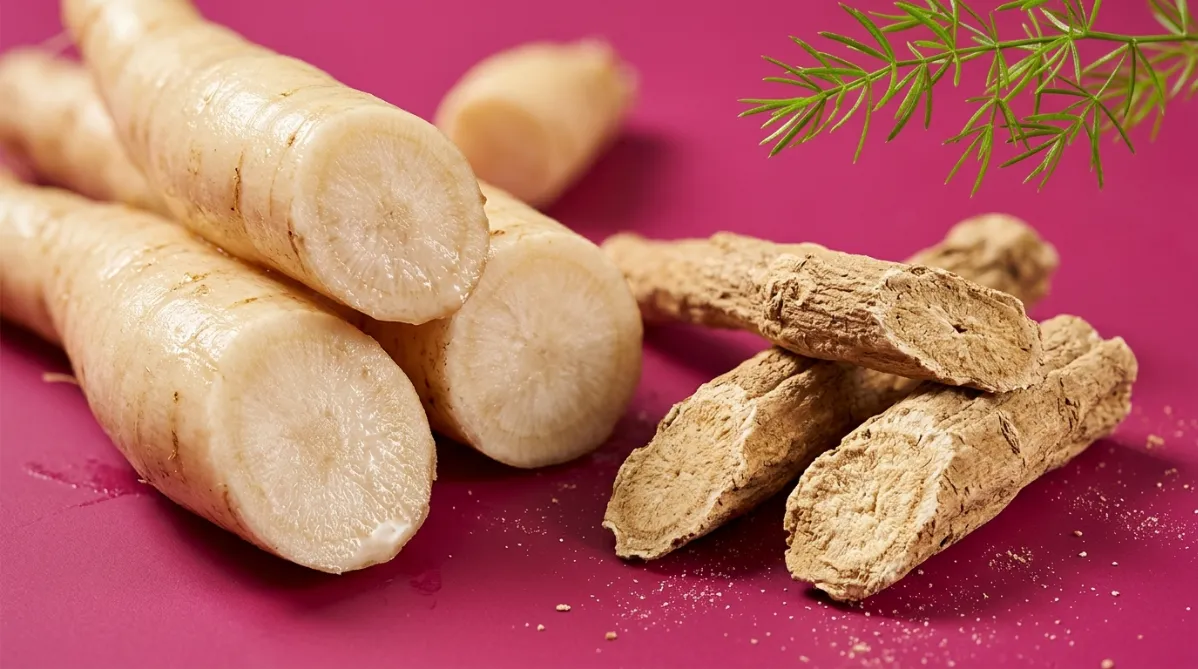
Shatavari (Asparagus racemosus) is classed in Ayurveda as a Rasayana, a rejuvenating tonic traditionally used to support female reproductive health and general well-being. Ashwagandha is another Rasayana, best known as an adaptogen for stress.
The study was prospective, randomized, double-blind and three-armed. Participants received one of the following for 8 weeks:
- SHT: standardized shatavari root extract
- SHT-ARE: shatavari plus ashwagandha root extract
- PL: placebo
The primary outcome was the Female Sexual Function Index (FSFI). Secondary measures covered satisfying sexual events, sexual distress (FSDS), mood (POMS), happiness (Oxford Happiness Questionnaire) and sleep quality (PSQI). Safety monitoring included adverse events plus liver, thyroid and renal markers.
The headline results
Shatavari alone
Compared with placebo, the shatavari-only group improved on:
- Total FSFI score (P = 0.025)
- Satisfaction domain (P < 0.0001)
- Sexual distress (FSDS) (P = 0.008)
Notably, the other individual FSFI domains did not reach significance in this arm.
Shatavari plus ashwagandha
The combination group showed a broader pattern versus placebo:
- Total FSFI (P = 0.005)
- Arousal (P = 0.041)
- Lubrication (P = 0.027)
- Orgasm (P = 0.031)
- Number of sexual intercourses (P = 0.001)
- Sexual distress (FSDS) (P < 0.0001)
- Happiness (OHQ) (P < 0.0001)
- Mood (POMS): lower tension, anger, depression, fatigue, confusion, esteem-related affect and total mood disturbance (P < 0.0001)
Sleep was largely unchanged. The only PSQI difference was in sleep efficiency (P = 0.045) for the combination group.
The authors conclude that shatavari is safe, effective and well tolerated, and that it shows an additive effect with ashwagandha.
Why the stack may make sense
Sexual function in women is not purely mechanical. Stress, low mood, fatigue and emotional distress all feed into desire and arousal. The combination arm improved the physical domains and the psychological ones at the same time. That fits the idea of pairing a women's-health tonic with a stress-focused adaptogen, though this trial was not designed to prove the mechanism.
Who this might be relevant for
Based on the abstract, the evidence applies to adult women interested in sexual wellness and well-being, particularly those who experience sexual distress or lower satisfaction. The abstract does not describe the participants' menopausal status or clinical diagnoses. Whether the results apply to women with a specific condition, such as menopause-related symptoms or a diagnosed sexual dysfunction, is unknown.
As for practical details, the abstract does not give the dose, timing or formulation. If you are considering a product, check the full text of the paper for the exact amounts. Look for a standardized root extract, not just a generic powder, because the trial tested standardized extracts. Treat 8 weeks as the evidence-based timeframe. There is no data here on what happens beyond that.
Safety: reassuring, with context
All reported adverse events were mild and resolved without intervention. The researchers also tracked liver, thyroid and renal function markers, which is a sensible step given general safety questions around herbal products.
That said, this was a short trial of 135 women. It cannot rule out rare or long-term effects. Ashwagandha in particular has attracted general caution regarding thyroid effects and rare liver injury reports outside this study, and the trial's reassuring abstract does not erase those concerns. Women who are pregnant, breastfeeding, on thyroid or hormone-related medication, or managing liver or hormone-sensitive conditions should speak with a clinician first. These groups were not addressed in the abstract.
The caveats worth knowing
1. The stack wasn't compared with ashwagandha alone. The design had shatavari, shatavari plus ashwagandha, and placebo. With no ashwagandha-only arm, the "additive effect" is an inference. The combination's broader results may reflect ashwagandha's own contribution, not true synergy.
2. Different significance patterns are not a head-to-head win. The combination reached significance in more domains versus placebo, but the abstract does not report a direct statistical comparison of the two active arms. "More boxes ticked" is not the same as "proven superior."
3. Many outcomes, small groups. The trial examined numerous secondary measures across about 135 participants. With that many comparisons, some findings may be chance, and the secondary results are best viewed as promising signals.
4. Subjective, self-reported outcomes. Questionnaires like the FSFI and POMS are standard, but they are vulnerable to expectation effects, even in blinded designs.
5. Industry-style trial features. Standardized proprietary extracts and a multi-endpoint, branded-ingredient design are typical of supplement-company research. The abstract does not state who funded the study. Check the paper's funding and conflict-of-interest disclosures, and look for independent replication before treating the results as settled.
6. Short duration. Eight weeks tells us nothing about long-term benefit or safety.
The bottom line
This is a well-structured, placebo-controlled trial with encouraging results. Shatavari alone improved total sexual function, satisfaction and distress, and pairing it with ashwagandha was associated with wider gains in arousal, lubrication, orgasm, mood and happiness. But the study needs replication, an ashwagandha-only comparison and transparent funding details before the "stack" claim can be called proven. For now, it is a credible early signal, not a prescription.
Source: Ademola et al., Int J Womens Health, 2026. https://doi.org/10.2147/IJWH.S561213. This article is for information only and is not medical advice.