Weight-loss headlines about semaglutide and its cousins keep circling one worry: that the drugs eat muscle. A new study in GeroScience suggests that, at least at the level of the muscle cell itself, the accusation may be misplaced. When researchers applied semaglutide or GIP directly to primary human myotubes, the cells did not waste. They did not switch on atrophy genes, release a worrying cocktail of inflammatory proteins, or lose thickness.
The finding does not make the lean mass problem disappear. It relocates it.
The Question Behind the Study
In clinical trials, GLP-1 receptor agonists and dual GIP/GLP-1 agonists produce striking weight loss. They also produce a measurable loss of lean body mass, which includes skeletal muscle, as part of that weight change. For older adults, who already face a gradual decline in muscle (sarcopenia), that matters a great deal.
There are two broad explanations. The first is a direct pharmacological effect, meaning the drug acts on muscle tissue and pushes it toward breakdown. The second is indirect: people eat much less, often get less protein, and move or load their bodies less, so muscle shrinks the way it would with any large energy deficit. Ditchfield, Macleod and Price set out to test the first possibility in a clean experimental system.
How the Experiment Worked
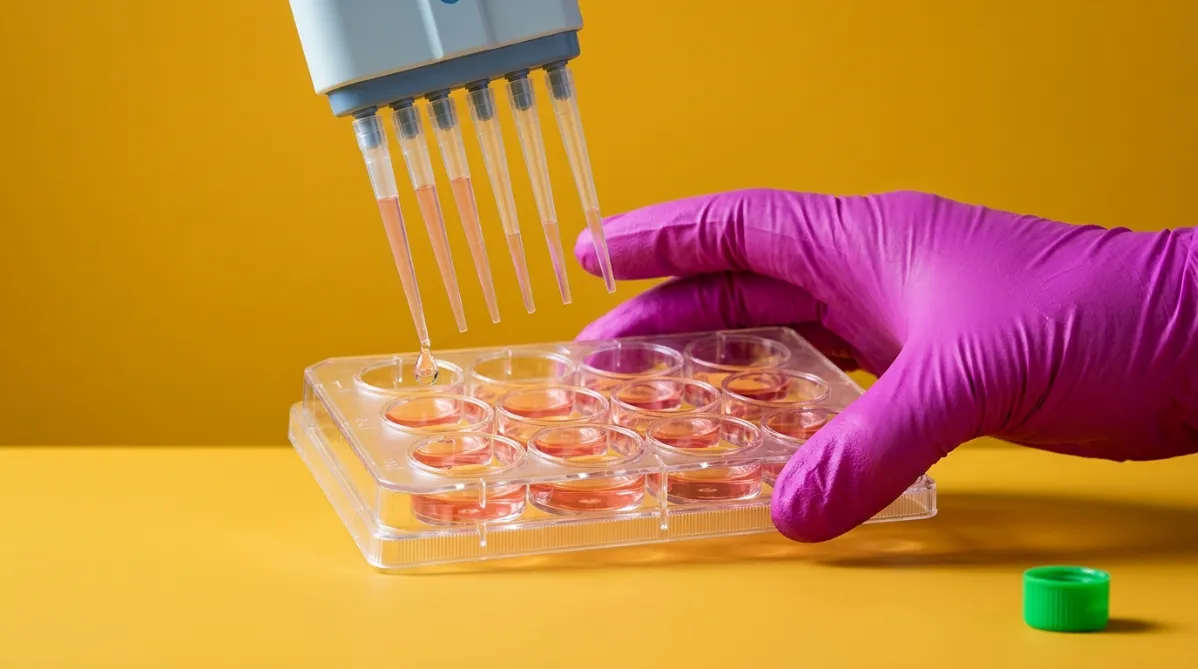
The team isolated primary myoblasts, the precursor cells of muscle fibers, from skeletal muscle of older adults with obesity who were undergoing orthopaedic surgery. That donor population is deliberately relevant: it resembles the people most likely to be prescribed incretin therapy and most vulnerable to muscle loss.
The researchers first asked whether these cells carry the right receptors. They then differentiated the cells into myotubes and treated them with semaglutide or GIP peptide. Readouts included:
- Atrophy-related gene expression by qPCR
- Secretome changes using the Olink Reveal proteomic panel
- Mitochondrial and glycolytic energy metabolism using Seahorse XF ATP rate assays, glucose uptake and lactate secretion
- Myotube thickness and differentiation using immunofluorescence
Receptors: GIPR Present, GLP-1R Barely There
GIPR mRNA was consistently detected in cells from every donor. GLP-1R told a different story. Its mRNA was undetectable by PCR. Using LUXendin645 flow cytometry in a subset of three donors, however, the team found low-level GLP-1R protein at the cell surface in roughly 51 to 66 percent of myoblasts.
That result is a useful reminder that receptor detection depends on the method. Absent mRNA does not always mean absent protein, and a low density of surface receptors may still matter, though here it did not translate into major cellular effects. The authors' data suggest that human muscle cells are, at best, modestly equipped to respond to GLP-1 directly.
No Atrophy Signal, No Secretome Alarm
The headline result is what did not happen. Neither semaglutide nor GIP altered the expression of atrophy-related genes. The secretome analysis, which looks at proteins released by the cells, found nothing reaching statistical significance. If the drugs were poisoning muscle, or pushing it to send distress signals, this is where it would likely appear.
Myotube thickness and differentiation were also preserved. Neither treatment impaired the ability of cells to fuse and form myotubes, so myogenesis appeared intact.
A Small Metabolic Wrinkle
There was one measurable effect. Semaglutide reduced glycolytic and total ATP production rates, with reduced lactate secretion, pointing to a modest suppression of glycolytic flux. Mitochondrial parameters were unaffected.
This is a subtle shift rather than a sign of cellular damage, and the study does not show it harms muscle function. Still, it is a signal worth following. Whether a small reduction in glycolytic output matters in living muscle, where fuel supply, hormones and nerve activity all interact, remains an open question.
GIP Might Even Help
In a twist, GIP increased myotube thickness after eight days of treatment. This was an in vitro observation and should not be read as evidence that GIP builds muscle in people. But it does cut against the notion that incretin signaling is inherently catabolic for muscle cells. It also adds some nuance to dual agonists such as tirzepatide, which engage both GIP and GLP-1 pathways.
What This Means for Older Adults
The authors conclude that direct activation of GLP-1 and GIP receptors did not produce major atrophic, inflammatory, morphological, myogenic or mitochondrial effects in these cells. That is consistent with an indirect mechanism for the lean mass loss seen clinically.
If that interpretation holds, the practical focus shifts from the drug as a muscle toxin to the context in which it is used:
- Energy deficit: large, rapid weight loss tends to cost lean tissue regardless of how it is achieved.
- Protein intake: appetite suppression can leave older adults under-eating protein.
- Mechanical loading: less activity and lower body mass reduce the stimulus muscles receive. Resistance training is the obvious countermeasure.
These are not new ideas, but this study adds cell-level support for prioritizing them. It suggests that protecting muscle during incretin therapy may depend more on diet quality and exercise than on avoiding a specific drug.
Important Caveats
This is an in vitro study. Myotubes grown in a dish lack blood flow, nerves, circulating hormones, immune cells and the whole-body energy deficit that accompanies treatment. Drugs could affect muscle indirectly through other organs, such as through appetite centers, adipose tissue, gut hormones or inflammation, none of which this model captures. The GLP-1R protein analysis was limited to three donors, and donors were older adults with obesity undergoing orthopaedic surgery, which may not represent all patients. Exposure conditions in a dish also may not mirror drug levels in muscle tissue.
The results show that direct receptor-mediated muscle wasting is not obvious in this model. They do not prove that these drugs are muscle-neutral in people.
The Bottom Line
For anyone worried that semaglutide is quietly dissolving muscle cell by cell, this study offers some reassurance: human myotubes exposed to semaglutide or GIP did not show the molecular or structural hallmarks of atrophy. The bigger risk is likely the circumstances around the drug, namely eating far less, getting less protein and moving less. Clinical trials that combine incretin therapy with protein targets and resistance exercise in older adults will be the real test of that idea.