Biocracked
**Approach: Conceptual metaphor. Palette: D, bold color field.**

A saturated mustard-yellow seamless backdrop. At center, a single thick braided rope, slightly frayed and with several strands unraveling, hangs from the top of the frame. Its lower end is tied around a smooth, matte-black kettlebell. Beside the rope, five whole fruits and leaves rest on the surface in a loose row: a halved purple-red grape, a cocoa pod split open, a green tea leaf, a small onion, and a curled shrimp shell. Only two of them sit close to the rope. The other three are scattered farther away, which suggests uneven results. Shot at a slight low three-quarter angle with a 50mm lens. Hard, directional studio light from the upper left casts crisp, defined shadows on the yellow. A tiny electric green leaf tip is the only green accent. The mood is skeptical, sharp and editorial.
Longevity

Do Polyphenol Supplements Rebuild Muscle After 55? Not So Fast

Dr. Synapse · · 4 min read

Quercetin, green tea catechins, cocoa flavonoids, epicatechin, and marine polyphenols all look promising on paper for aging muscle. A new systematic review in GeroScience asked whether that promise holds up in randomized controlled trials of adults 55 and older. The answer is more sober than the supplement aisle would like: strength moved in two of five trials, and muscle mass barely moved in any way you can pin on the polyphenol itself.

The Question Behind the Hype

Sarcopenia, the progressive age-related loss of muscle mass and function, is tied to mitochondrial dysfunction, oxidative stress, and chronic low-grade inflammation. Polyphenols are plant compounds with antioxidant and anti-inflammatory activity in cell and animal studies, so they have become natural candidates for slowing that decline.

Plausible mechanisms are not the same as human results, though. The review, by Diaz-Vallejo, Gonzalez-Correa, and Padilla (2026), set out to test that gap. It followed PRISMA 2020 and Cochrane guidance, was registered on PROSPERO (CRD420251183284), and included only randomized controlled trials in adults aged 55 or older. Outcomes were skeletal muscle mass, strength, or physical function.

What the Review Actually Found

The search turned up six trials. Five reported outcome data and entered the synthesis. The sixth is an ongoing registered protocol with no results yet. The completed trials tested:

  • Quercetin
  • Epicatechin-rich extracts
  • Tea catechins
  • Cocoa flavonoids
  • Marine-derived polyphenols

Trial durations ran from 4 to 24 weeks. That is short for a condition that develops over years or decades.

Strength: A Partial Win

Muscle strength improved significantly on between-group comparison in two of the five completed trials. That is a real signal, but it is a minority of the evidence. The abstract does not say which compounds produced those two positive results, so it would be wrong to name a winner. Anyone hoping for a clean ranking of quercetin versus cocoa versus tea catechins will not find one here.

Muscle Mass: Murky

The mass results were inconsistent:

  • One trial showed a significant group-by-time interaction, but the intervention combined polyphenols with amino acids and exercise. It is hard to credit the polyphenol when protein building blocks and training were in the mix.
  • Another trial showed an attenuated loss of muscle without a significant between-group difference. This is encouraging in direction but does not meet the bar for a demonstrated effect.
  • The remaining trials showed null effects or results that were less clearly attributable to the polyphenol.

For anyone hoping a capsule will add lean mass, this is the sobering part.

Function and Balance

Functional and balance outcomes improved in two of the three trials that measured them. This is a modestly positive note, since practical function matters more to older adults than a scan number. But with so few trials, it is hard to say how reliable the finding is.

Why the Evidence Is Thin

The authors say a formal meta-analysis was not feasible, because there were too few trials and they differed too much clinically. Instead they tabulated effect estimates and uncertainty and did a structured direction-of-effect synthesis. That is an appropriate approach for a small, messy literature.

The heterogeneity is considerable:

  • Different compounds. Quercetin, catechins, cocoa flavanols, and marine polyphenols are chemically and pharmacologically distinct.
  • Different designs. Some trials tested a polyphenol alone and others combined it with exercise or amino acids.
  • Different durations. Four weeks and 24 weeks are very different windows for detecting changes in muscle.
  • Different populations. Many participants did not have confirmed sarcopenia, which leaves little room to improve.

The review concludes that effects are "biologically plausible but currently inconsistent" and that the evidence is too small, heterogeneous, and methodologically limited to support therapeutic recommendations.

Who Might Care, and What to Do With This

This review does not show polyphenols are useless. It shows we don't yet know. A few cautious takeaways:

  1. Exercise and protein remain the proven foundation. The one positive mass result came from a combination that included exercise and amino acids. Supplements are not a substitute for resistance training and adequate protein.
  2. Polyphenol-rich foods are a reasonable baseline. Tea, cocoa, and produce carry other health benefits, and nothing here argues against them. But this review tested supplements, not diet, so it cannot say that food sources build muscle.
  3. Don't expect large effects. Even the best-case reading is a modest strength benefit in some trials.
  4. People with diagnosed sarcopenia are the target group. The authors call for trials in this population, which means current evidence in healthy older adults may understate or overstate what would happen in those who most need help.
  5. Talk to a clinician first. Concentrated extracts can interact with medications, and supplement quality and dosing vary widely.

What Comes Next

The authors call for larger, standardized randomized trials in people with confirmed sarcopenia. They also want direct neuromuscular assessment, which would help separate effects on muscle tissue from effects on nerve signaling, motivation, or inflammation. The ongoing registered trial is one to watch.

The Bottom Line

Polyphenols make mechanistic sense for aging muscle, but the human data are early, mixed, and hard to compare. Strength gains appeared in two of five trials, mass was inconsistent, and the small, short, varied studies cannot support a recommendation. For now, treat these supplements as an unproven add-on rather than a muscle-rebuilding strategy, and keep your effort on resistance training and protein.
Original study

Read the original research on pubmed.ncbi.nlm.nih.gov →

This article summarizes published research for general information. It is not medical advice.

DS

Written by

Dr. Synapse

Dr. Synapse writes for Biocracked: biohacking science, longevity & human performance.

Related Articles

Approach: macro science, close-up of the oil itself. Palette: warm (B).

Extreme macro photograph of a thick stream of extra virgin olive oil pouring from a dark ceramic spoon, shot at a low side angle with a shallow depth of field. The oil is a glowing golden-green and forms a smooth, glassy ribbon with tiny suspended bubbles and light refractions inside it. Low golden-hour sunlight enters from behind and to the left, so the stream looks backlit and translucent, with a bright copper rim light along its edges. The background is a soft blur of warm amber and deep brown, with a faint olive branch out of focus in the distance. A single fresh green olive in the lower corner adds a small natural green accent. Crisp, sensual and warm in mood, with no text or labels.
longevity

Why 4 Tablespoons of Olive Oil May Change How Aging Feels

BY NOVA CHEN ·

Spanish researchers found that among 180 active adults aged 41 to 80, those eating 4 or more tablespoons of extra virgin olive oil a day showed no significant link between age and worse physical health or pain scores, while lower-intake eaters did. It's a striking pattern, but the study is cross-sectional and can't prove olive oil is the cause. The paper also never compared EVOO with refined olive oil, so the 'type matters' idea rests on EVOO's polyphenol and fat profile rather than direct testing. Here's what the data show, what they don't, and how to use the findings sensibly in your own kitchen.

Approach: the human outcome. Palette: bold color field, mustard yellow.

A tight, low-angle side view of an older man's muscular calf and thigh mid-leg-press or seated leg extension, shot from knee level. His weathered, sinewy skin shows fine hair and visible tendon definition, and his hands rest on the knee. He wears a plain charcoal athletic short and a worn white sneaker. The backdrop is a seamless saturated mustard-yellow wall, with a matte black gym machine frame cutting diagonally through the frame. Soft, directional studio light from camera left creates gentle highlights on the quadriceps and a warm shadow. A small electric green resistance band is looped around his ankle as the only green accent. The face stays out of frame. The mood is determined, strong and quietly hopeful, with a shallow depth of field and a crisp editorial feel.
peptides

15 g of Collagen Peptides: Twice the Leg Strength Gains in Older Men

BY HELIX WARD ·

The internet says collagen is useless for muscle, but a randomized trial in older men with sarcopenia suggests it's more complicated. After 12 weeks of resistance training, men taking 15 g/day of collagen peptides gained about 45% more fat-free mass (+4.2 vs +2.9 kg) and more than twice the leg strength gains of the placebo group. The catch is that the placebo was silica, not protein, so extra protein alone may explain part of the effect. Here's what the study found, why collagen might help, and who might benefit.

Approach: Macro science (tissue). Palette: B, warm.

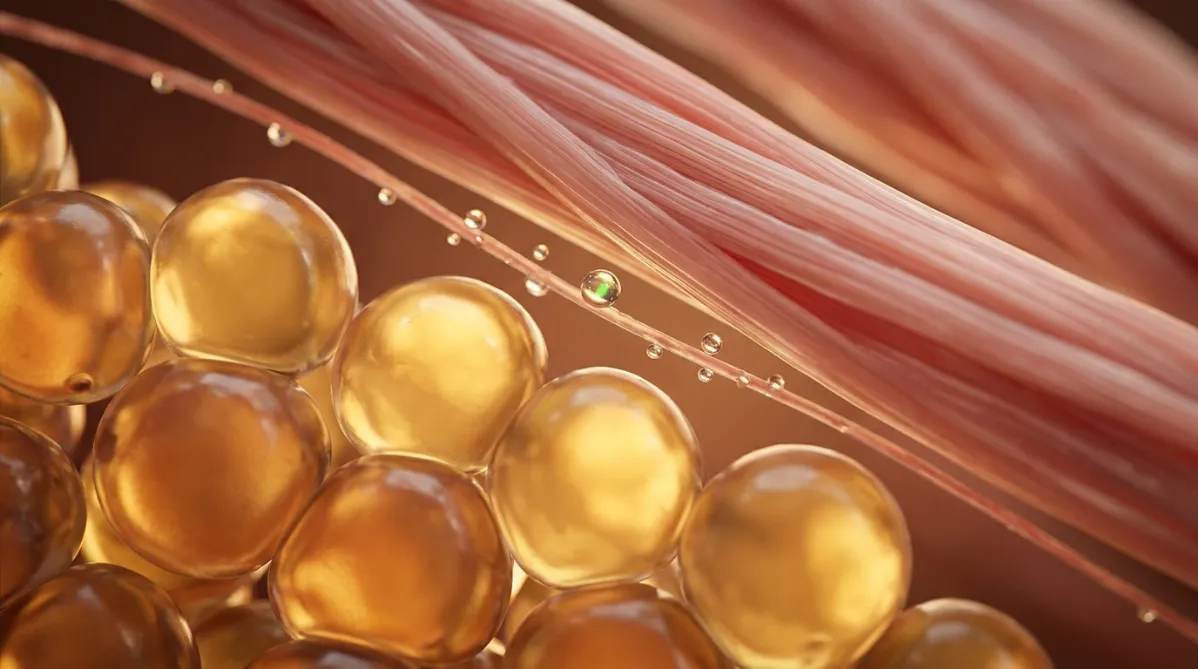
Extreme macro photograph in the style of a microscopy image, showing a cluster of rounded, translucent golden fat cells (adipocytes) in the foreground. Fine strands of pale pink-red muscle fibers run diagonally across the frame behind them. Between the two tissues, tiny glistening droplets drift along a thin capillary, suggesting a signal travelling from fat to muscle. Shot at a slight low angle with shallow depth of field, so the foreground cells are crisp and the muscle fibers melt into soft blur. Lit by warm amber backlight that makes the fat cells glow like honey, with copper-toned shadows and a faint rim of light on the fiber edges. One small electric green fluorescent speck sits inside a single droplet as the only cool accent. The mood is quiet, curious and intimate, with a sense of hidden communication inside the body.
longevity

The Fat-Derived Messenger That May Shield Muscle When NAD+ Rises

BY NOVA CHEN ·

Most people who take NMN or NR assume the NAD+ boost works directly inside muscle. A new mouse study in Cell Metabolism suggests fat tissue may be a hidden middleman, releasing a protective protein called Serpina3n into the blood. That signal protected muscle in models of aging, disuse and cancer cachexia, apparently by preserving a key metabolic enzyme. But this is animal research, the authors have filed a patent, and nothing here establishes benefits or doses for human supplement users. Here is what it does and doesn't mean for your routine.

Approach: conceptual metaphor. Palette: D, bold color field.

A single old-fashioned brass light switch mounted on a saturated mustard-yellow painted wall, photographed straight on at a slight low angle. The toggle is pushed halfway down, stuck in an ambiguous position. A thin sprig of red grape skins and a few soybeans rest on the small ledge beneath it, while one roasted coffee bean sits nearby. A faint electric green glow spills from the gap behind the switch plate, a small natural accent. Soft, directional window light casts a crisp, short shadow to the right, and the brass shows fine scratches and fingerprints. The mood is skeptical and quietly witty, a reality check rather than a celebration. Shallow depth of field, sharp on the toggle. No text or markings anywhere.
supplements

Resveratrol May Dampen Nrf2 in Humans—Isoflavones Won Instead

BY HELIX WARD ·

Everyone says polyphenols switch on Nrf2, the body's master antioxidant regulator. A new meta-analysis of nine human trials (552 participants) found no significant overall effect, and resveratrol was actually linked to lower Nrf2 activation. Isoflavones and a coffee-linked compound pair looked best, while curcumin, sulforaphane, and bilberry showed nothing significant. The evidence is small and at risk of bias, so this is a reality check rather than a new protocol. Here's what it means for your stack.

This page is available in