Biocracked
**Approach:** Conceptual metaphor. **Palette:** Bold color field (mustard yellow).

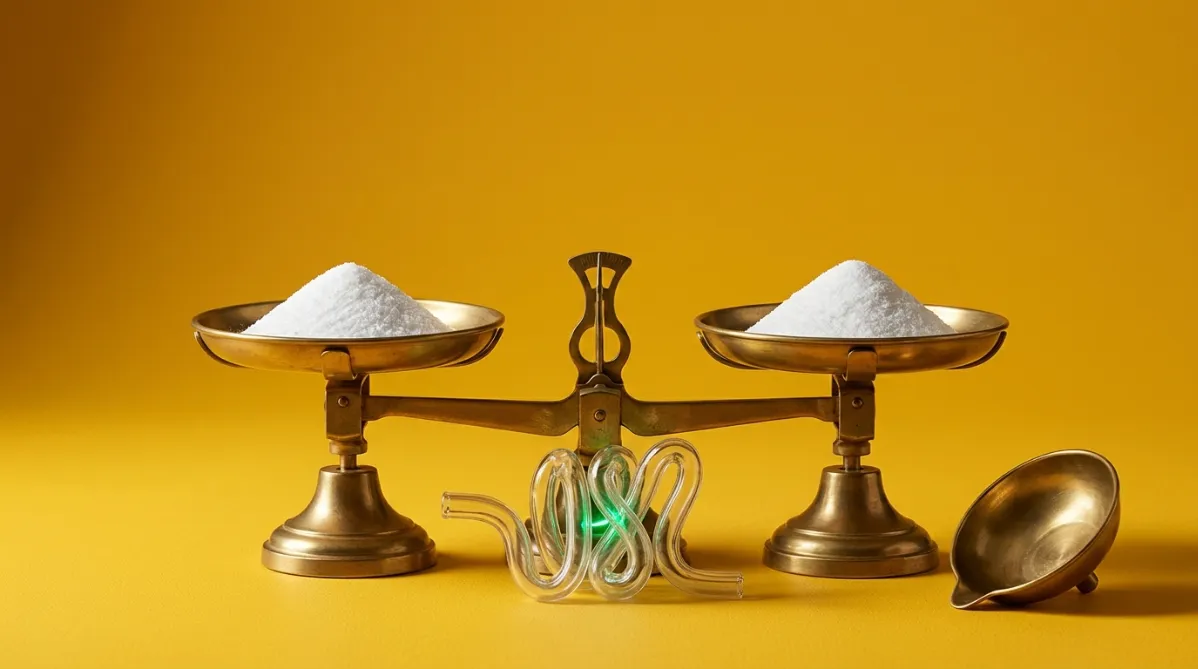
Straight-on, slightly elevated camera view of a pair of identical brass balance scales on a saturated mustard-yellow seamless backdrop. The pans sit perfectly level. One pan holds a small mound of fine white crystalline powder, the other holds an almost identical mound. A third, smaller pan lies tipped and lighter off to the side. Between the scales, a single translucent glass tube coils like a gut, with a tiny electric green (#00e676) glow inside it. This is the only green in the frame. Lighting is soft, directional studio light from the upper left, with crisp, gentle shadows on the yellow surface and warm metallic highlights on the brass. Mood: playful, curious, quietly skeptical. Photorealistic with sharp macro detail on the powder grain and the glass.
Supplements

NMN vs NR: First Human Head-to-Head Finds a Tie and a Gut Twist

Nova Chen · · 4 min read

You've probably seen the sales pitch: NMN is the "next-generation" NAD+ booster, NR is the original, and nicotinamide is the budget option nobody cares about. A new randomized human trial from Nestlé researchers just scrambled that hierarchy. NR and NMN performed comparably at raising blood NAD+. Nicotinamide did not. And the likely reason involves your gut bacteria turning both supplements into something much cheaper and more familiar: nicotinic acid, a form of niacin.

The study was published in Nature Metabolism (2026;8(1):62-73) and is the first to compare all three precursors directly in people.

Why NAD+ Is Such a Big Deal

NAD+ (and its phosphorylated cousin NADP) are vitamin B3-derived cofactors involved in countless metabolic reactions and protein modifications. Disturbances in NAD+ balance have been linked to a range of health conditions, which is why the supplement industry has built an entire category around "restoring" it.

Three precursors dominate the market:

  • Nicotinamide (Nam): the cheap, long-known form of vitamin B3
  • Nicotinamide riboside (NR): the first widely marketed "NAD+ booster"
  • Nicotinamide mononucleotide (NMN): the premium-priced challenger

Until now, the evidence for choosing among them came mostly from animal and cell studies. Human head-to-head data was missing.

The Study Design

Researchers ran a randomized, open-label, placebo-controlled trial in 65 healthy adults. Participants took Nam, NR, NMN, or placebo for 14 days. The team then went further than most supplement trials, adding two mechanistic layers:

  1. Ex vivo gut fermentation using human microbiota, to see what bacteria do to each compound.
  2. Whole-blood experiments, to test which compounds boost NAD+ directly in blood cells.

The trial is registered as NCT05517122. The abstract does not list exact doses, so check the full text for those.

The Results: A Tie, and a Loser

NR and NMN comparably increased circulating NAD+ after 14 days. Nicotinamide did not produce that sustained rise.

Nam wasn't inert, though. It was the only compound to acutely and transiently alter the whole-blood NAD+ metabolome, a short-lived spike in activity rather than a lasting elevation. The authors attribute this to Nam being rapidly absorbed and entering the salvage pathway quickly.

So the headline for shoppers: in this trial, there was no evidence that NMN outperforms NR on blood NAD+, despite the price gap commonly seen on shelves.

The Gut-Microbe Twist

Here's where it gets interesting. Recent rodent research had suggested that NR and NMN may work partly by being converted by gut microbes into nicotinic acid (NA). This study tested that idea in human material.

  • In ex vivo fermentation with human microbiota, NR and NMN gave rise to NA and specifically enhanced microbial growth and metabolism.
  • In whole blood ex vivo, NA was a potent NAD+ booster, while NMN, NR and Nam were not.

The authors propose a gut-dependent model: NR and NMN raise systemic NAD+ largely through the Preiss-Handler pathway (the route that starts with nicotinic acid), while quickly absorbed Nam acts acutely via the salvage pathway. The researchers describe a dual effect for NR and NMN: a sustained rise in systemic NAD+ plus a modulating effect on gut health via NA.

Note the careful wording: this is a proposed model built from a human trial plus ex vivo experiments. It is not proof that microbial conversion is the only route in a living person.

What It Means for the NMN vs NR Debate

If both compounds are funneled through similar microbial chemistry, the marketing arguments about NMN's "superior" absorption or NR's "better evidence" lose some force, at least for blood NAD+. On this evidence the two look interchangeable, so price and product quality become the main differentiators.

What It Means for Cheap Niacin

The uncomfortable implication for premium brands: if nicotinic acid is the potent NAD+ booster in blood, ordinary niacin may deserve a closer look. The study did not test niacin supplementation in humans, so it cannot say that niacin matches NR or NMN. But the mechanism raises a legitimate question that future trials should answer directly.

Limitations You Should Know

  • Short duration: only 14 days. Long-term effects are unknown.
  • Open-label: participants and researchers knew who received what, which can introduce bias, though blood NAD+ is an objective measure.
  • Healthy adults only: results may not carry over to older people or those with metabolic disease.
  • Surrogate endpoint: raising blood NAD+ is not the same as improving health outcomes.
  • Industry funding: the authors are employees of Nestlé Research and Nestlé Health Science (plus one from Cryptobiotix). That doesn't invalidate the work, which was peer reviewed, but independent replication matters.
  • Mixed evidence: ex vivo gut and blood experiments don't fully reproduce what happens in the body.

Practical Takeaways

This is general information, not medical advice. Talk to a clinician before supplementing, especially if you take medications or have a health condition.

  • Pick the cheaper of NR or NMN. Based on this trial, neither showed a blood NAD+ advantage over the other. Choose a reputable brand with third-party testing.
  • Don't count on plain nicotinamide for sustained NAD+ elevation. In this study it produced only a transient effect.
  • Doses vary. Other human trials of NR and NMN have commonly used roughly 250 to 1,000 mg per day. That is general context from the wider literature, not the doses from this study, and not a recommendation.
  • Gut health likely matters. If microbes do the conversion, your microbiome may influence how well these supplements work. That could partly explain why individual responses vary.
  • Mind the niacin flush. Nicotinic acid is the form known for causing flushing (warmth, redness, itching). If you consider niacin as a cheaper route, speak to a doctor first, since high doses carry real risks and the flush is only one of them.

The Bottom Line

The first human head-to-head suggests the NMN vs NR rivalry is more of a draw than the marketing implies, and that your gut bacteria may be the hidden middlemen. It's a short, industry-funded study in healthy people, so treat it as a strong hypothesis-builder rather than the final word. The next big question: does plain niacin do the same job for less?

Original study

Read the original research on pubmed.ncbi.nlm.nih.gov →

This article summarizes published research for general information. It is not medical advice.

NC

Written by

Nova Chen

Nova Chen writes for Biocracked: biohacking science, longevity & human performance.

Related Articles

**Approach: Human outcome. Palette: warm (B).**

Extreme close-up, slightly high angle, of a woman's scalp parting in her 40s. Dense, glossy chestnut-brown hair is split by a fine comb. Short new hairs rise from the visible scalp skin, and a few strands catch the light. Faces and identity are out of frame. Low golden-hour window light enters from camera left and rim-lights the strands in honey and copper. Shadows stay warm brown, with no blue cast. The shallow depth of field blurs the background hair into soft amber bokeh. A thin steel trichoscopy probe tip sits at the edge of the frame, and a tiny electric green LED glints on its housing as the only accent. The mood is hopeful but scrutinizing, like a clinical check-up with a cautious eye.
supplements

NMN Boosted Hair Density 57% in a Human Trial—With a Big Catch

BY NOVA CHEN ·

NMN, the NAD+ booster beloved by longevity fans, has now been tested on hair in people for the first time. In a 12-week pilot of 15 women aged 40-50, growth-phase hair density climbed from 55.9 to 87.7 hairs/cm², and hair diameter rose from 75.3 to 78.8 µm. Participants also reported better gloss, elasticity and volume. But there was no placebo group, the sample was tiny and the authors are linked to an NMN supplier. Here is what the numbers show, what they cannot show, and who should wait.

A softly lit editorial still life on a pale oat-colored linen surface, shot from a slightly elevated three-quarter angle in a wide landscape frame. At center-left, a small matte white ceramic dish holds a modest pile of fine off-white powder, with a tiny brushed-brass measuring spoon resting beside it. Next to the dish stands a minimalist amber glass supplement bottle with a plain cream label and no readable text. A few capsules spill casually across the linen, some translucent and some opaque ivory.

On the right side of the composition, a ripe blood orange cut in half and a handful of raw almonds sit on a light ash-wood board. A sprig of fresh rosemary adds a muted green accent. A sheer glass of water catches the light and throws a soft, rippled caustic pattern across the fabric.

In the background, out of focus, a woman's hand in a soft sage-green knit sleeve rests near a ceramic mug. This suggests a calm morning routine without showing a face. Behind her, a tall window casts diffused, golden-hour light from the upper left, with gentle shadows and a creamy, shallow depth of field.

The palette is warm and restrained: oat, ivory, terracotta, sage, and amber, with a single pop of coral from the blood orange. A thin, abstract line of muted terracotta paint, like a brushed arc, sweeps across the upper right background. It subtly evokes a rising curve without becoming a literal chart.

The mood is calm, trustworthy, and contemporary, like a premium wellness and science journal feature. The image has crisp focus on the powder and bottle, natural film-like grain, soft contrast, and generous negative space in the upper third for headline overlay. It looks like a high-end editorial photograph with no text, logos, or futuristic elements.
metabolism

NMN's First Human Win: 250 mg a Day Lifted Muscle Insulin Sensitivity by About 25% in Prediabetic Women

BY DR. SYNAPSE ·

NMN has long been a darling of the longevity market, but human evidence was thin until a 2021 Washington University trial published in Science. In postmenopausal women with prediabetes who were overweight or obese, 250 mg of NMN daily for 10 weeks improved muscle insulin sensitivity by roughly 25%. Muscle insulin signaling and genes tied to muscle remodeling also improved, while the placebo group saw no change. But the benefit was narrow, and the study did not show NMN lowering blood sugar or reversing prediabetes. Here's what the trial found, who it applies to, and what it didn't change.

Approach 4, conceptual metaphor, in palette D, bold color field.

A single AA-style cylindrical battery, shown as a real physical object with a matte metal casing, stands upright at the center of a saturated tomato-red seamless paper backdrop. Its top half is bright and glossy, while the lower half is scuffed and dull. A thin, crisp line of electric green liquid light fills the clear gauge window along its side, stopping about three-quarters of the way up. Three smaller, identical dead batteries lie tipped over in the foreground, slightly out of focus, to suggest the rival compounds. The camera sits at a low three-quarter angle with a shallow depth of field. A hard, warm key light from the upper left casts a sharp, long shadow across the red surface. The mood is punchy and skeptical: one cell charged, the others spent.
supplements

NMN vs NR vs NADH: One Lifted Endurance, None Fixed Fatigue

BY NOVA CHEN ·

A new network meta-analysis of 27 studies and 1,599 adults compared NMN, NR, NADH and nicotinamide, and the results are not what supplement marketing promises. NMN showed a dose-dependent boost in endurance, with a standardized mean difference of 1.02 at the high dose. NADH led for cognition, but mostly in cognitively impaired groups and with a result sensitive to influential studies. The surprise is that no precursor significantly improved perceived fatigue or sleep. Here is how the ranking breaks down, what the limits are, and who should or shouldn't bother.

Approach: conceptual metaphor. Palette: bold color field.

A single oversized brass balance scale sits on a saturated tomato-red seamless backdrop, photographed at a low three-quarter angle. One pan holds a small, glowing ember-orange coal that is cooling and dimming to grey ash at its edges, standing for inflammation. The other pan holds a tightly coiled, freshly cut green plant sprout with a tiny electric green (#00e676) tip, standing for repair and growth. The scale tips slightly toward the ember, leaving the viewer unsure which side is better. Hard but clean studio key light from upper left casts a crisp, graphic shadow across the red surface. Brass shows real fingerprints and fine scratches, and the ash has a visible powdery texture. The mood is tense, thoughtful and questioning, with the whole image shot at shallow depth of field and the fulcrum in sharp focus. No text, no markings on the scale.
supplements

NMN Calms Muscle Inflammation After Training—But at What Cost?

BY NOVA CHEN ·

NMN is sold as a cellular-energy booster, but a new muscle-biopsy study found a surprising tradeoff. After a damaging blood flow restriction workout, 1,200 mg/day of NMN suppressed inflammatory signals like TNF-α and IL-10. It also delayed a repair-related marker and erased the 171% mitochondrial increase seen with placebo. The study is tiny (11 untrained young men), so it can't settle anything. It does challenge the assumption that less post-workout inflammation is always better.

This page is available in