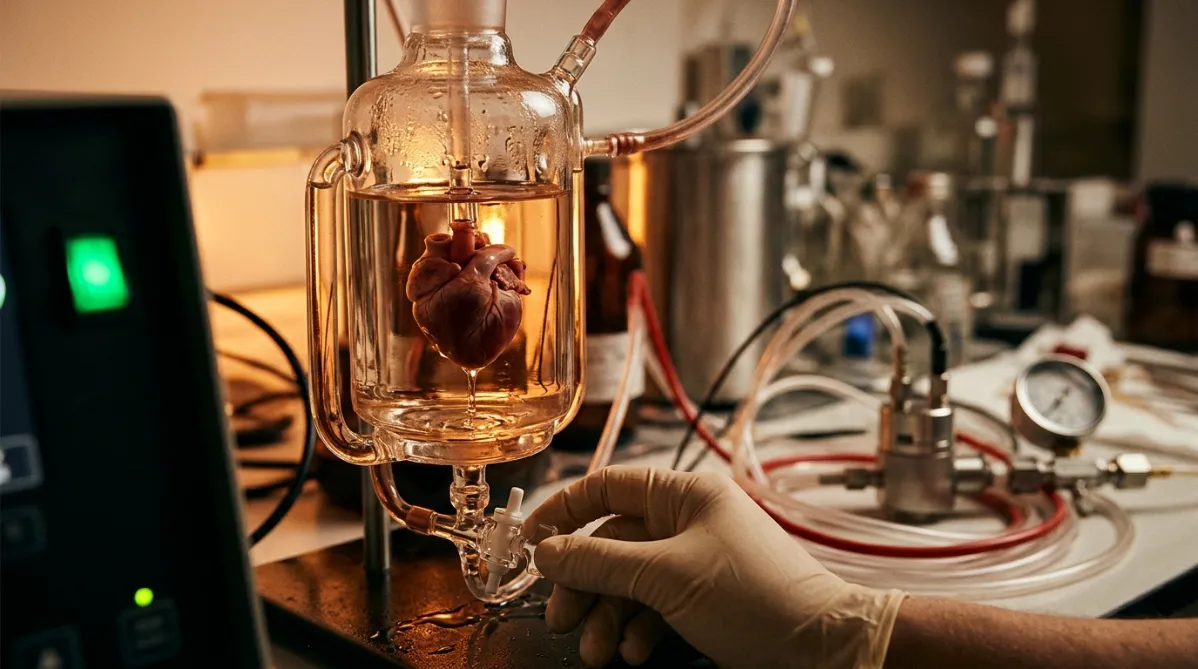
A pair of supplements you can buy online helped isolated hearts from aged rats recover from a heart-attack-style injury. Together they worked better than either one alone. That is the headline result of a new paper in Veterinary Research Forum. It comes with a large caveat: the work was done in rats, on hearts studied outside the body, so it says nothing yet about people.
What the researchers tested
The study, led by Amanzadeh and colleagues at Urmia and Tabriz Universities of Medical Sciences in Iran, looked at melatonin and nicotinamide mononucleotide (NMN). Each has shown heart-protective properties in earlier research, but the authors note that their combined effect on ischemia-reperfusion (IR) injury in the aged heart was unclear.
IR injury is the damage that occurs when blood supply to heart tissue is cut off (ischemia) and then restored (reperfusion). Restoring flow is essential, yet the sudden return can trigger inflammation and further injury. It is a central problem in heart attacks and in cardiac procedures. Age makes things worse, since the paper opens by noting that aging markedly raises vulnerability to cardiovascular disorders such as acute coronary syndrome and coronary artery disease.
How the experiment worked
- Animals: 40 male Wistar rats, split into five groups of eight: Sham (no injury), IR (injury only), melatonin plus IR, NMN plus IR, and NMN plus melatonin plus IR.
- Injury: hearts underwent 30 minutes of ischemia, then reperfusion.
- Melatonin: given at 50 µM in the reperfusion solution for 15 minutes after the ischemic period. It was delivered straight into the heart's perfusion fluid, not taken as a pill.
- NMN: given by intraperitoneal injection (into the abdominal cavity) at 100 mg/kg every other day for 28 days.
- Measurements: coronary flow, heart rate, left ventricular end-diastolic pressure, and left ventricular developed pressure. The team also measured creatine kinase, a marker of muscle injury, and the inflammatory markers IL-1β, IL-6, tumor necrosis factor-alpha, and NF-κB.
What they found
Injury alone significantly impaired coronary flow and heart rate. Both melatonin and NMN improved these measures.
Both agents also lowered left ventricular end-diastolic pressure and improved recovery of left ventricular developed pressure. The combination produced the greatest effect on these measures.
The biochemical results followed the same pattern. Creatine kinase and the inflammatory markers rose significantly in the untreated IR group. Treatment markedly reduced them, and combined treatment did so most. The authors conclude that melatonin and NMN have additive cardioprotective effects against IR injury in aged rats.
Why the combination is interesting
NMN is a precursor to NAD+, a molecule involved in cellular energy metabolism that has become a staple of longevity discussions. Melatonin is best known as a sleep-related hormone and is one of the most widely used over-the-counter supplements. Both are popular in the healthy-aging space, which makes any study pairing them attractive.
The paper's finding is more modest than the hype around either compound. It shows that in this rat model the two treatments, given together, outperformed each given alone on several measures of function and inflammation. It does not show that this is how they would act in a human heart, and the abstract does not claim so.
Limits you should not skip
This is animal, ex vivo research. The hearts were assessed as isolated organs, so there was no circulating blood, no full immune response, and none of the complexity of a living patient with other conditions and medications.
The delivery routes are not supplement-like. Melatonin went into the perfusion fluid at a fixed concentration for a short window. NMN was injected into the abdomen. Neither mirrors swallowing a capsule, and the study cannot be translated into an oral human dose.
Small, single-sex samples. Eight rats per group, all male, is a standard design for early work but limits how far the findings generalize. The abstract also describes the animals as "adult male Wistar rats" while the title and aims refer to aged rats, so the exact age of the animals is worth checking in the full text.
The abstract is limited on mechanism. It reports reduced inflammatory markers and better function, but it does not establish exactly how the two compounds interact. It also does not mention other outcomes, such as infarct size, in the summary.
The timing differs between the two agents. NMN was a four-week pretreatment, while melatonin was given only at reperfusion. This makes it hard to say what the benefit would look like in a real emergency, which usually cannot be planned for.
The authors report no competing financial interests.
Practical takeaways
- Dose: there is no human dose to take from this paper. The rat doses (100 mg/kg NMN by injection, 50 µM melatonin in perfusate) are not human supplement doses and should not be converted into one.
- Timing: in the study, NMN was given every other day for 28 days beforehand and melatonin during reperfusion. That protocol is a laboratory design, not guidance.
- Who it's for: at this stage, researchers, not consumers. People with heart disease, or anyone taking cardiac medications or blood thinners, should talk to a clinician before adding supplements. Neither compound is a substitute for emergency care or established treatment.
- What to watch for: studies in living animals, then human trials with clinical outcomes. Those will show whether this additive effect survives outside an isolated heart.
Bottom line
The study adds to the case that NAD+ support and melatonin deserve further investigation as heart-protective strategies in aging. It is an encouraging preclinical signal and nothing more. Until the work is repeated in living animals and tested in people, treat it as an interesting lead rather than a reason to change your supplement routine.