Biocracked
Approach: conceptual metaphor. Palette: D, bold color field.

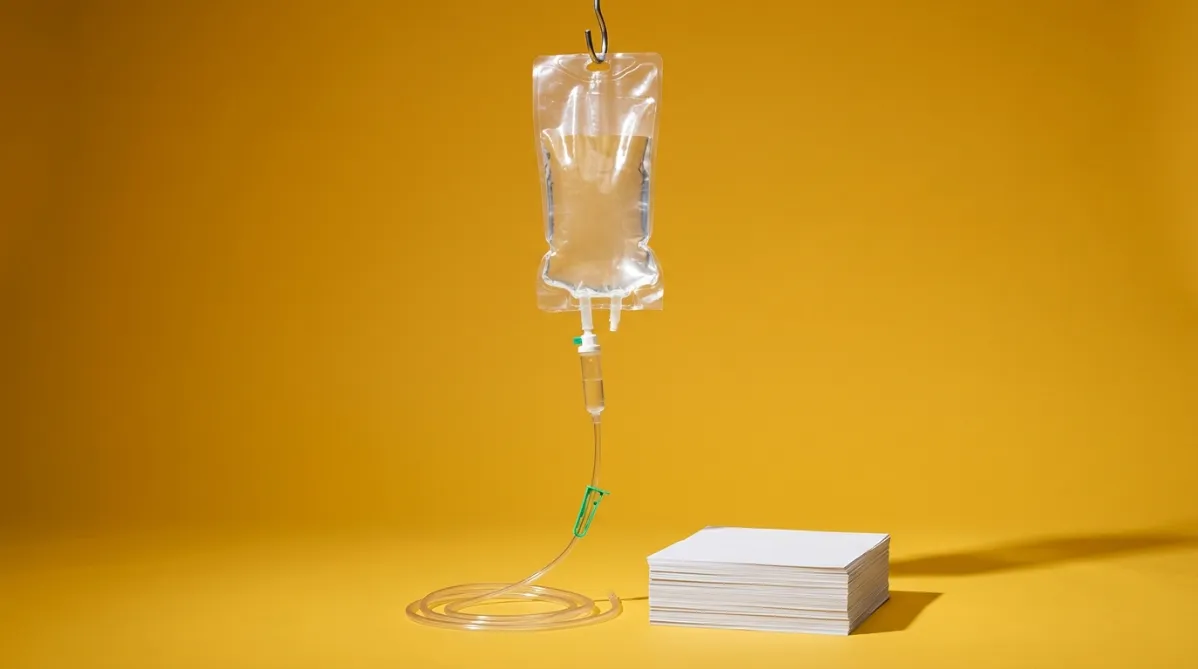
A single clear IV drip bag hangs against a saturated mustard-yellow seamless backdrop, photographed straight-on at slight low angle. The bag is full of clear fluid, but its tubing ends in a loose, empty coil on the floor, connected to nothing, which suggests a promise with no evidence behind it. Beside it sits a tidy stack of 113 thin white paper sheets, unmarked and blank, casting a hard-edged shadow. A thin electric green clamp on the tubing gives a small accent. Lighting is bright, direct studio strobe from upper left, with crisp, warm-neutral shadows and slight translucent glow through the bag. The mood is skeptical, clean and editorial, with a wry tone. Sharp focus, shallow depth of field on the background, photorealistic plastic and liquid textures.
Supplements

NAD+ Drips Have Zero Outcome Trials: What 113 Studies Show

Nova Chen · · 4 min read

IV NAD+ drips are now sold in wellness clinics as a shortcut to energy, focus and slower aging. A new systematic review in Ageing Research Reviews asked what the published evidence supports. The answer for infusions is blunt: the authors found no eligible outcome trials of intravenous or intramuscular NAD+ for anti-aging or wellness. For oral NMN and NR, the evidence is better but still falls short of the marketing.

What NAD+ Is and Why It Declines

Nicotinamide adenine dinucleotide (NAD+) is a coenzyme found in every cell. It takes part in energy metabolism and in the activity of enzymes involved in DNA repair and stress responses. Levels appear to fall with age, and that observation drives the whole "NAD+-boosting" market.

The strategies fall into three groups:

  • Lifestyle approaches, such as exercise and diet.
  • Oral precursors, mainly nicotinamide riboside (NR) and nicotinamide mononucleotide (NMN), which the body converts into NAD+.
  • Parenteral NAD+, given by IV or intramuscular injection in some wellness settings.

The review (Gallagher and Emmanuel, 2026) is a PRISMA-guided systematic review, so it used a structured, predefined method to find and screen studies. It does not simply collect favorable papers.

What the Review Included

The authors searched peer-reviewed human and rodent intervention studies published from January 2010 to October 2025. They found 113 eligible studies:

  • 33 human studies, of which 28 were randomized and 5 were nonrandomized
  • 80 rodent studies

So the rodent literature is more than twice the size of the human literature. Most of the excitement around NAD+ comes from animal work.

Rodent Findings vs. Human Findings

In rodents: frequent benefits

In rodent models, raising NAD+ was often linked with improvements in metabolic, mitochondrial, inflammatory and functional outcomes. The authors add that effects varied across models and endpoints, so even the animal data are not uniformly positive.

In humans: the biomarkers move, the outcomes often don't

In people, the review reached two conclusions.

1. Oral NR and NMN reliably do something biochemically. Across trials, they consistently showed "target engagement." Circulating NAD-related metabolites (in plasma or whole blood) or cellular levels (for example in PBMCs, a type of white blood cell) rose. They were also generally well tolerated over weeks to months.

2. The downstream results are inconsistent. Effects on functional, metabolic, vascular and other healthspan-relevant outcomes were described as "heterogeneous and often null or endpoint-specific." In plain terms, a supplement can raise a blood marker without improving how you feel, perform or age. Some trials may show a benefit on one measure while others find nothing.

This gap between biomarker and benefit is the central point for buyers. A higher NAD-metabolite reading shows the molecule is absorbed and processed. It does not show you will gain strength, glucose control, vascular health or longevity.

IV and IM NAD+: A Large Evidence Gap

The review found no eligible outcome trials testing intravenous or intramuscular NAD+ itself for anti-aging or wellness purposes. Only two items touched on the parenteral route:

  • One nonrandomized intravenous NMN study met inclusion criteria. It mainly offered short-term safety and biomarker information.
  • An IV NAD+ pharmacokinetic pilot was noted as contextual evidence only, because it lacked eligible clinical outcomes.

This does not prove drips don't work. It means nobody has shown, in a controlled trial with meaningful endpoints, that they do. Short-term safety and pharmacokinetic data tell us what happens to the molecule in the body. They do not tell us whether a patient will be healthier or feel better afterward. Any improvement a client notices after a session could reflect expectation, the rest and hydration of sitting for an hour, or something else entirely, and without trials these can't be separated.

The authors say larger, well-designed randomized trials with longer follow-up and prespecified, clinically meaningful endpoints are needed, "particularly for parenteral approaches."

Practical Takeaways for Buyers

Typical oral doses in trials

For general context, human trials of oral precursors have mostly used the following ranges. These are not recommendations:

  • NR: roughly 300 to 1,000 mg per day
  • NMN: roughly 250 to 1,000 mg per day

These figures show what has been studied, not what is optimal. The review does not identify a dose that reliably produces functional benefits.

What to realistically expect

  • Likely: higher blood or cellular NAD-related metabolites, and good short-term tolerability in studied populations.
  • Uncertain: improvements in strength, metabolic markers, vascular function or biological aging. Results so far are mixed and often null.
  • Unproven: any outcome benefit from IV or IM NAD+.

Treat any product claiming dramatic rejuvenation with skepticism. Oral trials ran weeks to months, so long-term safety and benefit are still open questions.

The cost question

Prices vary widely by clinic and dose. IV NAD+ sessions are commonly advertised at hundreds of dollars each, and protocols often involve multiple sessions. Oral NR or NMN typically costs far less per month. Given that neither route has strong outcome data, paying for the more expensive and less-studied route carries a clear opportunity cost. If you try a precursor, a modest oral trial with a clear personal goal (such as a lab marker or a specific performance measure) is easier to evaluate than a prepaid drip package.

Talk to a clinician first

People with cancer histories, those on medications, and anyone pregnant or nursing should seek medical advice before using NAD-boosting products. The review's tolerability findings apply to the trial populations studied.

Limitations Worth Noting

The review covers studies through October 2025, and the human literature is small and varied in doses, durations, populations and endpoints, which limits direct comparison. The lead author discloses ownership of a management company serving an aesthetics clinic that does not offer NAD+ infusions or supplements, and the authors report no other competing interests.

Bottom Line

NAD+ augmentation shows clear biological activity, but the review concludes that clinical effectiveness for anti-aging or wellness remains inconclusive. Oral NR and NMN have real biochemical effects and reasonable short-term tolerability. IV NAD+ has no outcome trials to support it. Until those trials exist, the drip is a bet on biology and not an evidence-backed intervention.
Original study

Read the original research on pubmed.ncbi.nlm.nih.gov →

This article summarizes published research for general information. It is not medical advice.

NC

Written by

Nova Chen

Nova Chen writes for Biocracked: biohacking science, longevity & human performance.

Related Articles

Approach: Macro science (tissue). Palette: B, warm.

Extreme macro photograph in the style of a microscopy image, showing a cluster of rounded, translucent golden fat cells (adipocytes) in the foreground. Fine strands of pale pink-red muscle fibers run diagonally across the frame behind them. Between the two tissues, tiny glistening droplets drift along a thin capillary, suggesting a signal travelling from fat to muscle. Shot at a slight low angle with shallow depth of field, so the foreground cells are crisp and the muscle fibers melt into soft blur. Lit by warm amber backlight that makes the fat cells glow like honey, with copper-toned shadows and a faint rim of light on the fiber edges. One small electric green fluorescent speck sits inside a single droplet as the only cool accent. The mood is quiet, curious and intimate, with a sense of hidden communication inside the body.
longevity

The Fat-Derived Messenger That May Shield Muscle When NAD+ Rises

BY NOVA CHEN ·

Most people who take NMN or NR assume the NAD+ boost works directly inside muscle. A new mouse study in Cell Metabolism suggests fat tissue may be a hidden middleman, releasing a protective protein called Serpina3n into the blood. That signal protected muscle in models of aging, disuse and cancer cachexia, apparently by preserving a key metabolic enzyme. But this is animal research, the authors have filed a patent, and nothing here establishes benefits or doses for human supplement users. Here is what it does and doesn't mean for your routine.

Approach 4, conceptual metaphor, in palette D, bold color field.

A single AA-style cylindrical battery, shown as a real physical object with a matte metal casing, stands upright at the center of a saturated tomato-red seamless paper backdrop. Its top half is bright and glossy, while the lower half is scuffed and dull. A thin, crisp line of electric green liquid light fills the clear gauge window along its side, stopping about three-quarters of the way up. Three smaller, identical dead batteries lie tipped over in the foreground, slightly out of focus, to suggest the rival compounds. The camera sits at a low three-quarter angle with a shallow depth of field. A hard, warm key light from the upper left casts a sharp, long shadow across the red surface. The mood is punchy and skeptical: one cell charged, the others spent.
supplements

NMN vs NR vs NADH: One Lifted Endurance, None Fixed Fatigue

BY NOVA CHEN ·

A new network meta-analysis of 27 studies and 1,599 adults compared NMN, NR, NADH and nicotinamide, and the results are not what supplement marketing promises. NMN showed a dose-dependent boost in endurance, with a standardized mean difference of 1.02 at the high dose. NADH led for cognition, but mostly in cognitively impaired groups and with a result sensitive to influential studies. The surprise is that no precursor significantly improved perceived fatigue or sleep. Here is how the ranking breaks down, what the limits are, and who should or shouldn't bother.

Approach: the human outcome. Palette: natural.

A tight, low-angle shot of an elderly person's hands gripping a smooth wooden cane at the top of a sunlit garden path. The hands are weathered and slightly tremulous, with visible veins and thin, spotted skin. Behind them, the blurred figure of a seated older man in a cardigan is just recognizable, with his face out of frame. Warm late-morning daylight comes from the side and picks out the grain of the wood and the texture of the skin. The background is soft green foliage and a gravel path in shallow depth of field. The tones are plant greens, honeyed wood and natural skin. A single fresh leaf in vivid electric green sits in the lower foreground. The mood is quiet, honest and reflective, and it suggests fragility without drama.
longevity

Frail Seniors Had Lower Blood NAD+. What That Means for NMN/NR

BY HELIX WARD ·

A new GeroScience study of 529 older Japanese adults found that those with frailty had slightly lower NAD+ in their blood, with about 13% lower odds of frailty per 1 µmol/L increase. But the study was cross-sectional, included only 32 frail participants, and the difference in medians was just 24 versus 25 µmol/L. The link also weakened after adjusting for hematocrit, suggesting blood cell composition may explain part of it. Here is what the findings really say, why they don't show that NMN or NR prevent frailty, and what to consider if you're thinking about NAD precursors.

Approach 1, macro science, in palette D, bold color field.

Extreme close-up microscopy-style image of a single mouse oocyte, a translucent spherical egg, shot straight on at its equator. Inside the cytoplasm, hundreds of mitochondria appear as tiny glowing grains. Most are a muted grey-amber, while a scattered subset of small and large organelles glows vivid electric green (#00e676), clustered unevenly to suggest an uneven response. Fine granular cumulus cells cling to the egg's edge, slightly out of focus. The backdrop is a saturated, flat magenta-violet field, with soft rim light wrapping the egg's glassy membrane and shallow depth of field blurring the edges. The mood is quiet, precise and slightly uneasy, a closer look revealing what the averages hid. Photoreal confocal-meets-studio look, with no text and no labels.
longevity

NMN Rejuvenated Hidden Mitochondria in Aged Eggs, But Not Evenly

BY NOVA CHEN ·

Aged mouse eggs looked mitochondrially normal on average, but a new single-organelle study says the averages were hiding something. Specific subpopulations, high-membrane-potential and small mitochondria, carried elevated mtDNA copy number with age. NMN pulled those back toward young levels, yet pushed large mitochondria the opposite way, and in surrounding cumulus cells it overshot young levels in some groups. No fertility or pregnancy outcomes were measured, the work was in mice, and some authors have patent and company ties. Here is what it means, and does not mean, for women weighing NMN for fertility.

This page is available in