Biocracked
Approach 2, lab in action, with palette D, a bold color field.

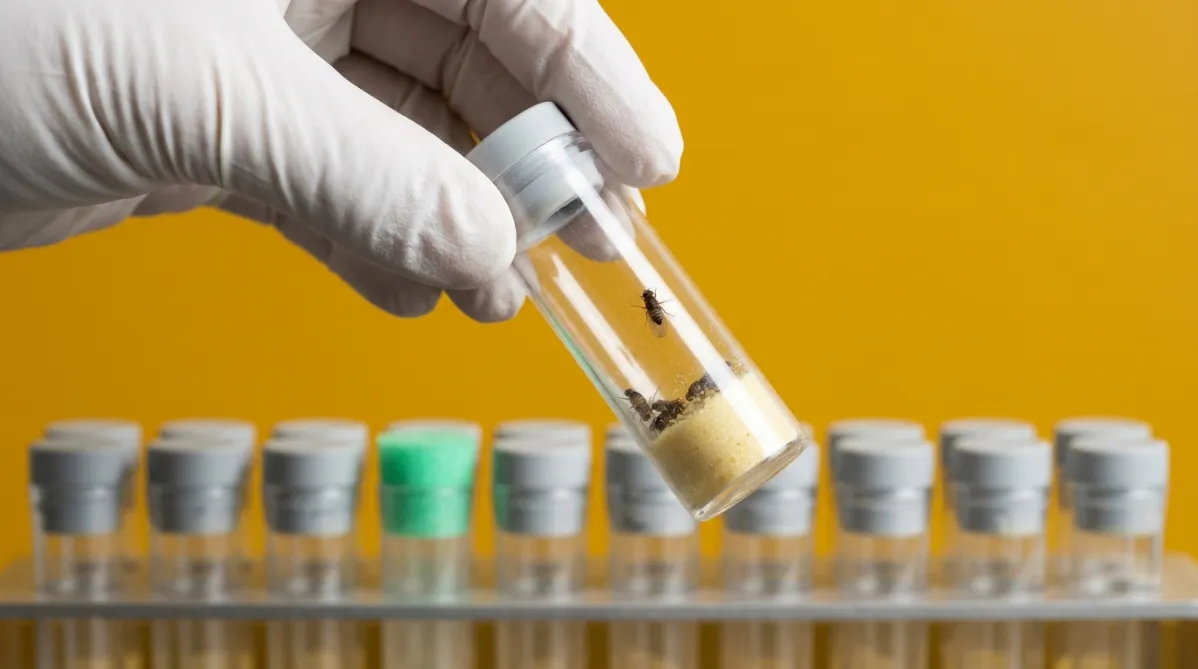
Top-down 3/4 angle, close shot of a gloved hand holding a clear plastic fly vial against a saturated mustard-yellow backdrop. Inside the vial, a few male fruit flies rest on pale cornmeal-colored food, and one small fly is in sharp focus on the glass wall. In the soft-focus foreground, a rack of identical vials stands in a neat row, with a few lined up against the mustard field. A single vial in the rack has a faint electric green (#00e676) foam stopper, the only green in the frame. Lighting is bright, even studio-style lab light with gentle highlights on the glass and crisp shadows in warm grey. The nitrile glove is white. The mood is precise, curious and skeptical, like a careful experiment getting a surprising result. No text or labels.
Longevity

The Lithium Longevity Hack Failed a Replication—Mating Mattered

Dr. Synapse · · 4 min read

A fruit fly study just poked a hole in one of longevity's tidiest stories, and the hole is shaped like a sex life. Researchers at the University of Liverpool tried to reproduce the lifespan-extending effect of lithium in male Drosophila melanogaster. Instead of living longer, flies on lithium chloride (LiCl) died sooner, but only if they were unmated. Males that mated frequently were largely spared.

This was a fruit fly study, not a human trial. It still matters for anyone eyeing low-dose lithium, including lithium orotate, as an anti-aging supplement. It shows how fragile a "geroprotector" result can be when the biological context changes.

Why Lithium Became a Longevity Darling

Lithium has been a psychiatric mainstay for decades, and its second career as an anti-aging candidate rests on a few threads:

  • Model-organism lifespan reports. Earlier work in several model organisms, including worms and flies, suggested that lithium could extend lifespan. In flies, 25 mM dietary LiCl was the concentration previously reported as beneficial.
  • Plausible biology. Lithium touches signaling pathways tied to growth, stress resistance, and cellular housekeeping, the same territory where many proposed longevity interventions operate.
  • Brain-health buzz. Interest in low-dose lithium for Alzheimer's disease and cognitive decline has spread well beyond psychiatry. Lithium orotate, a supplement form sold without a prescription, has been marketed on the back of that excitement.

Together these made lithium look like a cheap, old, well-known molecule with a possible second life as a geroprotector. The Liverpool paper's own abstract notes the catch: the evidence "remains inconsistent."

What This Study Actually Did

The team, led by Andrew McCracken with Jessica Garden, Nicola White, and Stuart Wigby, published in Biogerontology (2026). They asked a question earlier work had rarely addressed: does reproductive investment change how lithium affects lifespan? Reproduction is energetically costly and often correlated with lifespan, so it could plausibly reshape a drug's effects.

The design had two key features:

  1. Two doses of dietary LiCl: 25 mM, the concentration previously reported as beneficial, and a lower 10 mM.
  2. Two social conditions for male flies: unmated (UM) males and frequently mated (FM) males.

The researchers tracked survival and also measured reproductive performance: late-life mating latency (how quickly males mate), sterility, paternity share (how many offspring a male sires when competing), and female remating.

The Results: A Replication Failure With a Twist

Lithium did not extend lifespan. Both doses reduced survival. That includes the 25 mM dose that earlier work had linked to benefit, which the authors describe as "contrary to previous work."

The twist is who paid the price:

  • Unmated males drove the whole effect. The survival hit appeared exclusively in the UM group.
  • Frequently mated males were comparatively protected. The authors describe a "strong mating-dependent interaction."

On the reproductive side:

  • Lithium had no detectable effect on late-life mating latency, sterility, or paternity share.
  • In frequently mated males, lithium did increase female remating, which the authors count as reduced post-copulatory performance. A female who remates sooner is a sign her first mate's ejaculate was less effective at suppressing further mating.

The authors conclude that somatic and reproductive responses to lithium "can be decoupled." A fly's body can respond one way while its reproductive output responds another.

What It Means: Context Is Part of the Drug

The headline is not "lithium kills flies." It is that a geroprotector's effect can depend on the physiological and environmental context in which it is tested. If mating status alone can flip lithium from neutral-or-protective to harmful, then many other variables could also change the outcome: diet, sex, genetic background, housing conditions, stress, and age.

This fits a broader theme in aging research. Lifespan extensions in a single lab and a single protocol are hypotheses, not facts. Replication across conditions is what separates a robust intervention from one that works only under specific circumstances. The study also covers only male flies, so it says nothing about how females respond.

A study like this cannot overturn the earlier positive reports. It adds a complicating data point and a plausible reason the literature looks inconsistent.

Practical Takeaways for Supplement Shoppers

1. There is no human lifespan data. Nothing here, or in the earlier fly and worm work, shows that lithium extends human life. A fly result in either direction is not a dosing guide for people. Lithium orotate in particular should not be treated as proven for longevity.

2. Lithium has a narrow therapeutic window. At prescription doses, lithium requires blood-level monitoring because the gap between a helpful and a toxic amount is small. Kidney and thyroid problems are well-recognized concerns with pharmaceutical lithium. Low-dose supplement products are not exempt from the need for caution, especially for people with existing kidney or thyroid conditions or those taking other medications that affect lithium handling.

3. Don't self-dose for anti-aging. If you have a mood disorder or another medical reason to consider lithium, that is a conversation for a prescriber who can monitor you. If your only goal is a longer life, the evidence does not justify the risk or expense.

4. Treat "context-dependent" as a warning label. When a supplement's effect in animals flips with something as basic as mating status, confidence in a one-size-fits-all human protocol should drop.

The Bottom Line

Lithium's longevity story has always rested on a modest evidence base of animal lifespan studies and observational interest. This replication attempt showed no benefit in male fruit flies, a survival cost in unmated males, and a clear reminder that reproductive context can reshape a drug's effects. For now, lithium belongs in the "interesting hypothesis" column, not the supplement cabinet.
Original study

Read the original research on pubmed.ncbi.nlm.nih.gov →

This article summarizes published research for general information. It is not medical advice.

DS

Written by

Dr. Synapse

Dr. Synapse writes for Biocracked: biohacking science, longevity & human performance.

Related Articles

**Approach:** Lab in action. **Palette:** D, bold color field.

A macro, slightly high-angle photograph of a clear plastic vial of houseflies, with several flies visible and a few resting on a damp cotton plug. A gloved hand holds the vial. The backdrop is a saturated mustard-yellow seamless surface, which contrasts with the flies' dark bodies and the clear glass. Behind it, a row of identical fly vials is out of focus, and one small glass pipette tip rests in the foreground with a single droplet of water. A faint electric-green cap on one vial adds a subtle accent. Lighting is soft but directional studio light from the left, with crisp highlights on the glass and wet droplets and gentle warm shadows. The shallow depth of field keeps the flies sharp. The mood is calm, skeptical and methodical, with no text or labels visible.
longevity

Deuterium-Depleted Water Fails Longevity Test in Houseflies

BY HELIX WARD ·

Deuterium-depleted water is marketed to biohackers as a way to slow aging, but a new University of Aberdeen experiment found no lifespan benefit. Researchers fed houseflies water with deuterium ranging from 31 to 1021 ppm, versus 147 ppm in controls. Laser spectroscopy confirmed the isotope reached the flies' body water, yet survival, mortality risk and body weight did not budge. It is an insect study, not a human trial, so it cannot close the case. But it weakens the mechanistic story behind a pricey longevity trend.

Approach: conceptual metaphor. Palette: D, bold color field.

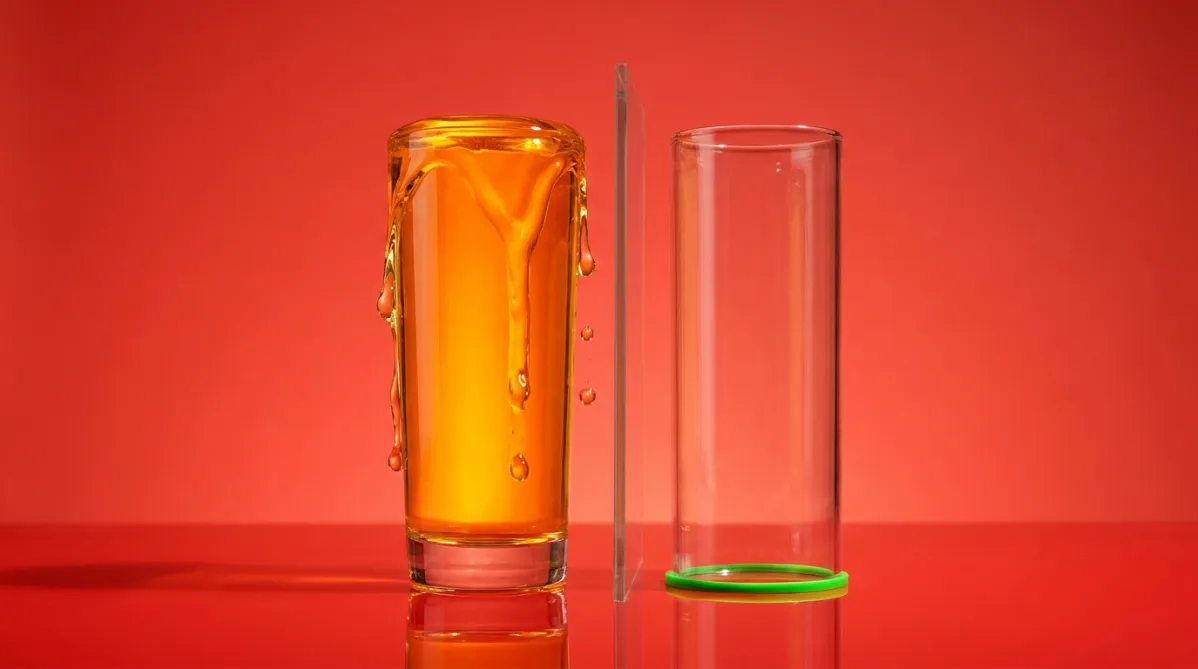
A tall glass of bright orange-gold liquid sits in the center of the frame, filled to the brim and overflowing down its sides, shot at a slight low angle. Beside it, a sealed, empty glass cylinder with a thin glass wall stays bone dry. A clear glass barrier stands between them, so the flow clearly never crosses. The backdrop is a saturated tomato-red seamless paper, with a glossy red surface reflecting both vessels. Hard, directional studio light from the upper left throws crisp, warm-neutral shadows and bright highlights along the glass rims and liquid droplets. One small electric green ring sits at the base of the empty cylinder as a subtle accent. Mood: tense, ironic, clean and editorial. Photorealistic, shallow depth of field, no text or labels.
supplements

Your CoQ10 Reaches Your Blood, But Not Your Mitochondria

BY NOVA CHEN ·

A new human trial put a hugely popular longevity supplement to the test with muscle biopsies, and the results are awkward for the marketing. In 40 healthy adults averaging 74 years, 400 mg/day of CoQ10 for 12 weeks raised blood levels but left muscle and mitochondrial CoQ10 unchanged. Mitochondrial function, VO2max, glucose control and body composition did not move either. The study is small, short and limited to robust older adults, and the senior author consults for Pharma Nord. Here is what it shows, what it cannot say, and who might still want to ask a doctor about CoQ10.

Approach: Macro science. Palette: D, bold color field.

Extreme close-up photograph of taurine crystals, long translucent needle-like prisms with sharp faceted edges, bundled and crossing in a loose cluster. They rest on a saturated tomato-red matte acrylic surface. The camera is a low three-quarter angle with a shallow depth of field, so the front crystals are razor sharp and the back ones melt into soft red blur. A hard, warm key light from the upper left makes the facets glint white and throws crisp, thin red-tinted shadows. A single crystal tip in the foreground catches a tiny edge of electric green (#00e676) light refracted through the glass-like prism. The mood is bold, tense and curious, which suits a paradox in the findings. The image has no text, no labels, and no blue cast.
longevity

Taurine Rises With Age. So Why Did More Protect Old Mice?

BY NOVA CHEN ·

Taurine, the amino acid on every energy drink can, just got a surprising twist in Cell: blood levels rise with age in both humans and mice, yet raising them further still helped old mice. A Yale-led team reports better health span and fewer deaths from sepsis and inflammasome-driven inflammation. The proposed mechanism is that danger signals make macrophages dump taurine, which helps trigger the NLRP3 inflammasome, while restoring it keeps that alarm quiet. The human evidence is only observational, and the paper didn't test a human supplement dose. Here is what it shows, what other trials say about taurine doses, and who should hold off.

Macro photograph at a low 30-degree angle of two tiny mounds on a glossy, saturated teal acrylic surface. The left mound is orange-yellow CoQ10 crystalline powder with visible faceted flakes. The right mound is dull metallic grey selenium granules. A hairline crack runs across the acrylic between them, hinting at the catch. Hard, clean studio light from the upper left throws crisp, short shadows and sparkles on the crystal edges. The background falls softly out of focus, with a thin electric green reflection streaking across the glossy surface. The palette is bold color field: teal against orange, with silver-grey accents. The mood is precise, curious and cautionary, like a lab specimen photographed for a magazine. Photorealistic, shallow depth of field, no text.
longevity

Two Cheap Supplements Cut Heart Deaths by Half. There's a Catch.

BY NOVA CHEN ·

Two inexpensive supplements, CoQ10 and selenium, were linked to a drop in cardiovascular deaths from 12.6% to 5.9% in elderly Swedes. Heart-strain biomarkers and echocardiograms improved as well. But the trial enrolled just 443 people in a selenium-poor country, and it can't say which nutrient did the work. Here's what the KiSel-10 study actually showed, who it may apply to, and the safety limits to know before you try it.

This page is available in