Biocracked
**Approach:** Macro science, with a hint of the human outcome.

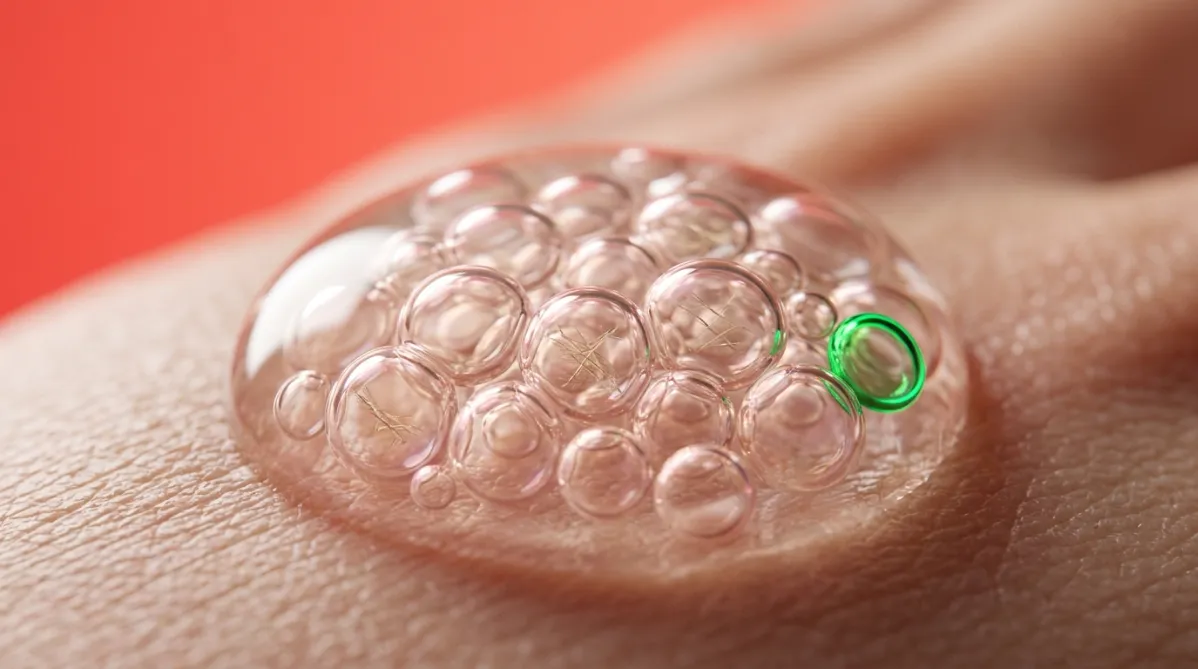
**Subject:** An extreme close-up of liposomes in a clear droplet of liquid. Dozens of translucent, iridescent spheres of different sizes cluster and overlap like soap bubbles, and a few of them enclose tiny fibrous strands. The droplet rests on a slightly textured skin surface, with fine wrinkle lines and pores visible in soft focus behind it.

**Camera:** Macro lens, shallow depth of field, shot at a low 30-degree angle. The focus sits on the front spheres.

**Lighting:** Soft diffuse window light from the left, with gentle specular highlights on the bubbles' surfaces.

**Palette:** Bold color field (D). The backdrop is a saturated, warm coral-tomato red that fades smoothly into the blurred skin tones. The spheres pick up pearly pink and gold reflections. One small sphere has an electric green (#00e676) rim reflection.

**Mood:** Fresh, precise and quietly optimistic. It should look scientific but tactile, with no text.
Supplements

Only Liposomal Collagen Cut Wrinkle Area vs Placebo in 8-Week Trial

Nova Chen · · 4 min read

Collagen drinks are everywhere, and so is the doubt about whether swallowing collagen does anything for your face. A new randomized trial in the Journal of Cosmetic Dermatology tested a twist: wrap the collagen tripeptides in liposomes. Of the two collagen formulations, only the liposomal one produced a statistically significant reduction in wrinkle area versus placebo at Week 8.

That is a striking result. It also comes with caveats you should know before you buy anything.

The Head-to-Head: What Researchers Actually Tested

The team ran a randomized, double-blind, placebo-controlled trial (ClinicalTrials.gov: NCT06771388) in 75 healthy adults aged 25-65. Participants were assigned to one of three groups:

  • Placebo
  • A nonliposomal formulation containing collagen tripeptides
  • A liposomal formulation containing collagen tripeptides

Both active products were given at 50 mL per day for 8 weeks. Nobody was relying on self-reported glow. Researchers used standardized instruments to measure dermal collagen density, skin hydration, elasticity, wrinkle area, skin luminance and tone evenness. Measurements were taken at baseline and at Weeks 2, 4 and 8.

The Headline Finding: Wrinkles

Both collagen groups improved on several measures. Wrinkle area was where they separated.

Only the liposomal group showed a significant reduction in wrinkle area at Week 8 relative to placebo (p < 0.05). The nonliposomal group did not reach significance on that measure.

One nuance matters here. The abstract frames this as liposomal versus placebo. It does not say the liposomal product beat the regular one on wrinkles in a direct comparison. The wrinkle result is a difference in which group cleared the significance bar against placebo, not proof of a head-to-head win.

Where Liposomal Won Head-to-Head: Elasticity

The one direct advantage the authors report is for skin elasticity. At Week 8, the liposomal formulation showed a statistically significant advantage over the nonliposomal one (p < 0.05).

The researchers also report that the liposomal product showed an earlier onset and greater magnitude of improvement across multiple parameters. The abstract gives no specific effect sizes, so treat that as a directional signal rather than a number to quote.

What Both Collagen Formulations Did

Compared with placebo, both collagen tripeptide groups showed significant improvements (p < 0.05) in:

  • Dermal collagen density
  • Skin hydration
  • Skin elasticity

Both groups also showed significant increases in skin luminance and tone evenness. In other words, the regular collagen product was not a dud. Liposomal delivery seems to have added speed, magnitude and the wrinkle signal on top.

Why Liposomes?

Liposomes are tiny lipid-based vesicles used to encapsulate ingredients. The working idea is that encapsulation improves delivery or bioavailability. The abstract does not report blood levels or tissue uptake, so the trial shows that outcomes differed, not why. The mechanism is an assumption here, not something this study demonstrated.

Practical Takeaways

Dose and duration: The studied regimen was 50 mL per day for 8 weeks. The abstract does not specify time of day or whether the product was taken with food, so there is no evidence-based timing advice from this paper.

Who it might suit: The participants were healthy adults aged 25-65. The results say nothing about people with skin disease, older adults, or anyone on medications that affect skin. Whether men and women responded differently is not reported in the abstract.

What to expect: Changes were measured with instruments. Differences a device detects are not always differences you or a friend would notice in the mirror. The abstract does not report any visual or subjective assessment.

Don't assume it's just collagen: The products are described as "collagen tripeptide-containing formulations." That phrasing implies the liquids may have contained other ingredients, and the abstract does not list them. A different product with plain collagen tripeptides may not behave the same way.

The Fine Print

This is where a critical reader should slow down.

  • Industry link: Several authors are affiliated with TCI Co. Ltd., and the article carries a TCI copyright line. The paper's conflict-of-interest statement declares none, but the industry association is worth weighing when you read the glowing conclusion.
  • Short duration: Eight weeks tells us nothing about long-term maintenance or whether benefits persist after stopping.
  • Small trial: With 75 participants split across three arms, the groups are small. Subtle differences between the two active formulations are harder to pin down at this size.
  • Single study: It needs independent replication, ideally with identical formulations differing only in delivery.
  • Wrinkle comparison: As noted, the wrinkle finding is relative to placebo, so it is not a decisive liposomal-versus-regular verdict.

Bottom Line

This randomized, double-blind trial adds a credible data point to the case for oral collagen peptides and suggests that liposomal delivery may give an extra edge. The strongest claims are that both formulations beat placebo on collagen density, hydration and elasticity, that liposomal beat the nonliposomal on elasticity at Week 8, and that only the liposomal group showed a significant wrinkle-area reduction versus placebo. Promising, yes. Definitive, no. Wait for independent replication before treating liposomal collagen as a proven upgrade.

Original study

Read the original research on pubmed.ncbi.nlm.nih.gov →

This article summarizes published research for general information. It is not medical advice.

NC

Written by

Nova Chen

Nova Chen writes for Biocracked: biohacking science, longevity & human performance.

Related Articles

Approach: macro science. Palette: bold color field, magenta and violet.

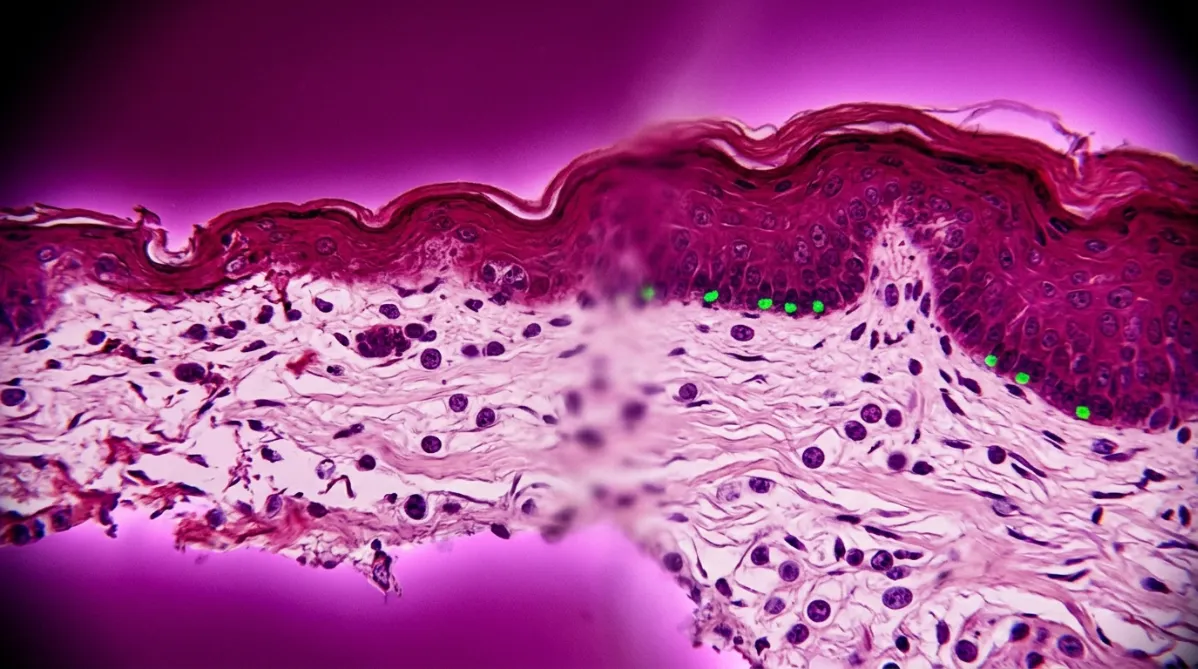
Extreme close-up microscopy photograph of a stained skin tissue cross-section, shot straight-on through the eyepiece with shallow depth of field. A thin, wavy epidermis in deep magenta sits above a fibrous dermis in pale pink, with visible collagen strands and a few round cell nuclei in dark violet. The left half of the frame shows noticeably thinned, flattened tissue, and the right half shows thicker, healthier layers, separated by a soft focus fall-off rather than a hard line. A few tiny electric green fluorescent dots mark nuclei along the basal layer. Lighting is bright, transmitted microscope light with a luminous glow behind the tissue and a saturated magenta backdrop in the out-of-focus edges. The grain is realistic and the mood is precise, curious and cautionary. No text or labels.
longevity

Resveratrol Stopped Mouse Skin Thinning With Age—Here's the Catch

BY NOVA CHEN ·

Aging skin gets thinner, and a new mouse study says a famous supplement compound may slow that decline. In aged mice, 32 weeks of dietary resveratrol attenuated epidermal and dermal thinning, restored skin cell proliferation, and blocked a rise in collagen-degrading MMP-9 and MMP-13. The proposed mechanism is SIRT1 activation, backed by keratinocyte experiments linking SIRT1 loss to senescence. But this is not a human trial, no human dose is established, and resveratrol's poor bioavailability is a real hurdle. Here is what the study shows and what to do with it.

Approach: the human outcome. Palette: natural.

Extreme close-up of a woman's eye and the delicate skin around it, shot from a slight three-quarter angle with a 100mm macro lens and a shallow depth of field. Her skin is a mature 50s complexion with fine crow's feet that are sharp and tactile, with visible pores and soft vellus hairs. Her gaze is relaxed and not at the camera, and the face is cropped so identity isn't the focus. Soft, directional window daylight rakes across the skin from the left to bring out the wrinkle texture, with gentle warm skin tones and a blurred leafy green background outdoors. A single glass of water with a faint dissolving powder swirl sits out of focus in the foreground, with a tiny electric green leaf highlight at the edge. The mood is calm, honest and quietly scientific.
peptides

2.5 g of Collagen Peptides Cut Eye Wrinkles 20% in 8 Weeks

BY NOVA CHEN ·

Collagen is one of the most searched beauty and longevity supplements, but few products have placebo-controlled human data. In this trial of 114 women aged 45-65, 2.5 g a day of the specific bioactive peptide Verisol cut eye wrinkle volume by 20% versus placebo after 8 weeks. Biopsies showed 65% more procollagen type I and 18% more elastin, while a 6% fibrillin bump wasn't significant. The effect was still detectable 4 weeks after the last dose. But the results apply to one branded peptide in one population, not every collagen powder, so here's what the paper does and doesn't prove.

Approach 4, conceptual metaphor, with palette D, bold color field.

A single cross-section of a rusted, mineral-crusted copper pipe stands upright at center, shot from a slightly low three-quarter angle with a shallow depth of field. Its inner wall is thickly lined with chalky white-orange scale that narrows the bore to a small opening. One side of the buildup is hard and crystalline, while the other side is softer and still forming. A thin, clean ribbon of electric green liquid (#00e676) runs through the remaining channel, a subtle accent. The backdrop is a seamless saturated mustard-yellow field. Hard, directional studio light from upper left casts a crisp, short shadow to the right. Textures are tactile and macro-sharp, with visible grit and flaking. The mood is calm, analytical and slightly cautionary.
supplements

The Vitamin That Slowed Artery Calcification for 2 Years

BY NOVA CHEN ·

A two-year randomized trial in JAMA Cardiology found that 360 µg a day of vitamin K2 as MK-7 slowed coronary calcium buildup in people with symptomatic heart disease. Median CAC scores rose from 135 to 184 AU on MK-7 versus 145 to 214 AU on placebo. The effect appeared tied to noncalcified plaques becoming calcified, and no significant adverse effects were reported. But nobody yet knows whether this translates into fewer heart attacks, and one author disclosed grants from an MK-7 manufacturer. Here is what the study showed, what it didn't, and who should be careful, especially anyone taking warfarin.

Approach: conceptual metaphor. Palette: D, bold color field.

A single cracked ceramic-white bone-shaped column, like a femur section, stands upright at the center of a saturated mustard-yellow seamless backdrop. A thin, clean hairline fracture runs through its middle. Beside it, a small golden-amber glass dropper bottle sits tipped, with one droplet suspended just above the bone and not touching it, which suggests extra vitamin D that makes no difference. The camera is at a low three-quarter angle with a shallow depth of field. Hard, directional studio light from the upper left casts a crisp, long shadow across the yellow floor. The porous bone texture is visible in fine detail. A tiny electric green (#00e676) droplet reflection glints on the glass. The mood is skeptical, cool-headed and editorial.
longevity

High-Dose Vitamin D for Bones? A 5-Year Trial Says No

BY DR. SYNAPSE ·

Taking extra vitamin D to keep your bones strong? A five-year randomized trial in 2,495 older Finns found that neither 1,600 nor 3,200 IU/day reduced fractures compared with placebo. Oddly, the 1,600 IU group had more fractures (HR 1.52), though the higher dose showed no such effect, which suggests chance may be at play. Participants already had sufficient vitamin D at baseline, so the results may not apply to people who are deficient. Here is what the study found, what its limits are, and what to do before buying another bottle.

This page is available in