Biocracked
**Approach 1: Macro science, Palette D: Bold color field**

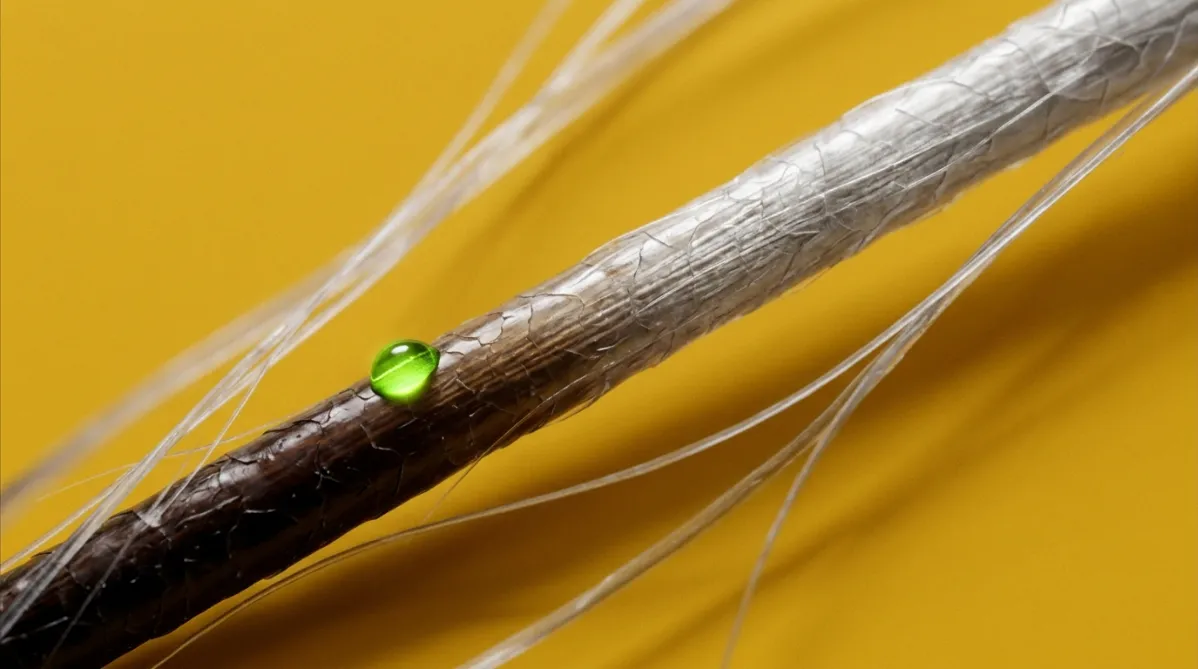
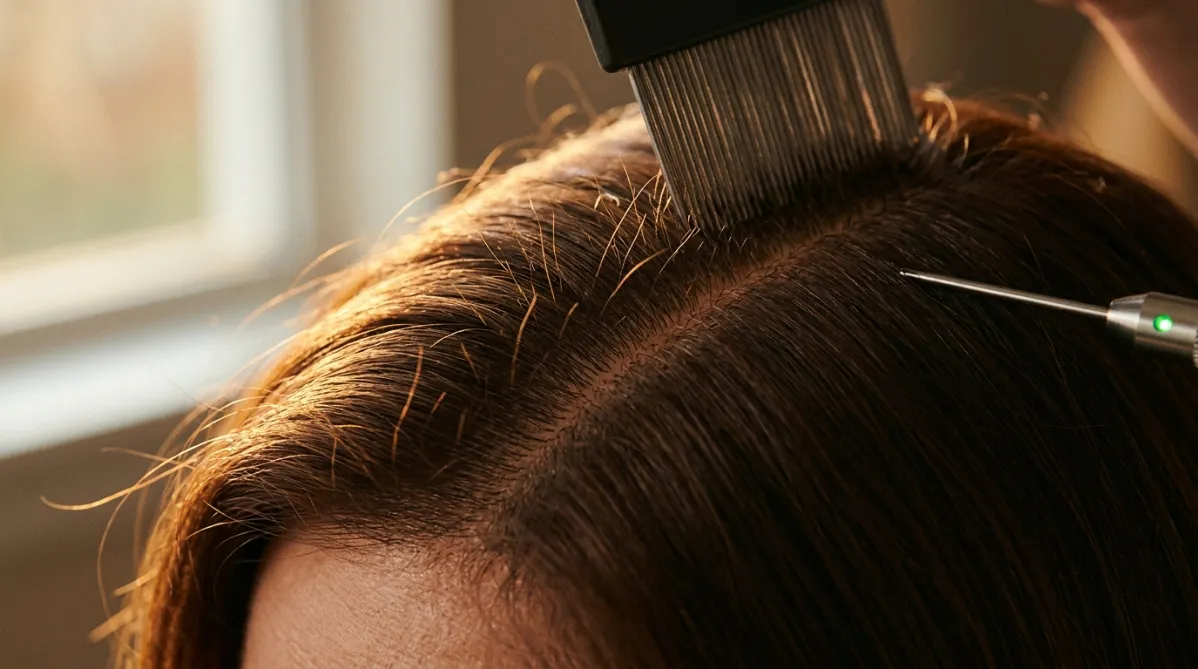
Extreme macro photograph of a single human scalp hair strand, shot at a slight diagonal. It is pigmented dark brown at the root and fades into silvery-white along its length, with the cuticle scales and fine texture visible. Beside it, a few pure white strands cross the frame. The backdrop is a smooth, saturated mustard-yellow field with no pattern. A soft, wide key light from the upper left gives the strands a glossy, translucent sheen and a gentle shadow on the yellow. Shallow depth of field blurs the far end of the hair into creamy softness. One tiny electric green droplet of serum clings to the strand near the root, catching a bright highlight. The mood is crisp, curious and optimistic, with a scientific tone.
Supplements

Grey Hair Dropped 13% in 24 Weeks With a Pill-Plus-Serum Combo

Nova Chen · · 4 min read

What if the most telling number in a grey hair trial isn't how much hair improved, but how much the placebo group got worse? In a new randomized, double-blind study, people taking a supplement and using a serum saw their grey hair count fall by 13.0% over 24 weeks. Volunteers on a double placebo ended up with 9.7% more grey hairs than they started with.

The study, published in the Journal of Drugs in Dermatology (2026), is notable for what it claims. Its authors say no treatment had previously been shown in a clinical trial to repigment or slow the development of grey hair.

The Problem: Grey Is Nearly Universal

The paper opens with a striking statistic. Worldwide, 74% of men and women between 45 and 65 have some grey hair. Despite how common it is, the researchers note there is currently no treatment backed by clinical trial evidence for repigmenting grey hair or slowing its development. Most of the market consists of dyes that cover grey hair rather than address it.

That gap is what this trial tried to fill, using a two-part regimen from Two Lines Inc.: To The Root® serum (topical) and Not Today Grey (oral supplement).

How the Trial Was Built

The design is stronger than many consumer-product studies:

  • 173 men and women aged 28 to 65 completed the study
  • All had 5–25% grey hair at the start, so these were early-to-moderate greys, not fully silver heads
  • It was randomized, double-blind and placebo-controlled
  • It ran for 24 weeks, with at least 40 participants in each of four groups

The four arms were:

  1. Combination: supplement + serum
  2. Supplement only: supplement + placebo serum
  3. Serum only: serum + placebo supplement
  4. Placebo: placebo supplement + placebo serum

The four-arm layout is what allows the study to ask whether the two products work alone or need each other.

The Headline Numbers

The combination group's results:

  • Week 12: a 9.2% reduction in grey hair (P=0.034 vs baseline)
  • Week 24: a 13.0% reduction (P=0.016 vs baseline)

The placebo group moved the other way. Its mean number of grey hairs rose 9.7% from baseline to week 24. Comparing the combination group with placebo at week 24 gave P=0.004, a statistically significant difference.

The researchers describe the combination result as both statistically significant and clinically meaningful.

It Wasn't Just a Hair Count

It is fair to ask whether counting hairs could be subjective or noisy. The authors report two other measures that pointed the same way:

  • Photo grading of grey hair: P=0.002 for week 24 vs baseline
  • Subject observation, meaning participants' own assessment: P=0.002 vs baseline

When objective-style grading and the participants' own perceptions agree, the finding is harder to dismiss as a measurement quirk.

The Fine Print: Combination, Not Individual Products

The abstract credits the results to "synergistic effects" of the proprietary blends in the oral supplement and the patented topical serum. The benefit was demonstrated for the combination. The abstract does not report significant effects for the supplement alone or the serum alone, so it would be inaccurate to say a supplement by itself reduces grey hair based on this paper.

Two other limits are worth stating plainly:

  • The ingredients aren't listed in the abstract. The products are described only as proprietary blends, which makes it impossible to say from the abstract what is doing the work, or to compare the formulas with other products.
  • The products come from one company. The study tested Two Lines Inc. products. Readers should check the full paper's disclosures and funding statements, and independent replication would add confidence.

Practical Takeaways

What the combo result means

The positive finding belongs to the supplement and serum used together. Based on the abstract, you shouldn't assume that buying one half of the regimen delivers the same effect.

Set realistic expectations

A 13.0% reduction in grey hair count is a reduction, not a full reversal. Participants started with only 5–25% grey hair, and nothing in the abstract suggests that a head of grey would return to its original color. Think "fewer greys than before," not "youthful color restored."

Remember the placebo comparison

The placebo group got about 10% greyer over the same period. That makes the gap between the combination and placebo groups larger than the 13% figure alone suggests, and it is the comparison the authors used for their significance test (P=0.004).

Who this is relevant for

The evidence applies most directly to adults aged 28–65 with early to moderate greying (5–25%). The abstract says nothing about people with predominantly grey or white hair, so those results shouldn't be extrapolated to them.

Stay critical

A single trial, proprietary formulas and one manufacturer's products are reasons for optimism rather than certainty. The result is promising, but it is no reason to abandon caution about supplement claims. Check ingredient lists for allergens and talk to a clinician before adding a supplement, especially if you take medication or have a medical condition.

The Bottom Line

Grey hair has long been treated as inevitable, and this trial is an early sign that it may be modifiable. Over 24 weeks, a supplement-plus-serum regimen cut grey hair counts by 13.0% while placebo users got 9.7% greyer. The next steps are independent replication, disclosure of what is in the blends, and data on whether each product contributes on its own.
Original study

Read the original research on pubmed.ncbi.nlm.nih.gov →

This article summarizes published research for general information. It is not medical advice.

NC

Written by

Nova Chen

Nova Chen writes for Biocracked: biohacking science, longevity & human performance.

Related Articles

Approach: the human outcome. Palette: natural.

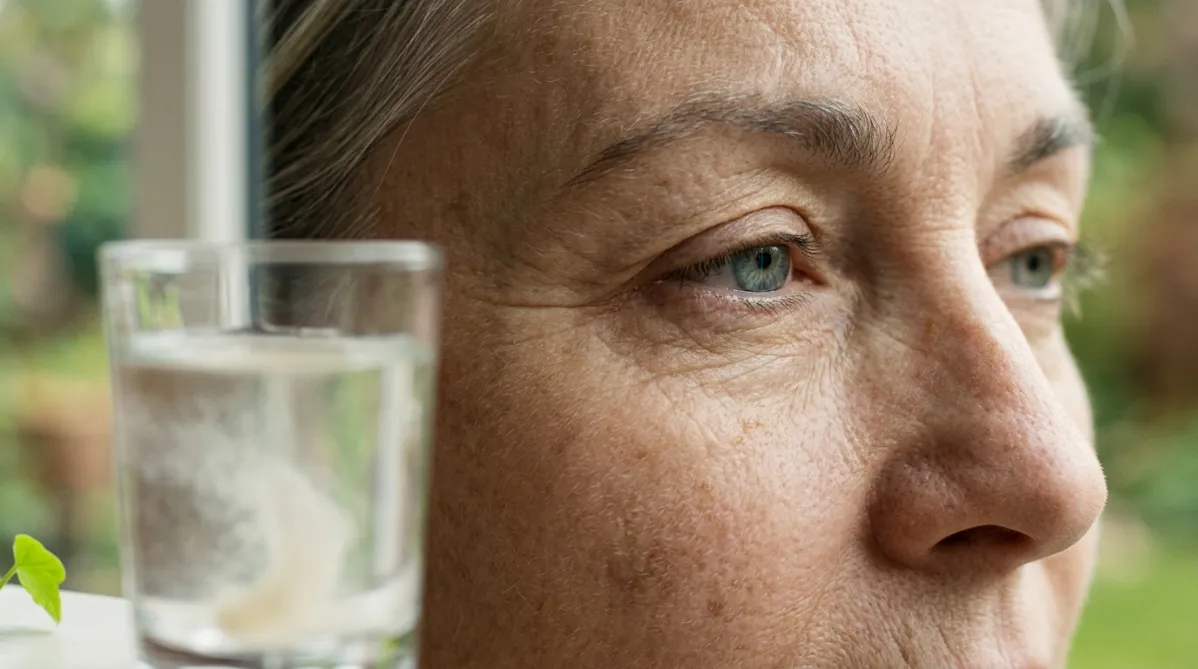
Extreme close-up of a woman's eye and the delicate skin around it, shot from a slight three-quarter angle with a 100mm macro lens and a shallow depth of field. Her skin is a mature 50s complexion with fine crow's feet that are sharp and tactile, with visible pores and soft vellus hairs. Her gaze is relaxed and not at the camera, and the face is cropped so identity isn't the focus. Soft, directional window daylight rakes across the skin from the left to bring out the wrinkle texture, with gentle warm skin tones and a blurred leafy green background outdoors. A single glass of water with a faint dissolving powder swirl sits out of focus in the foreground, with a tiny electric green leaf highlight at the edge. The mood is calm, honest and quietly scientific.
peptides

2.5 g of Collagen Peptides Cut Eye Wrinkles 20% in 8 Weeks

BY NOVA CHEN ·

Collagen is one of the most searched beauty and longevity supplements, but few products have placebo-controlled human data. In this trial of 114 women aged 45-65, 2.5 g a day of the specific bioactive peptide Verisol cut eye wrinkle volume by 20% versus placebo after 8 weeks. Biopsies showed 65% more procollagen type I and 18% more elastin, while a 6% fibrillin bump wasn't significant. The effect was still detectable 4 weeks after the last dose. But the results apply to one branded peptide in one population, not every collagen powder, so here's what the paper does and doesn't prove.

**Approach: Human outcome. Palette: warm (B).**

Extreme close-up, slightly high angle, of a woman's scalp parting in her 40s. Dense, glossy chestnut-brown hair is split by a fine comb. Short new hairs rise from the visible scalp skin, and a few strands catch the light. Faces and identity are out of frame. Low golden-hour window light enters from camera left and rim-lights the strands in honey and copper. Shadows stay warm brown, with no blue cast. The shallow depth of field blurs the background hair into soft amber bokeh. A thin steel trichoscopy probe tip sits at the edge of the frame, and a tiny electric green LED glints on its housing as the only accent. The mood is hopeful but scrutinizing, like a clinical check-up with a cautious eye.
supplements

NMN Boosted Hair Density 57% in a Human Trial—With a Big Catch

BY NOVA CHEN ·

NMN, the NAD+ booster beloved by longevity fans, has now been tested on hair in people for the first time. In a 12-week pilot of 15 women aged 40-50, growth-phase hair density climbed from 55.9 to 87.7 hairs/cm², and hair diameter rose from 75.3 to 78.8 µm. Participants also reported better gloss, elasticity and volume. But there was no placebo group, the sample was tiny and the authors are linked to an NMN supplier. Here is what the numbers show, what they cannot show, and who should wait.

Approach: conceptual metaphor. Palette: D, bold color field.

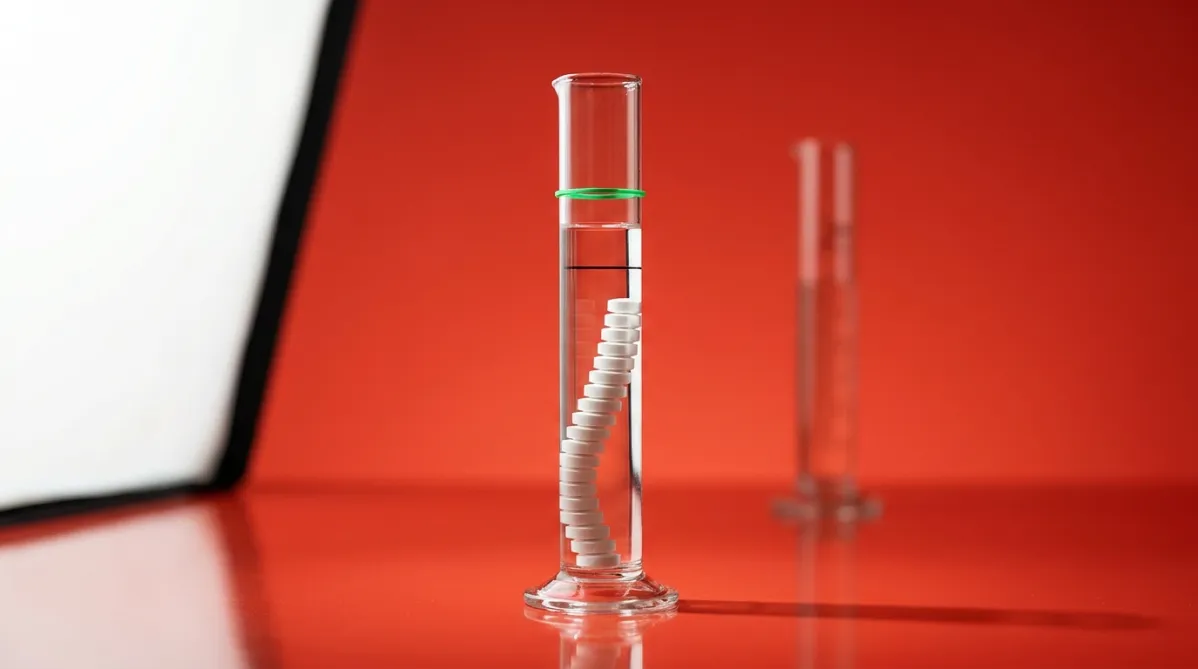
A single brass dial-style dosing syringe-free metaphor: a tall glass measuring cylinder, photographed straight on at eye level, filled with clear liquid and a column of stacked white tablets that rises in even steps and then stops short of a thin painted line, as if a staircase of doses has been held back. The glass cylinder stands on a glossy surface against a saturated tomato-red seamless backdrop. Soft large-softbox light from the left gives crisp highlights on the glass and a clean, short shadow on the right. A tiny electric green (#00e676) rubber band circles the cylinder near the top limit. Shallow depth of field blurs a second, taller cylinder in the background. Mood: controlled, restrained, quietly hopeful. No text, no markings legible.
supplements

Magtein Cut Opioid Dose Creep in Cancer Patients? What the Trial Found

BY NOVA CHEN ·

A magnesium supplement best known as a brain and sleep booster just showed up in a cancer pain trial. In 83 advanced cancer patients on oral opioids, those taking magnesium-L-threonate (L-TAMS, the compound sold as Magtein) saw their morphine doses climb about half as much over 90 days as those on placebo. The supplement also eased opioid-induced constipation. But this was a small, single-center study in a very specific group, and it is not a reason to change any medication without a doctor. Here is what the paper found, what it didn't, and who should be talking to a clinician.

Approach: conceptual metaphor. Palette: D, bold color field.

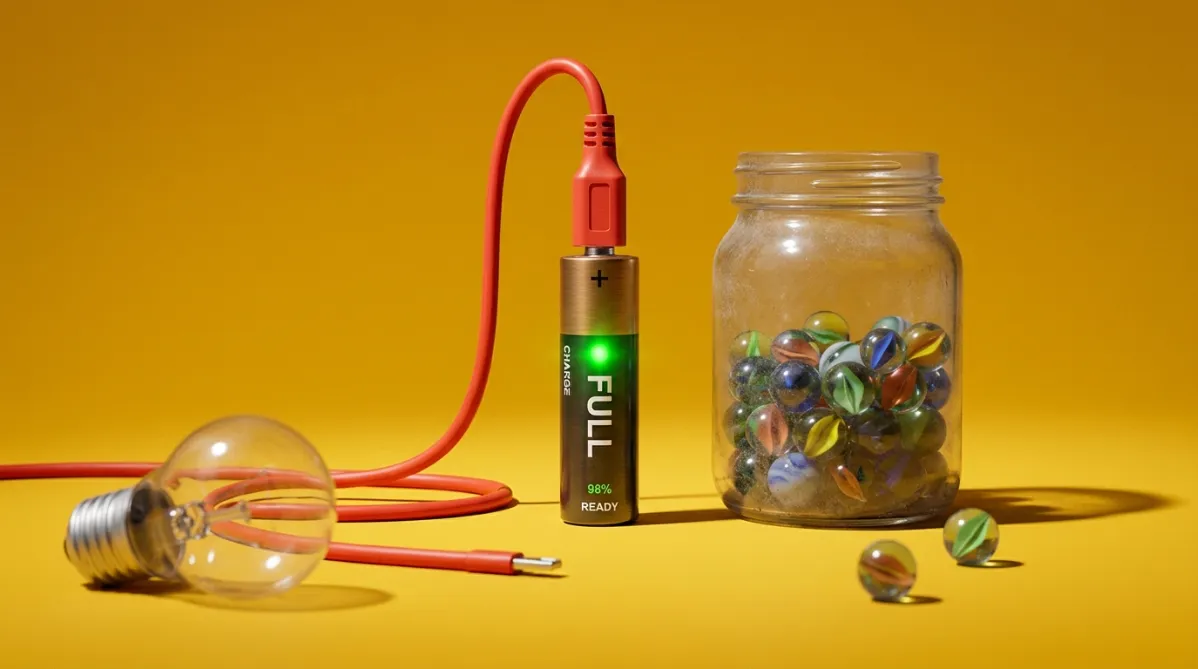
A single AA-style cylindrical battery stands upright, fully charged, on a seamless saturated mustard-yellow backdrop. Beside it sits a matching, untouched, slightly dusty glass jar of marbles, so the charge shows no visible link to any result. More precisely, a bright tomato-red extension cord plugs into the battery's top. Its other end curls away unconnected, lying on the floor beside an unlit incandescent bulb. A small electric green LED glows on the battery's side as the only green accent. Camera: low three-quarter angle, 50mm lens, shallow depth of field, with the bulb softly blurred in the foreground. Lighting: hard, clean studio key light from the upper left, with crisp shadows falling to the right on the yellow surface. Mood: puzzled, wry, a full power source that fails to light anything.
supplements

Nicotinamide Riboside Doubled NAD+ but Failed to Boost Memory

BY NOVA CHEN ·

A supplement doubled a key molecule in the blood, and memory didn't budge. In a 12-week randomized trial of older adults with amnestic mild cognitive impairment, nicotinamide riboside raised NAD+ twofold but did not improve cognition, total brain blood flow, or blood pressure. There was one tantalizing exploratory hint of increased hippocampal blood flow, but it's far from proof. Here's what the study really shows, where its limits are, and what it means if you're thinking about buying an NAD+ booster.

This page is available in