Biocracked
Approach: the human outcome. Palette: bold color field.

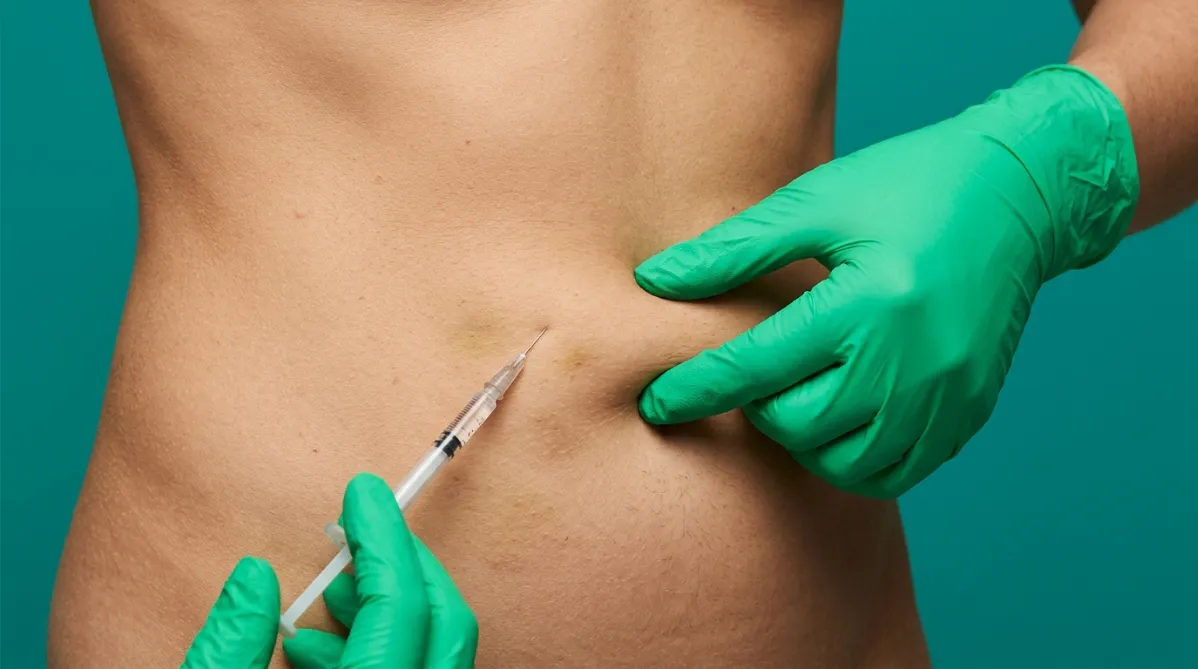
A close, slightly high three-quarter view of a bare abdomen, cropped at the ribs and hips with no face. A hand in an electric green (#00e676) nitrile glove pinches a fold of belly skin and holds a slim syringe with the needle just about to enter. Faint yellow-purple bruising near the injection site hints at the side effects. The torso fills the frame against a flat, saturated teal backdrop that contrasts with the warm skin tones. Soft, even studio light from the left gives gentle shadows and visible skin texture, with fine pores and small hairs. The syringe tip is in sharp focus and the background falls away. No text or markings anywhere. The mood is clinical, unsentimental and skeptical.
Research

Does CBL-514 really burn fat? Here's what we know

Helix Ward · · 5 min read

Does CBL-514 really burn fat? Here's what we know

The primary endpoint of the 2025 Phase 2 CBL-514 trial was not weight loss, and it was not "fat burning." It was the proportion of participants who lost at least 150 mL of abdominal subcutaneous fat volume, measured by ultrasound. At 8 weeks after the final treatment, 69.6% (16/23) of CBL-514 participants hit that mark, versus 0% (0/16) on placebo (P < .001). The catch is that the denominators shrank over follow-up, the per-protocol group was only 30 people, and mean body weight did not fall.

Not medical advice. CBL-514 is investigational, not FDA-approved, and not a supplement.

What CBL-514 is (and isn't)

CBL-514 (not "CL-514") is an investigational small-molecule injectable from Caliway Biopharmaceuticals. Investigators inject it into subcutaneous fat, here the abdomen. It is not an oral pill or a consumer product. The papers do not disclose its chemical structure.

The proposed mechanism is injection lipolysis through targeted fat-cell (adipocyte) apoptosis. It is not a raised metabolic rate or calorie burning. Earlier nonclinical claims, including DYRK1b inhibition and caspase 3 and Bax/Bcl-2 upregulation, are cited to unpublished confidential company reports. The earlier Phase 2a study (Goodman et al., 2022) was smaller and open-label, not placebo-controlled.

The paper: Gold M, et al. Aesthet Surg J. 2025;45(6):611-620. Open access on PMC | PubMed | DOI | NCT04897412.

Design in brief

  • Phase 2, randomized 2:1, single-blind (participants blinded; investigators and sponsor were not), placebo-controlled. Placebo was saline.
  • Five centers in the US and Australia, February 2022 to March 2023.
  • Up to 4 treatments at 4-week intervals, with follow-up 4 and 8 weeks after the last one. Each treatment used 25 to 50 injections of 2.4 mL (2 mg/cm²), up to 600 mg.
  • Fat volume was calculated from ultrasound thickness at 4 points across a 300 cm² area.
  • 76 were randomized (50 CBL-514, 26 placebo) and 75 were treated (49 and 26).

The headline numbers (ITT)

≥150 mL loss (primary endpoint)

Follow-up CBL-514 Placebo P
4 weeks 63.9% (23/36; 95% CI 46.22–79.18) 17.4% (4/23; 95% CI 4.95–38.78) <.001
8 weeks 69.6% (16/23; 95% CI 47.08–86.79) 0.0% (0/16) <.001

≥200 mL loss

  • 4 weeks: 58.3% (21/36) vs 8.7% (2/23), P < .001.
  • 8 weeks: 60.9% (14/23) vs 0.0% (0/16), P < .001.

Exploratory ≥250 mL: 44.4% (16/36) at 4 weeks and 52.2% (12/23) at 8 weeks on CBL-514. No placebo participant reached it.

LS mean fat volume change vs baseline (CBL-514): −199.80 mL at 4 weeks and −209.46 mL at 8 weeks (both P < .001). The between-group differences were −206.62 mL (95% CI −276.09 to −137.16) and −216.28 mL (95% CI −288.28 to −144.28).

Per-protocol (n=30 only): −314.70 mL at 4 weeks and −279.45 mL at 8 weeks. Between-group differences were −312.08 mL and −276.83 mL. These are larger, but the PP set is small and selected for completers with stable weight.

The largest single loss was over 750 mL in one CBL-514 participant. That is a maximum, not a typical result.

Treatments to target: Of the 28 CBL-514 participants who reached ≥150 mL, 42.9% (12/28) did so after one treatment and 35.7% (10/28) after two, about 78.6% combined. In the PP group it was 44.4% (8/18) after one and 27.8% (5/18) after two.

The weight caveat

This is regional fat volume, not systemic fat oxidation. Mean body weight in the CBL-514 arm changed by +0.45 kg at 4 weeks and +0.02 kg at 8 weeks. Placebo changed by −0.76 kg and −0.26 kg. The authors report no significant change in mean weight or BMI, and say localized loss appeared even in some participants who gained more than 1 kg (data not shown). The data show a smaller treated abdomen, not a lighter body.

The denominator problem

Of 75 treated participants, 38 completed the study and 37 did not (49.3% non-completion). Reasons were:

  • loss to follow-up (6)
  • participant withdrawal (7)
  • weight instability (7)
  • schedule non-compliance (6)
  • adverse events (4)

That is why the CBL-514 denominator falls from 36 to 23 and placebo from 23 to 16. The 8-week 0/16 placebo result is striking but rests on a small, shrinking group. Percentages at 8 weeks come from fewer people, with wide confidence intervals (for example 47.08–86.79% for the primary endpoint). The authors did not adjust for multiple testing, and the sample size was exploratory.

Photos and ultrasound: anecdotes

The paper shows two representative women, aged 49 and 46, with fat-volume reductions of 40.85%–47.37% and body-weight change under 1 kg. In the 46-year-old, ultrasound thickness at four points went from 4.06, 4.20, 3.90 and 3.26 cm at baseline to roughly 2 cm or less at both follow-ups. A 3D overlay suggested the loss stayed within the treated area. The authors saw little or no skin laxity in posttreatment images, but this was a visual impression, not a formal endpoint.

Safety: frequent, mostly local

Almost every participant had a treatment-related TEAE, at 98–100%, including the placebo group. Injection-site reactions drive the profile. The injection-site table highlights:

  • Discoloration: 71.4% CBL-514 vs 11.5% placebo
  • Induration: 61.2% vs 7.7%
  • Severe pain: 18.4% vs 0%

The paper also reports severity breakdowns, pain medication use and resolution times, with most reactions resolving within about a week. Check the full text for exact figures. Two participants discontinued because of treatment-related events. One hyperlipidemia case was judged probably related. One serious event, peritoneal metastasis, was judged unrelated. No skin necrosis, ulceration or nerve injury was reported in this dataset.

How it compares (with caveats)

The authors cite cryolipolysis studies that used different measurement methods. One reported an average 264.8 mL abdomen and flank reduction at 12 weeks after up to 24 cycles over two sessions. Another reported 39.6 mL in the flank at 2 months after a single cycle. They say CBL-514's trend "appears to be larger," and call the results "comparable to that achieved with liposuction." These are the authors' interpretations. This trial included no head-to-head comparison with cryolipolysis or liposuction.

Limitations

  • Phase 2 with short follow-up (8 weeks post-treatment)
  • Single-blind design, with unblinded investigators
  • Sponsor involvement in design, analysis, writing and the decision to publish
  • High dropout and a small PP population
  • Skewed demographics: 94.0% female in the CBL-514 arm, and 86.0% White
  • Ultrasound volume derived from a cuboid formula, not a direct fat measurement
  • No adjustment for multiple comparisons

Bottom line

CBL-514 reduced measured abdominal subcutaneous fat volume versus saline in this trial, with a large and statistically clear effect. It did not reduce body weight, and the evidence does not show systemic fat burning. Durability, larger confirmatory trials and independent replication are still needed, and the drug remains investigational.

More from this CBL-514 series

This article is part of our CBL-514 series. For the full Phase 2 trial overview, start here: CBL-514 Injection Lipolysis: A Phase 2 Map of the Evidence.
Original study

Read the original research on pmc.ncbi.nlm.nih.gov →

This article summarizes published research for general information. It is not medical advice.

HW

Written by

Helix Ward

Helix Ward writes for Biocracked: biohacking science, longevity & human performance.

Related Articles

Approach 1, macro science, with Palette D, bold color field.

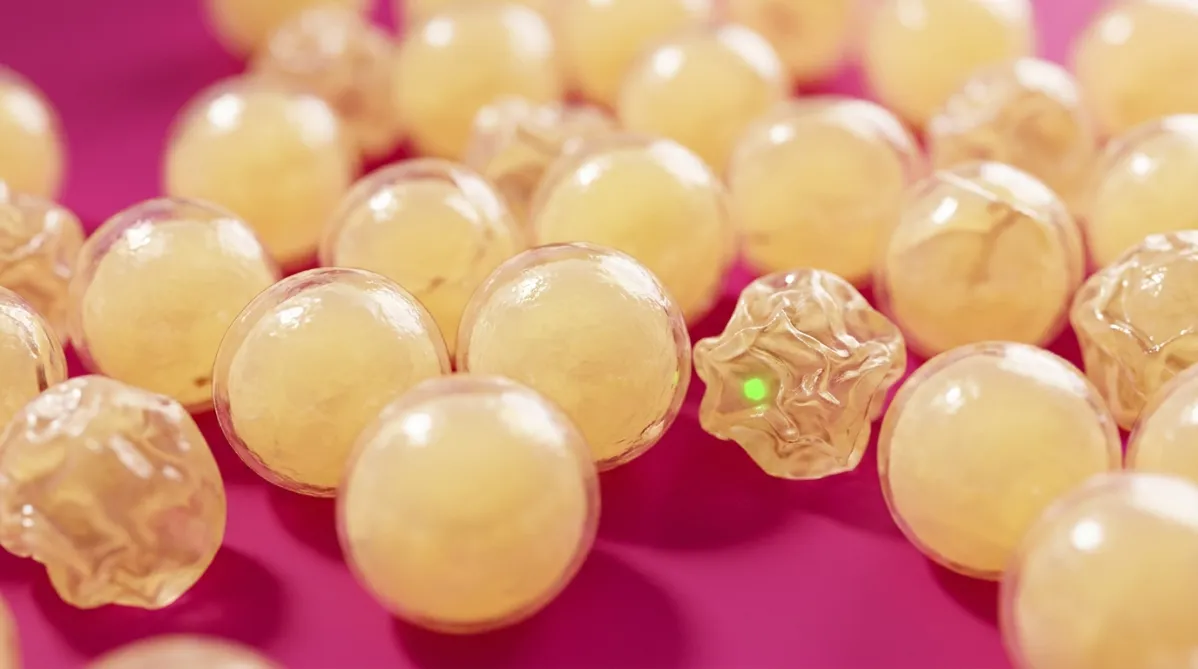
Extreme close-up microscopy-style photograph of a cluster of adipocytes (fat cells). Each is a translucent, pale yellow sphere with a thin membrane, and a few are shrunken and crinkled to suggest apoptosis. The cells sit against a saturated magenta backdrop. The camera is slightly above, at a shallow 30-degree angle, with a very shallow depth of field so the foreground cells are razor sharp and the rest melts into soft bokeh. Hard, clean side light from the left makes the membranes glisten and casts crisp magenta-tinted shadows. One tiny electric green fluorescent speck glows inside a single collapsing cell as a subtle accent. The mood is precise, clinical and curious, with a bold editorial feel. There is no text and no blue cast.
research

CBL-514 Injection Lipolysis: A Phase 2 Map of the Evidence

BY DR. SYNAPSE ·

CBL-514 is an investigational injection that aims to trigger fat-cell apoptosis in a treated abdominal area. In a 2025 Phase 2 trial of 76 randomized participants, it produced large ultrasound-measured fat-volume losses versus saline while mean body weight stayed flat. This hub maps the design, the 2 mg/cm² dosing, the exact efficacy figures with their shrinking denominators, and the company-reported DYRK1b/caspase mechanism. It also spells out the caveats: single-blind design, sponsor involvement, about 49% non-completion, short follow-up and a mostly female sample. Five deeper explainers are linked for readers who want to go further.

**Approach 1 (macro science), Palette D (bold color field).**

Extreme close-up microscopy-style photograph of a cluster of fat cells (adipocytes), rendered as translucent, pearly spheres with thin membranes and tiny lipid droplets inside. One cell in the center is visibly shrinking and blebbing, its membrane crinkled and fragmenting into small beads, the look of apoptosis. A few of the surrounding cells are intact and glossy. The cells sit against a saturated tomato-red backdrop, so the pale yellow-cream spheres stand out sharply. The camera looks straight down at shallow depth of field, with the focal plane on the dying cell and the edges softly blurred. Soft, diffuse top light gives gentle highlights and warm shadows, with no blue cast. One thin electric green fluorescent ring around the central cell's nucleus is the only green accent. The mood is analytical, precise and quietly skeptical.
research

How does CBL-514 work? Here's the science

BY DR. SYNAPSE ·

CBL-514 is not framed as a fat-melting or fat-burning drug. The proposed claim is that it inhibits the survival kinase DYRK1b and pushes fat cells toward apoptosis through caspase 3 and Bax/Bcl-2. That evidence comes from unpublished company reports cited in the Phase 2a and Phase 2 papers, and the chemical structure has not been disclosed. The 2025 Phase 2 trial measured ultrasound fat volume, photos, and safety, with no human biopsy or caspase data. This article separates the molecular hypothesis from what was actually measured in people, including the high dropout and single-blind design.

Approach 2, lab in action, with palette D, bold color field.

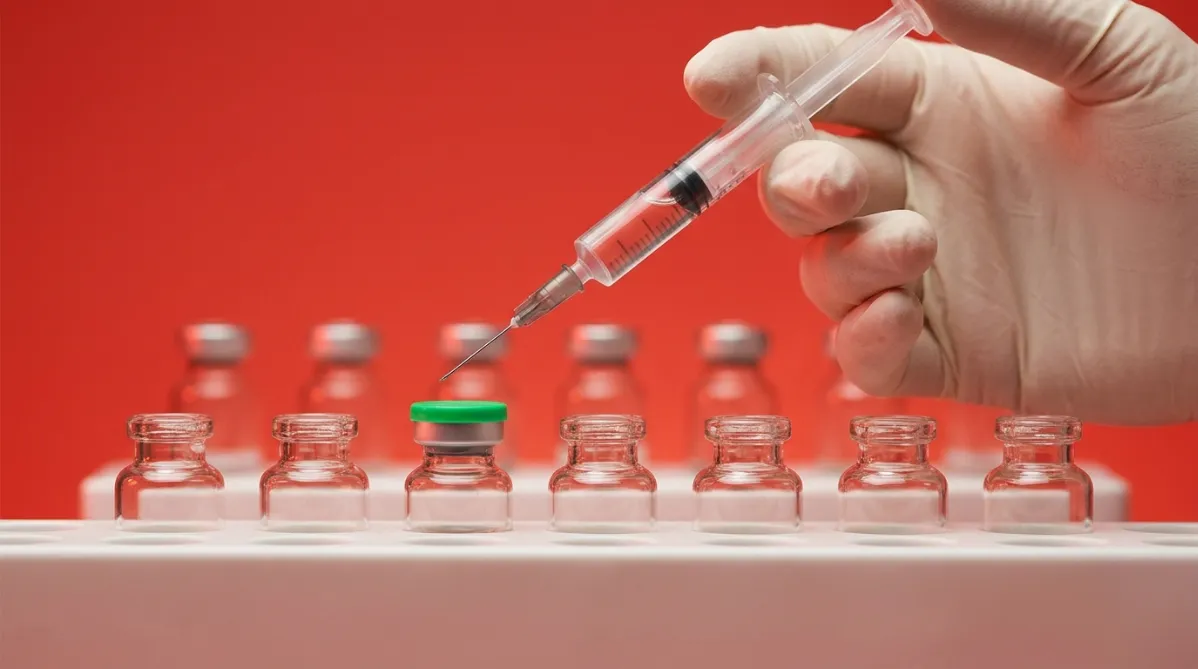
Straight-on, slightly elevated close shot of a gloved hand in a pale nitrile glove holding a glass syringe with a fine needle. The syringe is filled with clear liquid and sits over a row of small glass vials in a matte white rack. The whole scene sits against a saturated tomato-red seamless backdrop. Soft, even studio light gives crisp highlights along the syringe barrel and the vial glass, plus gentle warm-red reflections on the surfaces. A thin electric green (#00e676) cap on one vial is the only small accent. The dosing markings on the syringe are blurred and unreadable. Shallow depth of field blurs the back vials into soft shapes. The mood is precise, clinical and investigational, with high contrast and a measured, careful feel. No text, no labels, no logos.
research

CBL-514 Dosages - what does science say?

BY DR. SYNAPSE ·

CBL-514 trials are investigational injection protocols, and the "600 mg" figure is a per-treatment cap, not a supplement dose. This article walks through the Phase 2a dose-finding study (1.2, 1.6 and 2.0 mg/cm² over 150 cm², n=43, open-label) and explains where the much-quoted 24.96% figure comes from. It then covers the placebo-controlled Phase 2, which kept 2.0 mg/cm² but doubled the area to 300 cm² and raised the cap to 600 mg. You will see why mg totals cannot be compared across studies, what safety was reported, and why this is still not approved or advice.

Approach 1, macro science, in palette D, bold color field.

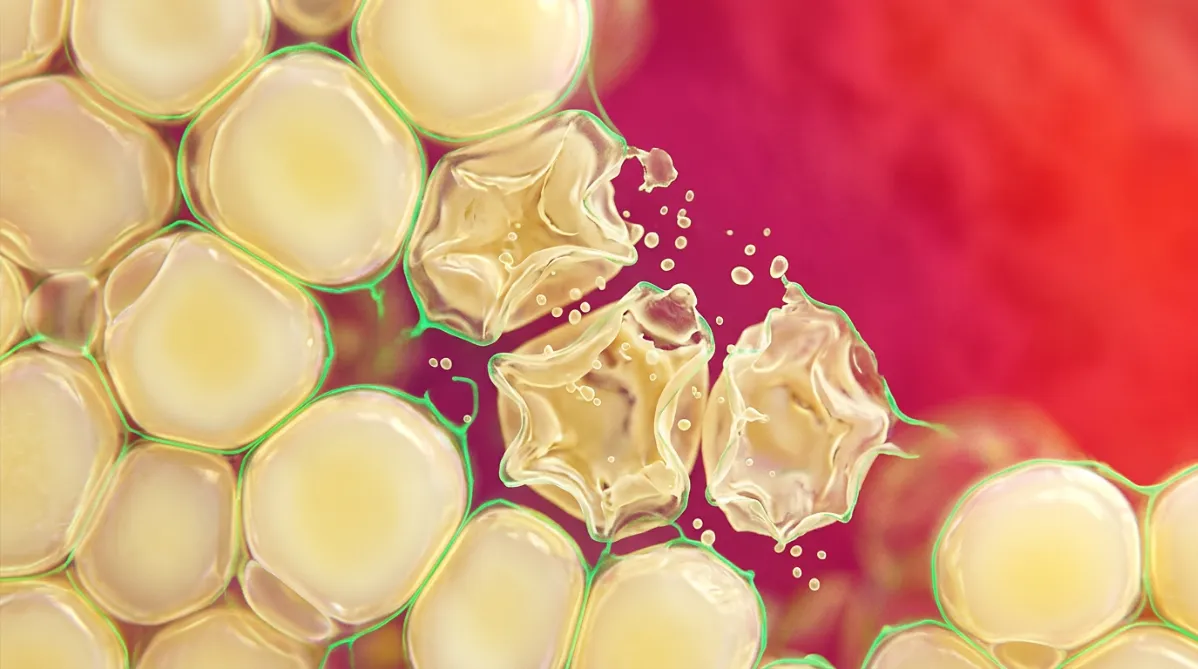
Extreme close-up photograph of a cluster of fat cells (adipocytes) in tissue, shot like a stained microscopy image. Rounded, translucent, pearly-yellow lipid-filled cells press together in a honeycomb. Several in the center look collapsed and shriveled, with ruptured membranes and scattered droplets. A few fine threads of electric green (#00e676) fluorescent stain outline the cell walls. The camera is straight-on at shallow depth of field, with the background cells melting into soft blur. Bright, even transmitted light makes the membranes glow. The backdrop is a saturated magenta-to-tomato-red field that sets off the pale yellow cells. The mood is scrutinizing, skeptical and precise. No text, no labels.
research

CBL-514 fat removal injections: What does the science say?

BY DR. SYNAPSE ·

CBL-514 now has a placebo-controlled Phase 2 randomized trial in Aesthetic Surgery Journal, and the authors report it met its primary and secondary endpoints. But this appraisal shows why the design deserves a hard look: it was single-blind with unblinded investigators and sponsor, and the sponsor helped design, analyze and write the study. Of 75 treated participants, only 38 finished, and the per-protocol set was just 30 people. Follow-up ended 8 weeks after the final treatment, and the sample was mostly female and White. Here is what the trial can support, what it cannot, and why it is not medical advice or proof of an approved treatment.

This page is available in