Biocracked
Approach 2, lab in action, with palette D, bold color field.

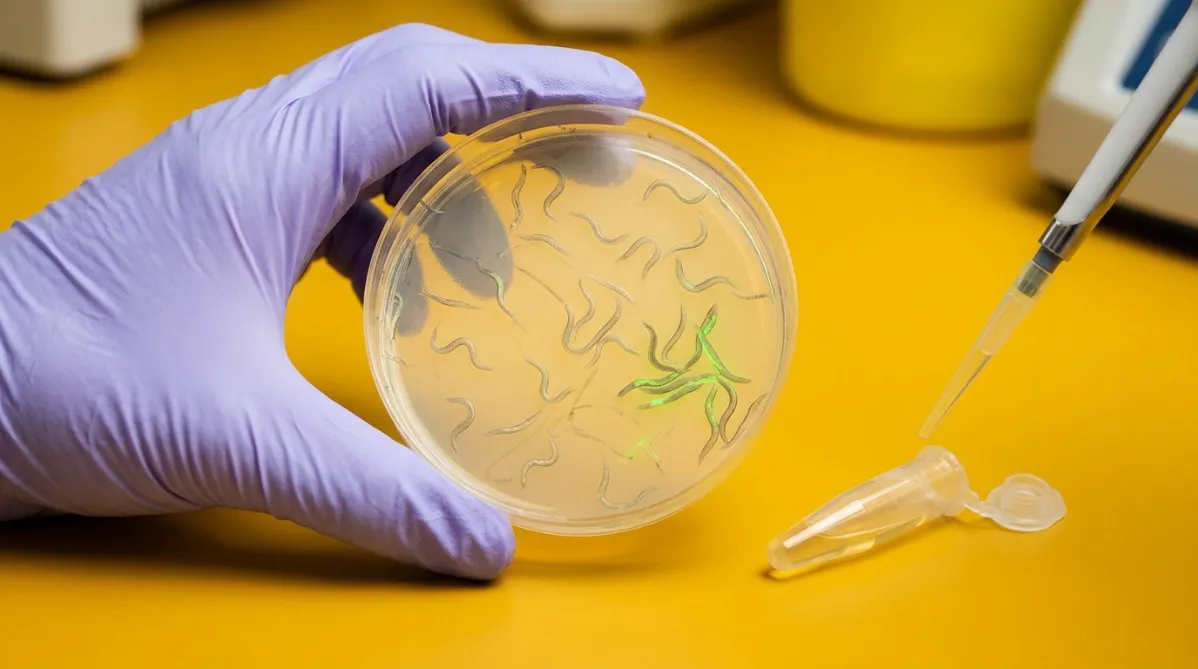
Overhead-angled close shot of a gloved hand in a pale purple nitrile glove holding an open agar petri dish above a saturated mustard-yellow lab bench. Inside the dish, dozens of tiny translucent C. elegans worms trace sinuous curved tracks across a faintly glowing bacterial lawn. A small cluster of the worms shows a subtle electric green fluorescence along their bodies, suggesting neurons. Beside the dish, a microcentrifuge tube holds a pale golden-yellow DHM solution, with a pipette tip hovering nearby. Lighting is bright, crisp, directional studio-style lab light with soft short shadows. The shallow depth of field blurs the background to a smooth yellow. The mood is curious, precise and optimistic, with a slightly playful contrast between the vivid backdrop and the delicate, nearly invisible animals.
Longevity

Hangover Supplement DHM Stretched Worm Lifespan by Up to 15%

Nova Chen · · 4 min read

Dihydromyricetin, better known as DHM, is the compound sold in "hangover relief" capsules and drink mixes. A new study suggests it may do something else in a very small animal: it lengthened lifespan and protected aging neurons. Before anyone changes their supplement stack, the caveat belongs up front. This was a roundworm study. There are no human longevity data.

What the researchers actually did

A team from Chosun University and Chonnam National University in South Korea tested DHM in Caenorhabditis elegans, a transparent roundworm widely used in aging research. The paper appeared in Antioxidants and examined lifespan, neuron integrity, oxidative stress resistance, mitochondrial status, and fat handling.

DHM is a dietary flavanonol, a plant compound type with a reputation for antioxidant and neuroprotective effects. It has also been linked to mitochondrial health. What had not been worked out was how it interacts with mitochondrial quality control during aging, which is the gap this study set out to fill.

The headline numbers: up to 15% longer mean lifespan

Worms treated with DHM at 50 to 200 micromolar (μM) had a mean lifespan 9.1% to 15.0% longer than untreated worms. Note that this refers to mean lifespan, not a claim that the oldest worms lived dramatically longer.

The treated worms also showed signs of better healthspan:

  • Less neuron degeneration. Touch-receptor neurons known as ALM and PLM showed less age-related damage.
  • Better movement. Locomotor performance held up into later adulthood.
  • Preserved touch response. The anterior touch response was maintained as the worms aged.
  • Better survival under oxidative stress. DHM-treated worms did better after a challenge with juglone, a compound that induces oxidative stress.

In test-tube assays (DPPH and ABTS), DHM also showed strong radical-scavenging activity, which fits its reputation as an antioxidant.

The mitochondria angle

This is where the study gets interesting. DHM modestly lowered TMRE fluorescence, a readout related to mitochondrial membrane potential. In a separate cohort with a different exposure schedule, mitochondrial DNA copy number did not differ significantly from controls.

The researchers also saw more GFP-negative/mCherry-positive mitochondrial puncta in ALM neurons. That pattern is consistent with a shifted mitochondrial energetic state and more mitochondria being trafficked to acidic degradative compartments, which is the kind of cleanup associated with mitochondrial quality control. The authors describe it as consistent with that interpretation, not as proof.

Not a simple "antioxidant" story

One of the more instructive findings is what didn't happen. Two canonical antioxidant-response reporters, SOD-3 and GST-4, were not significantly induced. If DHM were simply boosting the worms' own antioxidant defenses, you would expect them to light up. They did not.

The lifespan benefit also persisted in daf-16(mu86) mutants, so it does not appear to depend on DAF-16, the worm's well-known FOXO longevity factor. An exploratory statistical model found no evidence of a genotype-by-dose interaction.

The neuroprotective effect still appeared in ucp-4(ok195) mutants, but was not statistically detected in pink-1(tm1779); pdr-1(gk448) double mutants. These two genes are the worm counterparts of PINK1 and Parkin, central to clearing damaged mitochondria. That hints at a role for mitophagy-related pathways. However, the authors did not run a formal cross-genotype interaction test, so they treat this as hypothesis-generating, not definitive.

Less fat, too

DHM lowered intestinal lipid stores and suppressed expression of fat-5, fat-6, and fat-7, genes involved in fatty acid desaturation. It also modestly upregulated atfs-1, a regulator of the mitochondrial stress response. The authors conclude that DHM is associated with healthspan-related phenotypes alongside coordinated redox, mitochondrial quality-control, and metabolic changes. The wording is "associated with," and it is deliberate.

Why this doesn't translate to your capsule

A few reasons to keep your enthusiasm in check:

  • Worms are not people. C. elegans is a valuable model, but many lifespan extenders in worms fail to do anything comparable in mammals.
  • Micromolar is not milligrams. The 50 to 200 μM concentrations apply to the worms' environment. They can't be converted into a capsule dose for a human. Absorption, metabolism, and tissue levels differ enormously, and DHM is generally described as having limited bioavailability. The paper does not offer a human dose.
  • No human longevity data. The study says nothing about whether DHM extends human life or protects human neurons.
  • Mean lifespan, not maximum. The gains were reported for mean lifespan.

Practical takeaways

What people buy. DHM is commonly sold as capsules or powder, often under the names dihydromyricetin or ampelopsin, and is frequently derived from Hovenia dulcis extract. It is mostly marketed for hangovers and liver support, not longevity. This study provides no basis for a longevity dose.

Who might find this interesting. People who follow aging biology and mitochondrial quality control will find it a useful preclinical lead, particularly the idea that DHM works through something other than classic antioxidant induction.

Who should be cautious or skip it. Anyone expecting proven anti-aging benefits should hold off. People who are pregnant or nursing, have liver conditions, or take prescription medications should talk with a clinician before using any concentrated plant extract. Nothing in this paper establishes safety or efficacy in humans.

The bottom line

This study shows that DHM extended mean lifespan by up to 15% in roundworms, preserved neurons and movement, lowered fat stores, and altered mitochondrial markers. It is a genuinely interesting preclinical result, and the mutant data suggest mechanisms worth testing. But it remains a worm study with hypothesis-level mechanistic claims. The next real tests would be in mammals, and eventually in humans.

Original study

Read the original research on pubmed.ncbi.nlm.nih.gov →

This article summarizes published research for general information. It is not medical advice.

NC

Written by

Nova Chen

Nova Chen writes for Biocracked: biohacking science, longevity & human performance.

Related Articles

Approach 1, macro science, in palette D, bold color field.

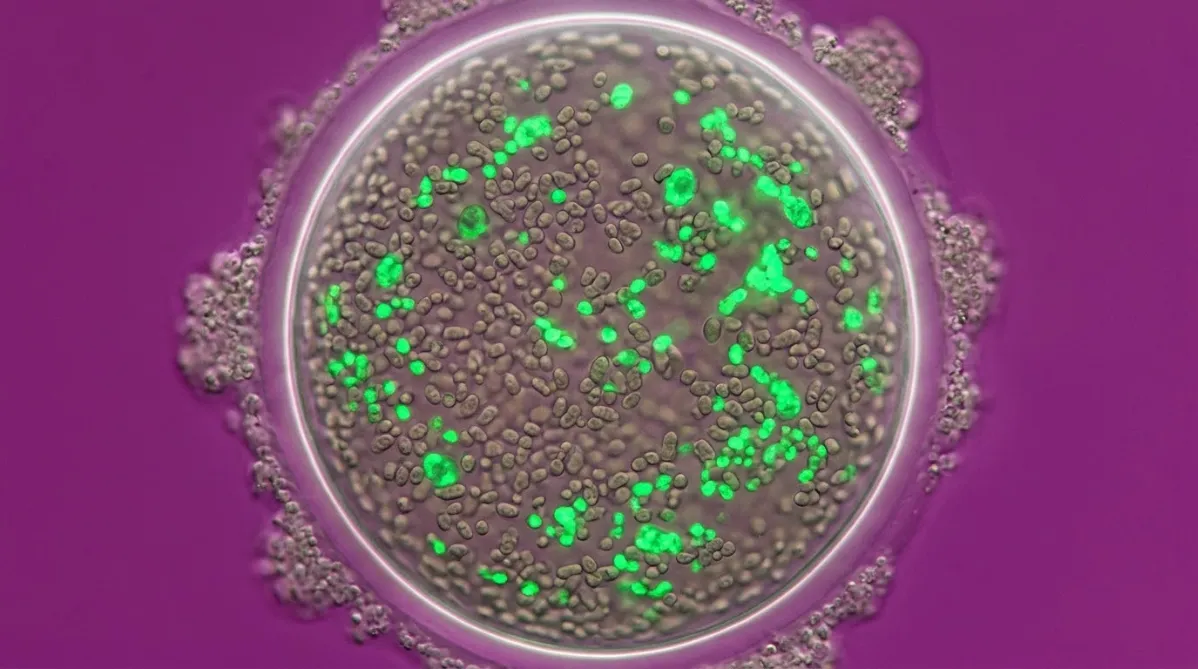
Extreme close-up microscopy-style image of a single mouse oocyte, a translucent spherical egg, shot straight on at its equator. Inside the cytoplasm, hundreds of mitochondria appear as tiny glowing grains. Most are a muted grey-amber, while a scattered subset of small and large organelles glows vivid electric green (#00e676), clustered unevenly to suggest an uneven response. Fine granular cumulus cells cling to the egg's edge, slightly out of focus. The backdrop is a saturated, flat magenta-violet field, with soft rim light wrapping the egg's glassy membrane and shallow depth of field blurring the edges. The mood is quiet, precise and slightly uneasy, a closer look revealing what the averages hid. Photoreal confocal-meets-studio look, with no text and no labels.
longevity

NMN Rejuvenated Hidden Mitochondria in Aged Eggs, But Not Evenly

BY NOVA CHEN ·

Aged mouse eggs looked mitochondrially normal on average, but a new single-organelle study says the averages were hiding something. Specific subpopulations, high-membrane-potential and small mitochondria, carried elevated mtDNA copy number with age. NMN pulled those back toward young levels, yet pushed large mitochondria the opposite way, and in surrounding cumulus cells it overshot young levels in some groups. No fertility or pregnancy outcomes were measured, the work was in mice, and some authors have patent and company ties. Here is what it means, and does not mean, for women weighing NMN for fertility.

Approach: conceptual metaphor, in palette D (bold color field).

A saturated mustard-yellow backdrop holds seven identical wooden-handled stopwatches in a staggered row, shot from a slightly raised three-quarter angle. Five stopwatches have run on and show tarnished, cloudy glass faces. The two in front have clean, glossy glass, and each carries a small electric green (#00e676) ribbon tied to its crown. The faces carry no numerals or readable marks. Soft, even studio light from a large overhead softbox gives gentle, short shadows. Shallow depth of field blurs the back of the row. The mood is playful but analytical, with crisp contrast between the dull watches and the bright pair. The image suggests that extra time and good time are not the same thing.
longevity

All 7 Longevity Compounds Extended Lifespan. Only 2 Kept Worms Functional

BY DR. SYNAPSE ·

Seven well-known longevity compounds all extended the lifespan of male roundworms in a new GeroScience study, but only two kept the animals functional late in life. Sulforaphane and metformin were the only treatments that improved late-life mating success, a proxy for reproductive healthspan. The other five added days without preserving that function, showing that lifespan and healthspan can be decoupled. This is strictly worm-only research from C. elegans, not evidence for humans. Still, it argues for screening longevity compounds on function, not survival alone.

Approach 4, conceptual metaphor, in palette D, bold color field. A single old brass pocket watch, photographed from a slightly high three-quarter angle, sits on a saturated mustard-yellow seamless backdrop. The watch case is cracked open and its glass is gone. One half of the gear train is clean and polished. The other half is corroded, with a dull green-black patina. A few fine droplets of clear liquid sit on the corroded gears, and one tiny electric green (#00e676) glint of oxidation shows at the edge of the damage. Hard but slightly diffused studio strobe from the upper left casts a crisp, short shadow on the yellow. The macro lens gives a shallow depth of field, with the sharpest focus on the split between healthy and damaged gears. The mood is cautionary, precise and quietly unsettling. No text or numerals appear on the dial.
longevity

The Anti-Aging Compound Spermidine Has a Dark Side in Old T Cells

BY DR. SYNAPSE ·

Spermidine is widely promoted as an anti-aging polyamine, but a new mouse-derived cell study found it can sabotage a specific group of old immune cells. In senescence-like CD49d- CD8+ T cells, it cut mitochondrial respiration, depleted antioxidant reserves, and fragmented mitochondria, while neighboring CD49d+ cells were untouched. Cells from young mice responded differently, which makes age a key variable. This is preclinical work, not evidence of harm in humans, but it challenges the idea that spermidine helps every aging cell. Here's what the paper found and what it does and doesn't mean for you.

Approach: conceptual metaphor. Palette: D, bold color field.

A tall glass of bright orange-gold liquid sits in the center of the frame, filled to the brim and overflowing down its sides, shot at a slight low angle. Beside it, a sealed, empty glass cylinder with a thin glass wall stays bone dry. A clear glass barrier stands between them, so the flow clearly never crosses. The backdrop is a saturated tomato-red seamless paper, with a glossy red surface reflecting both vessels. Hard, directional studio light from the upper left throws crisp, warm-neutral shadows and bright highlights along the glass rims and liquid droplets. One small electric green ring sits at the base of the empty cylinder as a subtle accent. Mood: tense, ironic, clean and editorial. Photorealistic, shallow depth of field, no text or labels.
supplements

Your CoQ10 Reaches Your Blood, But Not Your Mitochondria

BY NOVA CHEN ·

A new human trial put a hugely popular longevity supplement to the test with muscle biopsies, and the results are awkward for the marketing. In 40 healthy adults averaging 74 years, 400 mg/day of CoQ10 for 12 weeks raised blood levels but left muscle and mitochondrial CoQ10 unchanged. Mitochondrial function, VO2max, glucose control and body composition did not move either. The study is small, short and limited to robust older adults, and the senior author consults for Pharma Nord. Here is what it shows, what it cannot say, and who might still want to ask a doctor about CoQ10.

This page is available in