Every single person in this study had plastic in their blood. Not most. Every one. That is the starting point for a small but attention-grabbing pilot trial asking a question biohackers have been circling for years: can you actually lower your internal microplastic load, rather than just worry about it?
The candidate is chitosan, a fiber-like compound derived from crustacean shells. In the trial, 0.8 g per day for 15 days was associated with a 26.3% drop in measured blood microplastics. It's an intriguing result. It is also a very early one, and the caveats matter as much as the headline.
What Is Chitosan?
Chitosan is made by deacetylating chitin, the structural material in the shells of crustaceans such as shrimp, crabs and crayfish. It has long been sold as a supplement, usually pitched for fat binding or cholesterol support, and it's used in wound dressings and other biomedical products.
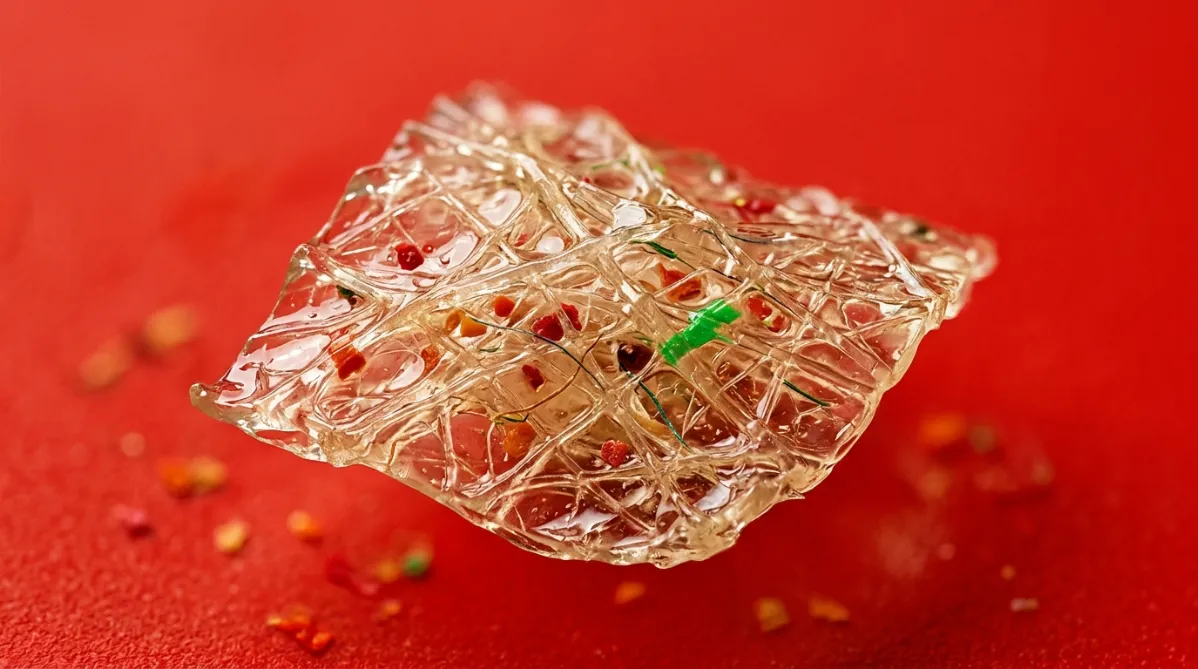
What makes it interesting here is its behavior in the digestive tract. Chitosan is positively charged in acidic conditions and can form a viscous gel. That gel-forming, binding quality is the basis of the microplastic hypothesis.
How Might It Trap Plastics in the Gut?
The idea is simple. Microplastics we swallow in food, water and dust pass through the intestine, where some fraction may cross into circulation. If chitosan gels in the gut and entangles plastic particles, those particles could be carried out in stool instead of being absorbed.
This is the proposed mechanism of "gastrointestinal sequestration," and it's worth stressing that the study did not directly prove it in humans. It measured blood, not stool, so the gut-trapping explanation remains an inference.
The Study
The paper, by Cornelli, Belcaro and Casella, was published in the Journal of Xenobiotics in May 2026. It was a pilot controlled study with 21 healthy adults:
- 11 participants took chitosan derived from Procambarus clarkii (red swamp crayfish), 0.8 g per day, for 15 days. In practice this was two 400 mg capsules in the evening.
- 10 matched controls received a placebo.
Blood microplastics were quantified using stereomicroscopy, scanning electron microscopy and micro-FTIR spectroscopy. Together these methods let researchers count particles and characterize them by size, shape and polymer type, detecting particles down to roughly 700 nm.
The Results
At baseline, microplastics were found in every participant. After supplementation, the chitosan group's mean concentration fell from 1.84 ± 0.28 µg/mL to 1.34 ± 0.20 µg/mL, a reduction of 26.3% (p < 0.01, paired analysis). The control group showed no significant change.
Two further details stand out:
- Across polymer types: reductions were seen consistently among the major plastic classes, rather than being driven by a single polymer.
- By size: the biggest declines appeared in intermediate particles of 11–50 µm.
The authors also estimated the mean residence time of circulating microplastics at about 58 ± 28 days. If accurate, that suggests blood levels are not permanent and may turn over on a timescale of weeks to months, which is at least consistent with the idea that cutting new absorption could lower levels fairly quickly.
The Earlier Rat Data
The human result doesn't come out of nowhere. A 2025 rat study by Liu and Shimizu in Scientific Reports found that chitosan increased fecal excretion of polyethylene microplastics. That supports the mechanistic story: if chitosan helps push plastics out via stool in animals, a lower absorbed fraction in humans is plausible. Still, animal findings frequently fail to translate, and one rodent paper is thin support for a human protocol.
The Big, Honest Caveats
This is where clickbait must give way to accuracy.
- Tiny sample. Twenty-one people total, 11 on chitosan. Small trials are prone to noisy and inflated effects.
- Pilot design. It's a hypothesis-generating study, not a confirmatory one.
- Short duration. Fifteen days says nothing about long-term effects, rebound, or safety with extended use.
- No health outcomes. The study measured particles, not inflammation, cardiovascular risk or any symptom. Lower blood microplastics has not been shown to make anyone healthier.
- Immature measurement methods. Quantifying microplastics in blood is difficult and not yet standardized. Contamination from lab plastics and variability between methods are recognized problems in the field, so absolute numbers should be treated cautiously.
- Within-group analysis. The headline p-value comes from a paired comparison in the treated group, which is less convincing than a clean between-group difference.
- Shellfish allergy. Chitosan from crustacean sources may be a concern for people with shellfish allergy. Anyone in that category should talk to a clinician before considering it.
Independent replication with larger samples, stool measurements and clinical endpoints is what would turn this from a curiosity into evidence.
Practical Takeaways
If you're intrigued, here is how to think about it responsibly:
- Know the dose used. The study used 0.8 g/day, taken as 2 × 400 mg in the evening, for 15 days. That is not a recommendation, just the tested protocol.
- Mind interactions. Because chitosan binds fats, it may interfere with absorption of fat-soluble vitamins (A, D, E, K) and potentially some medications. Separating timing from supplements and drugs is a sensible precaution, and checking with a pharmacist or physician is wiser still.
- Don't assume other fibers work. Alginate, psyllium and similar gel-forming fibers are sometimes suggested as alternatives. That is speculation; they weren't tested here.
- Reduce exposure first. Cutting intake is more certain than chasing removal. Filter drinking water, limit heavily packaged and plastic-heated foods, avoid microwaving in plastic, reduce synthetic dust, and favor glass or stainless steel.
- Check allergies. Shellfish allergy is a real flag.
Bottom Line
This pilot offers a genuinely novel signal: a cheap, familiar supplement associated with lower circulating microplastics over two weeks. But 21 people, a short window and no health outcomes mean it's an early lead, not a detox protocol. Treat it as a reason for better research, not a license to stack another capsule.