Biocracked
Approach: macro science, palette: warm.

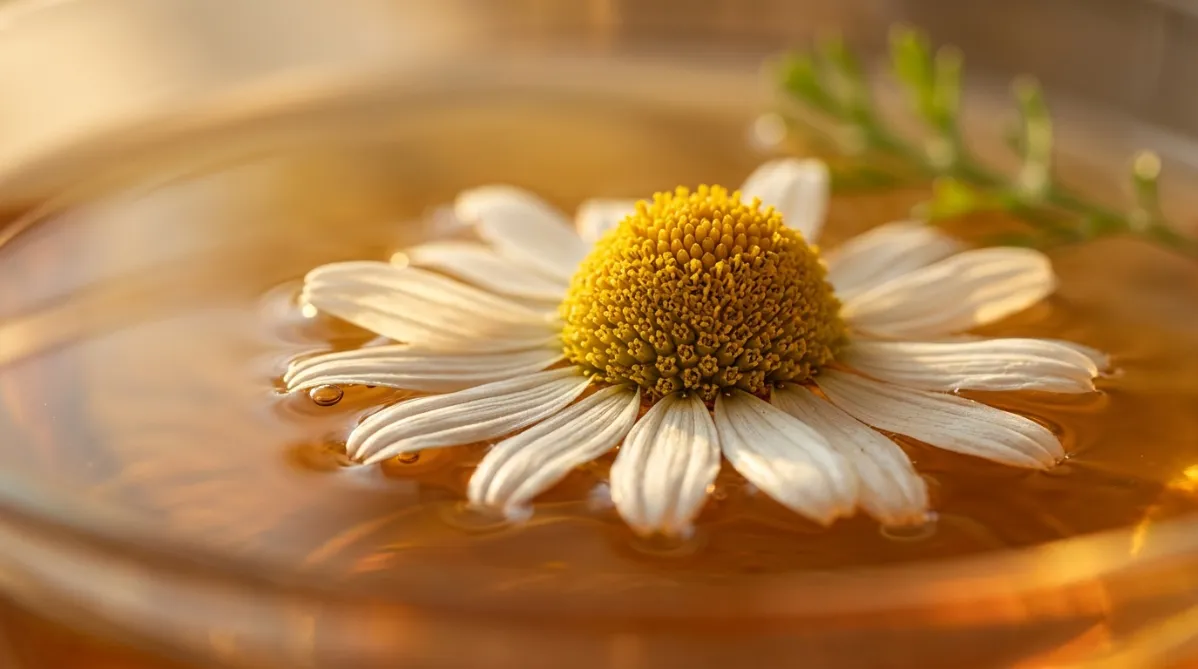
Extreme close-up macro of a single dried chamomile flower head floating on the surface of freshly steeped tea, shot from a low three-quarter angle just above the waterline. The white petals droop and curl, the golden domed center is packed with tiny pollen-dusted florets, and fine petal veins show in sharp detail. The tea beneath is a clear honey-amber, with soft ripples and a few tiny bubbles clinging to the petals. Low golden-hour sidelight from the left glows through the translucent petals and casts warm copper reflections across the liquid. Shallow depth of field melts the background into creamy amber bokeh, with one faint electric green sprig blurred at the far edge. Calm, quiet, slightly medicinal mood. Photorealistic, no text.
Supplements

400 mg of Chamomile Extract Improved Sleep in 4 Weeks, and the Effect Lasted

Rex Meridian · · 4 min read

The Bedtime Tea, Now in Capsule Form

Chamomile tea is the classic wind-down drink. Apigenin, one of chamomile's best-known compounds, has become a staple of "sleep stacks" in biohacking circles. A 2017 randomized trial in Complementary Therapies in Medicine tested a more concentrated version of the idea. It gave older adults 400 mg of chamomile extract a day for four weeks and tracked their sleep quality afterward.

The paper's conclusion is that chamomile extract "can significantly improve sleep quality among elderly people." The details are more modest, and more useful, than that headline suggests.

Study Design: Simple and Practical

Researchers at Kashan University of Medical Sciences in Iran ran a single-blind randomized controlled trial at the Kahrizak day-care nursing home in Karaj, Iran.

  • Participants: 60 adults aged 60 or older. Average age was about 70 in the control group and about 69 in the treatment group.
  • Intervention: Chamomile extract capsules, 200 mg twice daily (400 mg/day), for 28 consecutive days.
  • Control: Wheat-flour capsules of the same size, taken the same way.
  • Measurement: The Pittsburgh Sleep Quality Index (PSQI), a standard questionnaire, at four time points: before starting, two weeks in, right after the 28 days, and two weeks after stopping.

That last time point matters. Many supplement studies stop measuring when the supplement stops, so they can't say whether any benefit outlasts use.

The Results: What Changed and What Didn't

At baseline, both groups had poor sleep quality, with no significant difference between them (P=0.639). The groups differed on one component, habitual sleep efficiency. After the intervention, sleep quality in the chamomile group was significantly better than in the control group (P<0.05).

Summaries of the paper's data add specifics:

  • PSQI scores dropped by roughly 3 points in the chamomile group, a change generally considered clinically meaningful. Lower PSQI scores mean better sleep.
  • Participants fell asleep faster (shorter sleep latency).
  • They woke less often during the night.
  • Total sleep duration did not change.
  • The benefit persisted two weeks after stopping the capsules.

The duration finding is the most useful reality check. Chamomile didn't make these older adults sleep longer. It appears to have improved how they slept: how quickly they dropped off and how continuous the night was. Participants also still had moderate sleep problems at the end, so this was an improvement, not a cure.

The Apigenin Angle: Plausible, Not Proven Here

The proposed mechanism is that apigenin, a flavonoid in chamomile, binds benzodiazepine sites on GABA-A receptors. These receptors are part of the brain's main inhibitory signaling system, which is also targeted by prescription sedatives, though the proposed effect from chamomile is much milder.

This trial did not measure apigenin levels or brain activity, and it didn't test apigenin on its own. It tested a chamomile extract, which contains many compounds. The mechanism is a reasonable hypothesis from the broader literature, not something this study demonstrated. Treat "apigenin did it" as a plausible explanation, not a finding.

Limitations to Keep in Mind

The paper's own design limits how far you can push the conclusions:

  • Single-blind only. Participants didn't know which capsule they got, but the people running the study may have. That leaves room for bias.
  • Small sample. Sixty people is enough for a signal, not for firm conclusions.
  • One site, one population. Older adults at a single day-care nursing home in Iran may not represent younger adults, other cultures, or people living independently.
  • Self-reported outcomes. The PSQI is a validated questionnaire, but it is still subjective. No sleep-tracking device or lab measure was used.
  • Poorly described extract. The standardization of the extract, meaning how much apigenin or other active compounds each capsule contained, isn't well described. That makes it hard to replicate with an off-the-shelf product.
  • Short follow-up. The two-week post-treatment check is encouraging, but it says nothing about months of use.

Practical Takeaways

The dose used: 200 mg of chamomile extract, twice a day, for 28 days. If you're comparing products, this is the only regimen with evidence behind it here. Taking more, or taking it as a single nightly dose, goes beyond what was studied.

How it compares to tea: The trial didn't test tea, so there's no head-to-head data. A cup of tea and a standardized extract capsule differ in concentration and consistency, and the paper can't say whether tea would work equally well. Tea may still help as a calming ritual, but you can't assume it delivers the same effect.

Who it's for: The evidence applies most directly to adults 60 and older with poor sleep quality. For younger people, this study is suggestive at best. It's also not a treatment for diagnosed insomnia, sleep apnea, or other medical sleep disorders, and persistent sleep problems deserve a clinician's attention.

Safety flags:

  • Ragweed and related allergies. Chamomile belongs to the daisy (Asteraceae) family, and people allergic to ragweed, chrysanthemums, or similar plants can react to it. If that's you, be cautious or avoid it.
  • Sedatives and sleep medications. Because chamomile is thought to act on GABA-related pathways, combining it with benzodiazepines, sleep drugs, alcohol, or other sedating supplements could add to drowsiness. Check with a doctor or pharmacist first, especially if you take multiple medications, as many older adults do.
  • Stacking. Adding chamomile to a multi-ingredient sleep stack makes it impossible to tell what's helping, and the trial tested chamomile alone.

The Bottom Line

This small but well-structured trial suggests that 400 mg a day of chamomile extract for four weeks may improve self-reported sleep quality in older adults, with faster sleep onset, fewer awakenings, and benefits that lingered for two weeks after stopping. It did not lengthen sleep, and the people in it still had moderate sleep problems. The apigenin story is plausible but unproven here, and the single-blind design, small sample, and single site call for larger, better-controlled replication. For now, it's a promising, low-risk option for some older adults, not a magic sleep pill.
Original study

Read the original research on pubmed.ncbi.nlm.nih.gov →

This article summarizes published research for general information. It is not medical advice.

RM

Written by

Rex Meridian

Rex Meridian writes for Biocracked: biohacking science, longevity & human performance.

Related Articles

Conceptual metaphor in a bold color field palette: a single brass balance scale sits dead center on a saturated mustard-yellow seamless backdrop, photographed at eye level with a 85mm lens and shallow depth of field. One pan holds a small mound of coarse white magnesium salt crystals, the other pan holds a rumpled, empty pillow-soft wad of grey linen, and the beam hangs almost level but wavering, suggesting uncertainty. A thin electric green thread loops from the beam's pivot as a subtle accent. Soft, large-source studio light from camera left casts a gentle, defined shadow to the right across the yellow surface. Crisp metal reflections, visible salt crystal facets. Mood: skeptical, calm, quietly questioning, clean and editorial.
supplements

Magnesium for Sleep? 12 Trials Say the Hype Outruns the Evidence

BY NOVA CHEN ·

Magnesium is marketed as a natural sleep aid, but a new systematic review of 12 randomized controlled trials in adults says the evidence doesn't support it as a routine insomnia treatment. Results were inconsistent across questionnaires, EEG, actigraphy and wearables, and certainty was low to very low. The review used narrative synthesis rather than a meta-analysis because the trials differed so much in forms, doses and populations. Some adults may still see modest subjective benefits, particularly those with low intake. Here's what the paper found, what it didn't, and how to approach a magnesium trial sensibly.

Approach: Macro science, with the human outcome as a quiet secondary cue. Palette: C (Natural).

Extreme macro photograph of a halved red onion and fresh celery leaves, the real dietary sources of isorhamnetin and luteolin. The onion's glossy magenta-violet layers and translucent cell walls fill the left two-thirds of the frame, with fine droplets of juice catching the light. A few crisp green celery leaves and a sprig of dried parsley rest in soft focus to the right. Shot at a slight low angle, shallow depth of field, 100mm macro look. Soft morning daylight from a window behind and to the side gives a warm rim light and gentle translucency through the onion layers. The palette is earthy: plum, sage green, and warm wood tones, with one small electric green highlight on a celery leaf edge. The mood is calm, fresh, and quietly curious, with a hint of rest.
supplements

The Overlooked Flavonoid Linked to Better Sleep Isn't Quercetin

BY NOVA CHEN ·

Everyone talks about quercetin, but a large U.S. survey analysis points to two lesser-known flavonoids tied to better sleep: isorhamnetin and luteolin. People in the top tertile of isorhamnetin intake had about 25% lower odds of sleep disorders and reported longer sleep. Luteolin showed a smaller link, around 15% lower odds. But this is a cross-sectional study of 10,162 adults based on dietary recalls of foods, not supplements, so it cannot prove cause and effect. Here is what the numbers show, what they don't, and what a sensible takeaway looks like.

Approach: conceptual metaphor. Palette: warm.

A single ceramic mug on a wooden bedside table, filled with a pale, cloudy collagen drink, with a thin ribbon of steam rising from the surface. Camera angle is a low three-quarter view at table height, shallow depth of field. Behind the mug, a rumpled bed with crisp cotton sheets dissolves into soft bokeh. A small brass alarm clock stands beside it, its hands blurred and its face unreadable. Light comes from a warm amber bedside lamp, casting honey-gold highlights on the rim and long copper-toned shadows across the grain of the wood. Powder grains lie scattered on the table next to the mug, one tiny speck of electric green on the lamp's cord switch. The mood is quiet, drowsy and unhurried, the last calm minutes before sleep.
supplements

Is Your Collagen a Sleep Aid? Glycine Trials Say Maybe

BY NOVA CHEN ·

You bought collagen for your skin, but a new scoping review asks whether its glycine might also help you sleep. Glycine supplements reliably raise blood glycine, and all three glycine sleep trials found a benefit on at least one outcome. Collagen peptides showed fewer awakenings in one placebo-controlled trial and lower fatigue in another, yet failed to beat alpha-lactalbumin in head-to-head comparisons. Nobody has tested whether glycine is actually the mechanism. Here's the dose, the timing, and the limits you should know.

Approach 4, conceptual metaphor, in palette C, natural.

A single ceramic cup of freshly brewed green tea sits on a weathered wooden windowsill, photographed from a low three-quarter angle at eye level. Steam curls upward and catches soft, directional morning daylight from a window on the left. The tea is clear amber-green, with a few loose unfurled tea leaves resting on the saucer. Behind the cup, a softly out-of-focus garden of leafy green plants and a bright, hazy sky gives shallow depth of field. The wood has realistic grain and small chips, and the ceramic has a matte, slightly speckled glaze. A single tea leaf in the foreground has a faint electric green tint where light passes through it. The mood is calm, quiet and unhurried, with warm skin-tone wood against cool plant greens. No text, no labels.
supplements

L-Theanine Calms Without Sedation: What Doses Actually Work

BY NOVA CHEN ·

L-theanine, the amino acid in tea, is said to calm you without making you drowsy, and a new Frontiers in Nutrition mini-review tests that claim against human trial evidence. It reports doses of 100-400 mg for small cognitive gains (especially with caffeine), 200-400 mg/day for stress without sedation, and 200-450 mg/day for better sleep quality. The effects are small, and the paper does not report a pooled sample size. Both authors work for a British American Tobacco subsidiary that sells L-theanine products. Here is what the numbers say, who it may suit, and who should skip it.

This page is available in