Biocracked
Approach: Conceptual metaphor, with a macro feel. Palette: Bold color field.

Straight-on, eye-level shot of two identical glass hourglasses standing side by side on a glossy saturated tomato-red acrylic surface, against a seamless matching red backdrop. One hourglass holds fine, glittering pale-gold crystalline sand (for AKG). The other holds deep coral-crimson granules (for astaxanthin). In both, the sand has almost entirely run through to the bottom bulb, and the top bulbs are nearly empty. This shows that time kept running out on schedule. Hard, direct studio light from the upper left casts crisp, short shadows and sharp specular highlights along the glass curves. Tiny sand grains in sharp focus show a macro, almost microscopic texture. A single thin electric-green thread is looped around the base of one hourglass as a subtle accent. Mood: wry, skeptical, graphic and punchy, with clean modern editorial energy.
Longevity

AKG and Astaxanthin Just Flopped the Toughest Mouse Longevity Test

Dr. Synapse · · 4 min read

Alpha-ketoglutarate (AKG) and astaxanthin are two of the most popular longevity supplements, and neither extended lifespan in one of the toughest mouse tests in aging research.

A new paper in GeroScience (2026;48(3):3821-3830) reports results from the National Institute on Aging's Interventions Testing Program (ITP). Across eleven interventions, none significantly increased lifespan in male or female mice. Several of the compounds had looked promising in earlier work.

This does not prove these supplements are useless in people. It does show how easily an exciting early signal can fail to hold up.

What Is the ITP, and Why Does It Matter?

The ITP is widely treated as a gold standard for testing lifespan-extending compounds in mice. It has two main strengths:

  • Multi-site design. Identical experiments run at three sites: The Jackson Laboratory, the University of Michigan, and the University of Texas Health Science Center at San Antonio.
  • Genetically heterogeneous mice. The UM-HET3 mice are a genetically varied population, which makes the results less dependent on the quirks of a single inbred strain.

That is a stricter standard than many single-lab studies, which can be swayed by one strain, one facility, or one unusually long-lived control group.

What Was Tested

The paper evaluated eleven interventions, a mix of new agents and previously tested compounds given at new doses or later starting ages. The named compounds were:

  • Astaxanthin
  • Meclizine
  • Mitoglitazone
  • Pioglitazone
  • Alpha-ketoglutarate
  • Mifepristone
  • Methotrexate
  • Atorvastatin combined with telmisartan

The abstract does not give exact doses, group sizes, or treatment durations for each compound. Those details are in the full text, which is open access (PMC13356140). I have not filled them in here.

The Headline Finding: Nothing Extended Lifespan

Despite earlier evidence of benefit in other models or under other conditions, no compound significantly increased lifespan in either sex.

That includes AKG. Earlier mouse work, including studies of calcium AKG, had generated considerable excitement and helped drive its popularity as a supplement. The ITP found no lifespan benefit under its conditions.

It also includes astaxanthin, mitoglitazone, and meclizine, all previously linked to lifespan extension within the ITP. When the researchers tried different doses or later starting ages, the benefit did not appear.

The Twist: Some Compounds Looked Harmful in Females

In females, pooled data from all three sites linked astaxanthin, late-start mitoglitazone, and pioglitazone to significantly shorter lifespan.

The authors then noticed that control females at The Jackson Laboratory lived unusually long. That can make a treatment group look worse by comparison. When they reanalyzed using only the other two sites, astaxanthin dropped out, and only mitoglitazone and pioglitazone still showed a negative effect.

So the astaxanthin "harm" signal is probably a statistical artifact of an unusually long-lived control group, not a real toxic effect. The glitazone signal held up in the reanalysis, though it is still a mouse finding.

Why Might Promising Results Fail?

The authors point to two variables:

  1. Dose. A compound that works at one dose may do nothing at another.
  2. Starting age. Many interventions seem to work only if started early, and some may do nothing or worse when started later.

They also argue for caution with single-site or single-cohort findings. A striking result in one lab is a hypothesis, not a conclusion.

What This Means for You

  • Temper your expectations. The strongest controlled lifespan test so far found no extension. Don't expect a longevity payoff.
  • Don't panic. This was a mouse study. It does not show that either supplement is harmful to humans, and it doesn't test every dose, form, or starting age.
  • Dose and timing remain open questions. The paper itself says these variables are critical, and the abstract does not give a human-translatable dose.
  • Judge by other goals. If you take astaxanthin for something else, such as skin or eye health, this study neither supports nor refutes that use. It only addresses lifespan in mice.

Who might reasonably continue: people who are comfortable with the cost and tolerability, understand the evidence is thin, and aren't relying on the supplement to extend life.

Who should skip or be cautious:

  • Anyone buying it mainly for a lifespan benefit.
  • People on prescription drugs, who should check with a clinician first. This applies to all supplements.
  • Anyone considering pioglitazone for "anti-aging." It is an approved diabetes drug, and the female mouse signal is a reason not to use it off-label for longevity.

Focus on the proven basics: regular exercise, adequate sleep, not smoking, moderate alcohol intake, a healthy diet, a healthy weight, and managing blood pressure, lipids, and glucose. These have far stronger human evidence than any supplement here.

The Bottom Line

Negative results like this are valuable. They correct early hype and show why replication, multi-site testing, and attention to dose and age matter. For now, AKG and astaxanthin have not earned a place as proven longevity tools. They are interesting compounds that failed a very demanding test.

This article summarizes a published abstract. It is not medical advice.

Original study

Read the original research on pubmed.ncbi.nlm.nih.gov →

This article summarizes published research for general information. It is not medical advice.

DS

Written by

Dr. Synapse

Dr. Synapse writes for Biocracked: biohacking science, longevity & human performance.

Related Articles

Approach 4, conceptual metaphor, in palette D, bold color field. A single old brass pocket watch, photographed from a slightly high three-quarter angle, sits on a saturated mustard-yellow seamless backdrop. The watch case is cracked open and its glass is gone. One half of the gear train is clean and polished. The other half is corroded, with a dull green-black patina. A few fine droplets of clear liquid sit on the corroded gears, and one tiny electric green (#00e676) glint of oxidation shows at the edge of the damage. Hard but slightly diffused studio strobe from the upper left casts a crisp, short shadow on the yellow. The macro lens gives a shallow depth of field, with the sharpest focus on the split between healthy and damaged gears. The mood is cautionary, precise and quietly unsettling. No text or numerals appear on the dial.
longevity

The Anti-Aging Compound Spermidine Has a Dark Side in Old T Cells

BY DR. SYNAPSE ·

Spermidine is widely promoted as an anti-aging polyamine, but a new mouse-derived cell study found it can sabotage a specific group of old immune cells. In senescence-like CD49d- CD8+ T cells, it cut mitochondrial respiration, depleted antioxidant reserves, and fragmented mitochondria, while neighboring CD49d+ cells were untouched. Cells from young mice responded differently, which makes age a key variable. This is preclinical work, not evidence of harm in humans, but it challenges the idea that spermidine helps every aging cell. Here's what the paper found and what it does and doesn't mean for you.

**Approach: Conceptual metaphor. Palette: D, bold color field.**

A single analog wall clock with a blank white face and plain black hands, photographed straight-on against a saturated mustard-yellow backdrop. Its glass is slightly fogged. Several translucent multivitamin tablets, in the speckled orange-tan of a real multivitamin, rest on the clock's lower rim and in front of its face. One tablet is half-dissolved and leaves a faint haze on the glass. The clock hands sit just short of each other, hinting that the time barely shifted. Behind the clock a thin ghost shadow of a second clock hand falls a few degrees off, suggesting a nudge that isn't conclusive. A hair-thin electric green (#00e676) second hand adds a small accent. Soft, diffused studio light from the upper left creates gentle shadows on the yellow. The camera is at eye level with a shallow depth of field. The mood is wry and skeptical, curious but unconvinced.
longevity

A Cheap Multivitamin Nudged DHA Up—But the Aging Clocks Stayed Put

BY DR. SYNAPSE ·

Two years of a daily Centrum Silver gave older adults small bumps in DHA and omega-3 fatty acids and slowed the usual rise in creatinine, according to a COSMOS randomized trial analysis. Metabolomic risk scores for 16 chronic diseases also dipped, and all seven aging clocks trended 0.5 to 1.05 years younger. The twist is that none of it survived multiple-testing correction. Here is what the data show, what they don't, and who might care.

Approach: conceptual metaphor, with a natural palette.

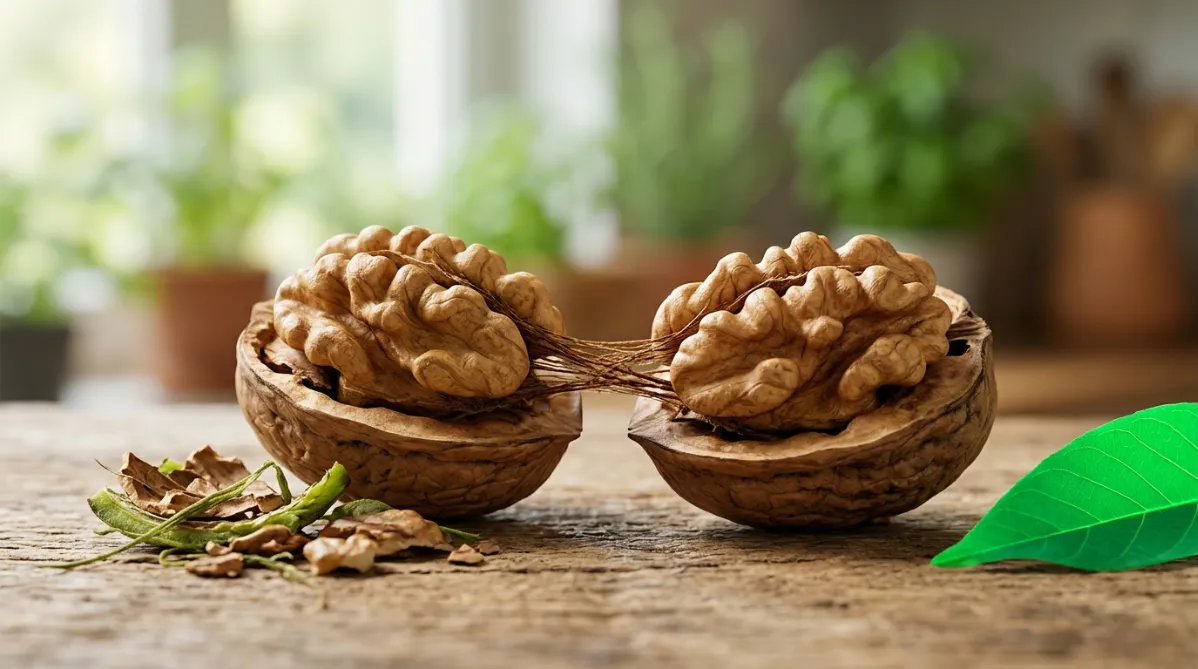
A single walnut is cracked open on a rough wooden board, and its two halves sit slightly apart. The halves are shot in tight macro from a low three-quarter angle. The walnut's brain-like folds are the focus. Between the halves, a thin cluster of fine, dark brown tannin-stained fibers stretches like a bridge. Beside it sits a small pile of shell fragments with a few strands of green walnut husk. A small, sharp, electric green (#00e676) leaf catches the light at the edge of the frame. The background is a softly blurred window-lit kitchen garden in leafy greens and warm earth tones. Soft natural daylight comes from the left and gives gentle shadows and visible texture on the nut's ridges. The mood is calm, curious and quietly scientific, with a fresh morning feel and no blue cast.
longevity

Urolithin A: The Walnut Gut Byproduct Tied to a Thicker Brain

BY NOVA CHEN ·

Eat a walnut and your gut bacteria turn its ellagitannins into urolithins, compounds that may be tied to how well your brain ages. In a 2-year MRI sub-study of the WAHA trial, bigger rises in urolithin A, urolithin C, and urolithin C glucuronide were associated with preserved cortical thickness among walnut eaters, mostly in right-hemisphere regions. The pattern was stronger in people with metabotype B gut profiles. But this is an association inside a randomized trial, not proof of cause, and it says nothing direct about urolithin A supplements. Here's what the data show, who might care, and who should stay skeptical.

**Approach: Conceptual metaphor. Palette: D, bold color field.**

A single clear glass pipette dropper hangs just above a small glass dish on a saturated mustard-yellow seamless backdrop. One golden-amber droplet of oil falls from its tip, caught mid-air, with a faint ripple already spreading across the otherwise flat surface below. The dish is half-filled with clear fluid, a quiet nod to cerebrospinal fluid. The camera sits low and slightly off-axis, at a shallow 35° angle, with a macro lens and a softly blurred background. Large diffused studio light from the upper left gives crisp highlights on the glass and a clean, soft shadow on the yellow floor. A thin electric green reflection runs along the glass rim. The mood is sober and skeptical: a hopeful intervention producing a measurable ripple but no dramatic change. Photorealistic, with no text.
longevity

2 g of DHA a Day Reached the Brain in APOE4 Carriers, but Memory Did Not Budge

BY DR. SYNAPSE ·

A two-year trial gave older adults 2 grams of DHA a day. It moved a key marker in the fluid around the brain, but it did not change brain volumes or cognitive test performance. The study, published in EBioMedicine by Yassine and colleagues, tested the idea in people carrying the APOE ε4 gene variant and in people without it. It is one of the clearer reality checks the omega-3 field has had.

This page is available in