Biocracked
←

#vegf

1 article
Approach: Macro science. Palette: D, bold color field.

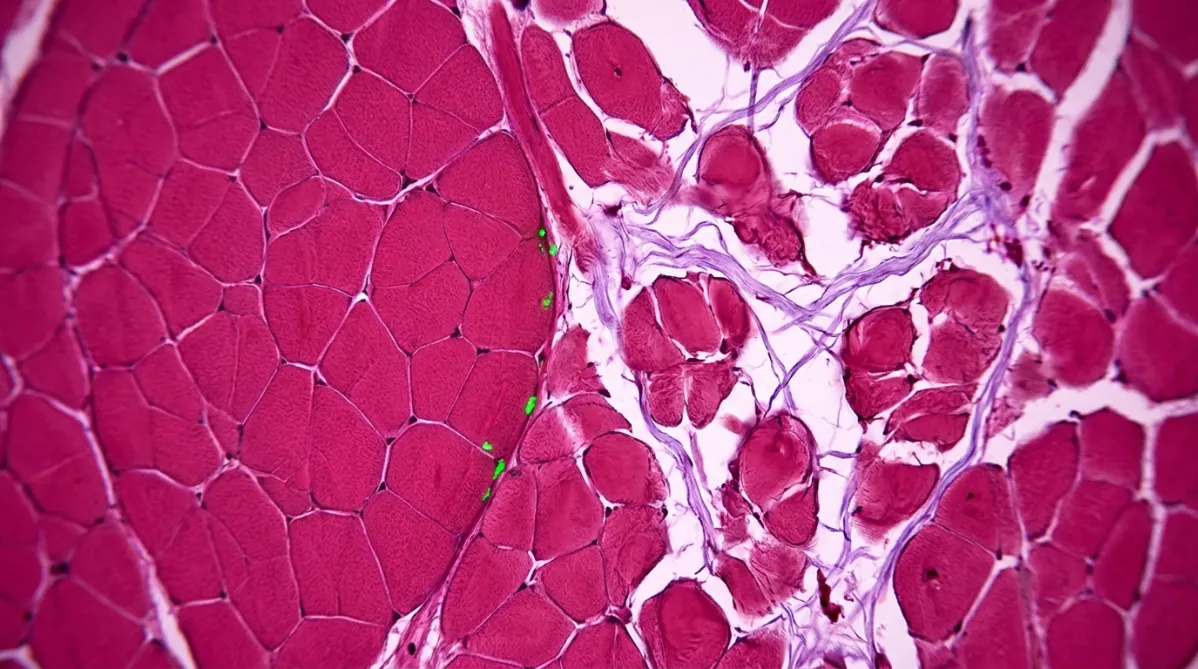
Extreme close-up microscopy-style photograph of a stained rat skeletal muscle cross-section, shot straight down through the microscope objective. Polygonal muscle fibers fill the frame in saturated magenta and pink eosin tones. A cluster of fibers on the left is neatly packed and uniform. On the right, the tissue is disrupted, with swollen gaps and thin, fibrous collagen strands in pale violet threading between damaged cells. A few tiny electric green fluorescent specks sit along one fiber edge as a subtle accent. Lighting is bright, even transmitted light with crisp focus at the center and soft falloff at the edges. The mood is analytical and tense, a rescue only partly complete. No text, no labels.
peptides

BPC‑157 protège le muscle de rat des lésions liées à l’ischémie – avec un bémol

BY NOVA CHEN ·

Couper le flux sanguin d’un muscle puis le restaurer peut causer davantage de dégâts que l’interruption elle‑même. Une étude récente sur des rats montre que le peptide BPC‑157 administré à la fin de l’ischémie limiterait le stress oxydatif, l’apoptose et l’inflammation, tout en favorisant partiellement la récupération du VEGF. L’expérience repose sur six rats par groupe, une dose unique intrapéritonéale de 20 µg/kg et deux heures de reperfusion. BPC‑157 n’est pas un médicament autorisé et ces résultats ne justifient en aucun cas une utilisation chez l’homme.

This page is available in