Biocracked
←

#foxo

1 article
Approach 1, macro science, with Palette B, warm.

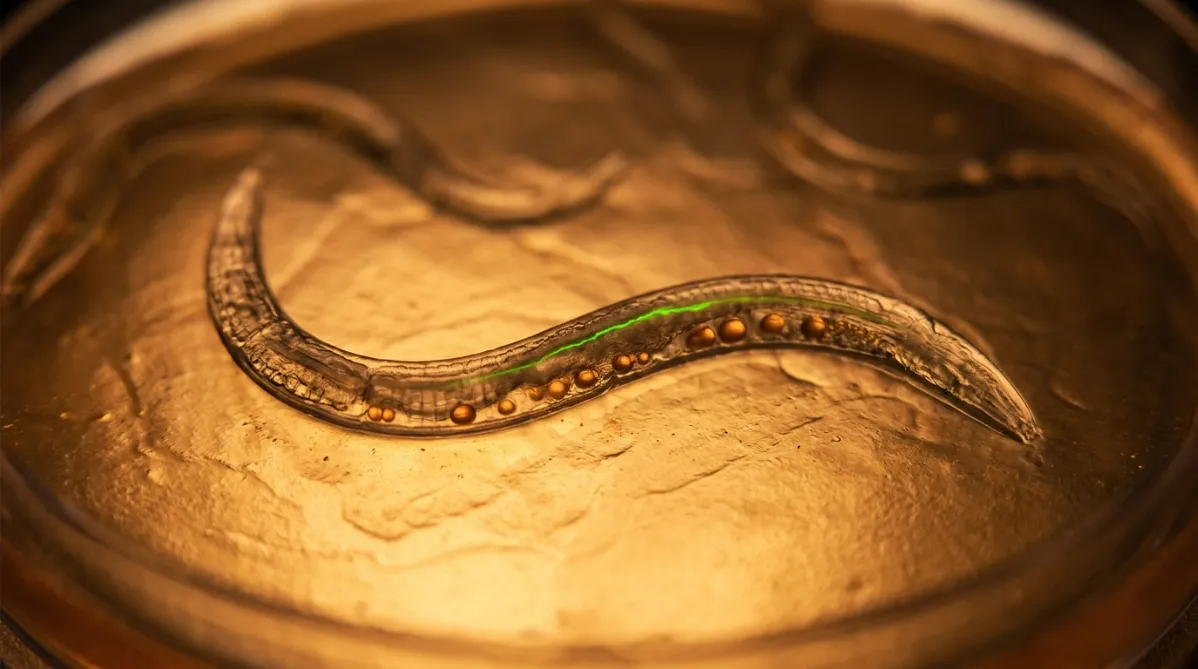
Extreme close-up of a single C. elegans roundworm, photographed through a microscope, lying curved on a bed of agar in a petri dish. Its translucent body shows fine internal structure, and a few tiny orange-amber fucoxanthin droplets glow along its gut. A few more worms blur softly in the background. Shot from slightly above at a low angle with shallow depth of field. Warm golden backlighting passes through the agar, turning it honey and copper, with soft amber highlights and warm brown shadows. One thin electric green fluorescent streak runs along the worm's body, suggesting a lit-up longevity gene. The mood is quiet, curious and cautiously optimistic. It looks like real microscopy, not an illustration, and contains no text or labels.
longevity

Fucoxanthin verlängert die Lebensdauer von Würmern um 12,1 %, doch kaufen Sie es noch nicht

BY NOVA CHEN ·

Fucoxanthin, das braune Algenpigment, das als Fettabbau‑Supplement verkauft wird, hat gerade die mittlere Lebensdauer von Rundwürmern um 12,1 % verlängert. Es verzögerte zudem den altersbedingten Abbau der Bewegungsfähigkeit, steigerte die Widerstandsfähigkeit gegenüber oxidativem Stress und schützte Würmer‑Modelle für Alzheimer‑ und Parkinson‑Krankheiten. Die Wirkung hing vom Langlebigkeitsfaktor DAF‑16 (FOXO) und dem Autophagie‑Gen bec‑1 ab. Doch es handelt sich um eine C. elegans‑Studie, nicht um menschliche Evidenz, und aus ihr lässt sich keine menschliche Dosis ableiten. Hier zeigen wir, was die Ergebnisse wirklich belegen und was nicht.

This page is available in