Biocracked
Approach 4, conceptual metaphor, in palette D, bold color field.

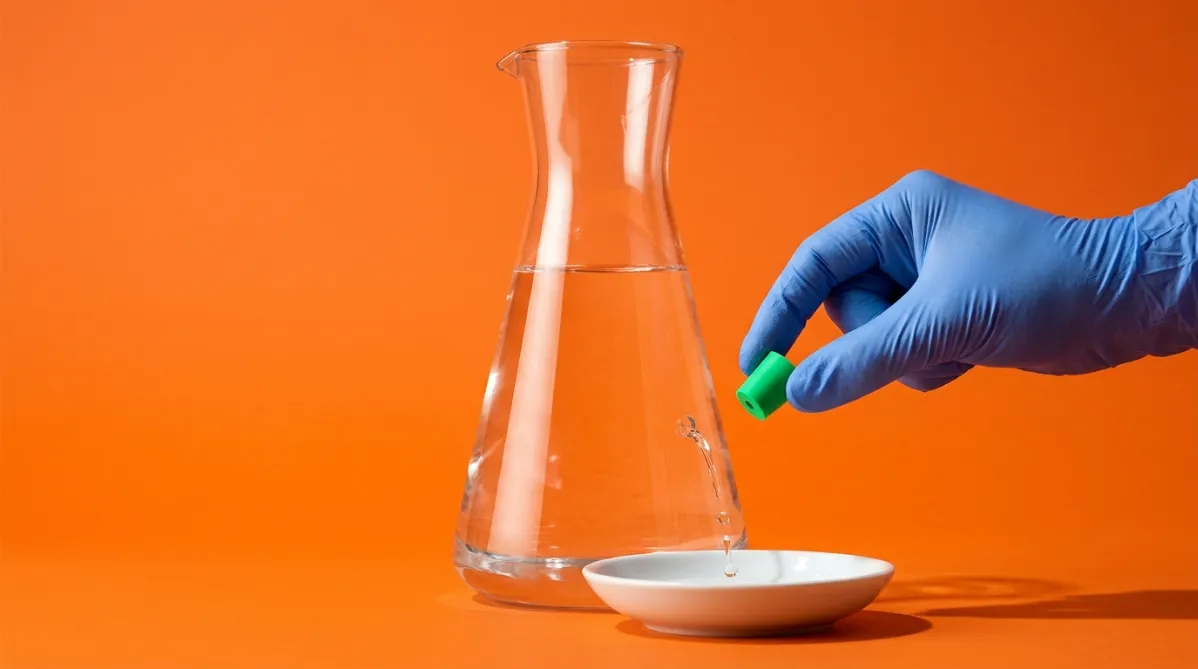
A single glass beaker-shaped water carafe sits at center frame on a saturated tangerine-orange seamless backdrop, photographed straight-on at slight low angle. The carafe is filled with clear water, and a small, cleanly drilled hole near its base releases a thin, steady stream that falls into a shallow white ceramic dish below, with a few droplets frozen mid-air. This stands for NAD+ draining away through a leak. A tiny electric green (#00e676) rubber stopper is held by a gloved fingertip entering from the right, about to plug the hole. Lighting is crisp, high-key studio light from upper left, giving sharp specular highlights on the glass and soft, warm-neutral shadows on the backdrop. Mood: clever, precise, optimistic but skeptical. No text or labels.
Longevity

Krađa NAD+ u vašem mozgu: blokiranje CD38 podiglo razinu NAD+ u mozgu

Nova Chen · · 4 min read

If you buy NMN or NR to refill your NAD+ tank, a new preclinical study asks an awkward question: what if the tank has a leak? The leak in question is an enzyme called CD38. In rodents, a drug that blocks it raised NAD+ in the brain and eased movement problems in a Parkinson's disease model.

Before anyone clears a shelf of supplements, here is the catch. The compound is CVN14, an experimental drug from Cerevance. It is not a supplement, it is not available to consumers, and the work was done in rats, mice and cell cultures, not people.

What is the 'NAD+ thief'?

NAD+ is a cofactor that cells need for many core processes. It tends to decline with age, and the authors point to two causes: less NAD+ is made, and more is used up.

CD38 sits on the consumption side. It is an NAD+-consuming enzyme (an NADase), and its expression rises with ageing and disease. The researchers argue that this likely contributes to the age-related drop in NAD+. They also note genetic links between CD38 and Parkinson's disease (PD), which gives them a reason to study it in that context.

Using NETSseq datasets from human post-mortem brain tissue, the team found that CD38 is highly enriched in astrocytes, the star-shaped support cells of the brain. Neurons are not the main place this enzyme is found.

The key finding: block CD38, brain NAD+ goes up

CVN14 is a brain-penetrant, selective CD38 inhibitor that the group had described previously. In this paper they characterised it in detail.

  • Potency: It inhibited recombinant CD38 with IC50 values of 19.0 nM (human), 5.1 nM (rat) and 2.4 nM (mouse). Lower numbers mean more potent, so it was strongest against the mouse enzyme and weakest, though still potent, against the human one.
  • Selectivity: It had no activity at CD157, the closest CD38 relative, or at other NADases.
  • Brain NAD+: It increased brain NAD+ in both rats and mice.
  • Knockout control: It had no effect in CD38 knockout mice. This supports the idea that the NAD+ rise comes from blocking CD38 and not from some other NAD-chewing enzyme.

The abstract does not give the size of the NAD+ increase, so no percentage claims are made here.

The Parkinson's angle

The researchers then tested whether this NAD+ boost mattered in models of Parkinson's disease, which is marked by the buildup of misfolded α-synuclein protein.

In cell culture: In rat mesencephalic cultures challenged with α-synuclein, CVN14 showed evidence of increasing the survival of dopaminergic neurons. Those are the cells that die in PD. It also reduced the number of neurons positive for pSer129 α-synuclein, a marker of pathological protein. The authors say this supports further investigation of a possible role for CD38 inhibition in clearing pathological protein. The wording is cautious, and it should be read that way.

In rats: In a rat model using AAV1/2-hA53T α-synuclein, CVN14 improved motor function in the cylinder test. That is one behavioural readout, in one animal model.

Read this before you get excited

The limits are substantial:

  • Not human data. Everything here comes from rats, mice, and cultured cells, plus human post-mortem tissue used only to map where CD38 is expressed.
  • Industry-funded. All authors were employed by Cerevance Ltd, which is developing the compound. That is not a reason to dismiss the work, but it matters for how you weigh it.
  • One behavioural test. The motor benefit was shown in the cylinder test. The conclusions stop at supporting "further investigation."
  • Correlation within the study. The paper shows brain NAD+ rising and neuroprotective signals appearing in the same system. The abstract does not prove that the NAD+ rise alone drives the benefit.
  • No dosing for humans. Nothing here tells you a dose, timing, or safety profile for any person.

What it means for NMN and NR buyers

This paper does not test NMN, NR, or any supplement. It is still useful for thinking about how NAD+ strategies might work in future. Here are the practical takeaways.

1. NAD+ is a supply-and-demand problem. Precursors like NMN and NR address the supply side. CD38 inhibition addresses the demand side. If CD38 is a major drain in an ageing brain, then boosting supply alone may be only half of the equation. That is a hypothesis from this line of research, not a proven fact for supplement users.

2. A combined approach is an idea to watch, not a protocol. The logic of pairing a precursor with a CD38 blocker is appealing. This study did not test it, and there is no human evidence here.

3. Be careful with 'natural CD38 inhibitor' claims. Compounds such as apigenin and quercetin are often described online as CD38 inhibitors. That claim is not from this paper, and their effects on brain NAD+ in people remain unproven. CVN14 was designed to be selective and brain-penetrant. There is no reason to assume a food-derived flavonoid does the same job.

4. Who is this for? Right now, nobody outside a research setting. The stated target is Parkinson's disease and other α-synucleinopathies, and the compound is still preclinical. Anyone with a neurological condition should work with a physician and not try to self-treat based on rodent data.

5. Dose and timing. There are no human dose or timing recommendations to give, because none exist for this compound. Be wary of anyone who claims otherwise.

Bottom line

The study makes a clear case that CD38, concentrated in astrocytes in the human brain, is a credible NAD+ drain worth targeting. A selective inhibitor raised brain NAD+ in rodents, and it did so only when CD38 was present. In Parkinson's models it was linked with better dopaminergic neuron survival in culture, lower pathological α-synuclein signals, and improved motor performance in rats. Whether any of this carries over to humans is the question for future trials.

For now, the main lesson for NAD+ enthusiasts is conceptual: how fast NAD+ is consumed may matter as much as how much precursor you take.
Original study

Read the original research on pubmed.ncbi.nlm.nih.gov →

This article summarizes published research for general information. It is not medical advice.

NC

Written by

Nova Chen

Nova Chen writes for Biocracked: biohacking science, longevity & human performance.

Related Articles

**Approach:** Conceptual metaphor. **Palette:** Bold color field (mustard yellow).

Straight-on, slightly elevated camera view of a pair of identical brass balance scales on a saturated mustard-yellow seamless backdrop. The pans sit perfectly level. One pan holds a small mound of fine white crystalline powder, the other holds an almost identical mound. A third, smaller pan lies tipped and lighter off to the side. Between the scales, a single translucent glass tube coils like a gut, with a tiny electric green (#00e676) glow inside it. This is the only green in the frame. Lighting is soft, directional studio light from the upper left, with crisp, gentle shadows on the yellow surface and warm metallic highlights on the brass. Mood: playful, curious, quietly skeptical. Photorealistic with sharp macro detail on the powder grain and the glass.
supplements

NMN vs NR: Prvo izravno ljudsko sučeljavanje otkriva neriješenost i iznenađenje u crijevima

BY NOVA CHEN ·

Godinama se NMN prodaje kao vrhunska alternativa NR‑u. Prvi izravni ljudski test NMN‑a, NR‑a i nikotinamida pokazao je da oba suplementa podižu razinu NAD+ u krvi, dok nikotinamid to ne čini. Zanimljiv obrat: crijevni mikroorganizmi pretvaraju NR i NMN u nikotinsku kiselinu, snažan pojačivač NAD+‑a u eksperimentima na krvi. To postavlja neugodno pitanje o cijeni, načinu djelovanja i ulozi mikrobioma.

Approach 1, macro science, in palette D, bold color field.

Extreme close-up microscopy-style image of a single mouse oocyte, a translucent spherical egg, shot straight on at its equator. Inside the cytoplasm, hundreds of mitochondria appear as tiny glowing grains. Most are a muted grey-amber, while a scattered subset of small and large organelles glows vivid electric green (#00e676), clustered unevenly to suggest an uneven response. Fine granular cumulus cells cling to the egg's edge, slightly out of focus. The backdrop is a saturated, flat magenta-violet field, with soft rim light wrapping the egg's glassy membrane and shallow depth of field blurring the edges. The mood is quiet, precise and slightly uneasy, a closer look revealing what the averages hid. Photoreal confocal-meets-studio look, with no text and no labels.
longevity

NMN je osvježio skrivene mitohondrije u starim jajima, ali ne jednako

BY NOVA CHEN ·

Stara jaja miševa na prosječnoj razini izgledala su normalno u pogledu mitohondrija, ali studija koja je ispitivala pojedinačne organele otkrila je skrivene razlike. Specifične podpopulacije – mitohondrije s visokim membranskim potencijalom i male mitohondrije – s godinama su akumulirale veći broj kopija mtDNA. NMN je vratio te vrijednosti na razine mladih, ali je istovremeno povećao broj kopija u velikim mitohondrijama, a u kumulus stanicama je ponekad premašio mlade razine. Studija nije mjerila plodnost, radila je na miševima, a neki autori imaju patente i veze s tvrtkama, pa je potrebno pažljivo razmotriti što to znači za žene koje razmišljaju o NMN‑u za plodnost.

Approach: Macro science (tissue). Palette: B, warm.

Extreme macro photograph in the style of a microscopy image, showing a cluster of rounded, translucent golden fat cells (adipocytes) in the foreground. Fine strands of pale pink-red muscle fibers run diagonally across the frame behind them. Between the two tissues, tiny glistening droplets drift along a thin capillary, suggesting a signal travelling from fat to muscle. Shot at a slight low angle with shallow depth of field, so the foreground cells are crisp and the muscle fibers melt into soft blur. Lit by warm amber backlight that makes the fat cells glow like honey, with copper-toned shadows and a faint rim of light on the fiber edges. One small electric green fluorescent speck sits inside a single droplet as the only cool accent. The mood is quiet, curious and intimate, with a sense of hidden communication inside the body.
longevity

Masno tkivo otkriva signal koji može štititi mišiće kad NAD+ raste

BY NOVA CHEN ·

Većina ljudi koji uzimaju NMN ili NR pretpostavlja da NAD+ pojačanje djeluje izravno unutar mišića. Nova studija na miševima, objavljena u časopisu Cell Metabolism, sugerira da masno tkivo može biti skriveni posrednik koji otpušta zaštitni protein Serpina3n u krvotok. Taj signal štiti mišiće u modelima starenja, nekorištenja i kancerozne kaše, očito očuvanjem ključnog metaboličkog enzima. Ipak, radi se o istraživanju na životinjama; autori su podnijeli patent, ali ništa ne dokazuje doze ili koristi za ljudske dodatke. Evo što to znači – i što ne – za vašu rutinu.

Approach: conceptual metaphor. Palette: D, bold color field.

A single dented red-orange bicycle pump-style hand bellows is not needed; instead, show a translucent glass bell jar standing on a saturated mustard-yellow seamless backdrop, photographed at a slight low three-quarter angle. Inside the jar, a real anatomical-looking sheep heart model in matte deep red sits slightly shrunken-looking under a thin, half-deflated clear balloon, suggesting low oxygen pressure. Beside the jar, a small cracked-open glass ampoule of white powder spills a tiny pale dusting onto the surface, with one thin electric green ribbon tied around the jar's knob. Soft studio key light from the upper left, crisp hard-edged shadow falling to the right, subtle glass reflections. Mood: puzzled, analytical, mixed result, tense but clean.
supplements

NMN pri niskom kisiku: nije spasio srce, ali je učinio ovo

BY NOVA CHEN ·

NMN se često predstavlja kao dodatak koji štiti stanice, ali što se događa kad je stres ponavljajući niskog kisika? Studija na miševima iz 2026. u časopisu Nutrients otkrila je da NMN nije spriječio povećanje srca uzrokovano hipoksijom. Smanio je biomarkere stresa srca BNP i Myh7, vratio veličinu slezene prema normalnom i promijenio crijevnu mikrofloru. Međutim, dodatno je povisio razinu serumske LDH, pa je slika miješana, a ne zaštitna. Ovaj rad prikazuje što je zaista otkriveno, što nije, i zašto ove preliminarne, isključivo životinjske rezultate ne bi trebalo još mijenjati suplementacijske navike.

This page is available in